What to know about getting the COVID-19 vaccine
We strongly encourage all individuals to stay up to date on their COVID vaccinations, which includes getting a booster. For additional information, please visit the COVID-19 vaccination county website.
Frequently Asked Questions
You may have some side effects, which are normal signs that your body is building protection. These side effects may affect your ability to do daily activities, but they should go away in a few days. More information can be found on the CDC website.
The CDC states that you are able to get vaccinated when you complete your isolation for COVID-19 and symptoms are improving. If you have had antibody treatment or convalescent plasma, you are recommended to wait for 90 days from treatment before getting vaccinated. If you would like to discuss personal recommendations for what is best for you individually, we encourage you to schedule a telehealth appointment with your provider.
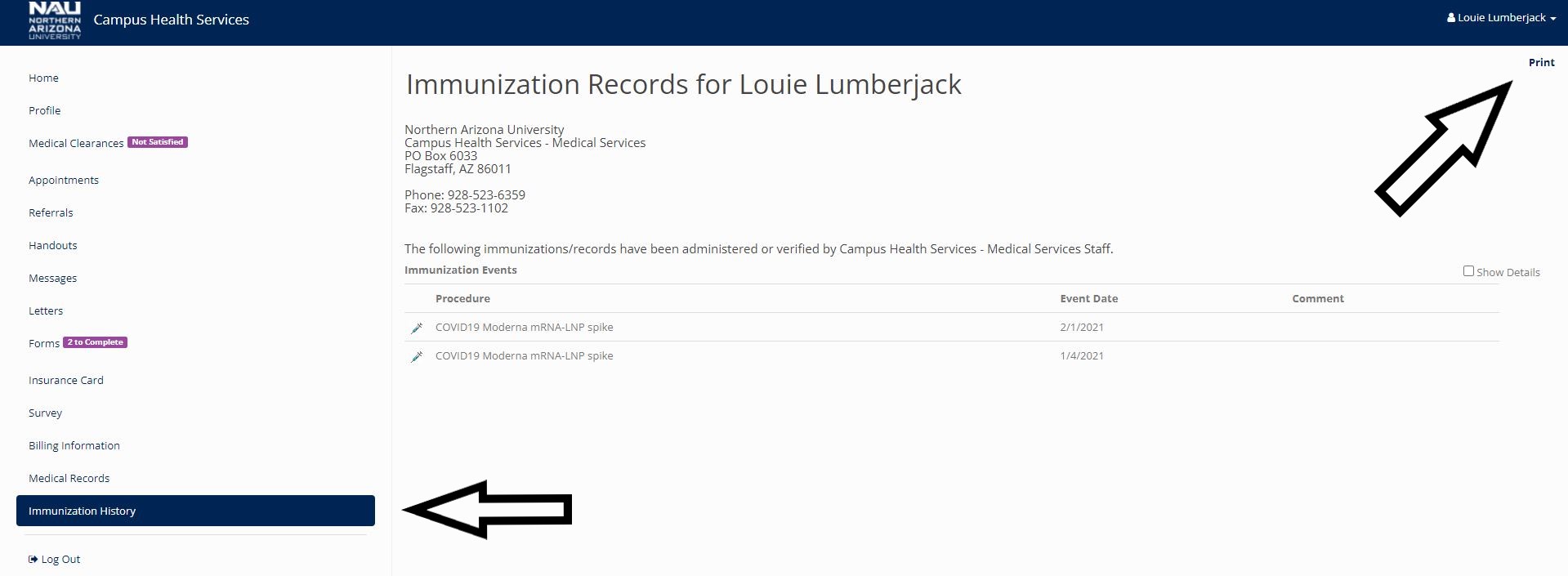
All verified vaccinations can be printed or viewed from the patient portal.
- Log into the Campus Health Patient Portal
- Click NAU student/employee
- Complete the 2 factor authentication
- On the left menu, click “immunization history”
- Click “print” in the upper right corner
- Log into the Campus Health Patient Portal and choose “NAU Student/Employee” and login with your NAU credentials. Click “Enter my COVID-19 Vaccine Information” and follow the on-screen prompts.
- If you’re having trouble with the upload, please visit information on uploading vaccine documentation.
Log into the Campus Health Patient Portal and choose “NAU Student/Employee” and log in with your NAU credentials. Click “Enter my COVID-19 Vaccine Information” to review what has been uploaded or recorded. If the fields are empty, follow the on-screen prompts to enter your information. If you’re having trouble with the upload, please visit information on uploading vaccine documentation.
COVID-19 Vaccine Patient Education
No. According to the CDC, additional doses of the vaccine are required to provider the best protection against COVID – 19.
If you are feeling ill we still recommend you:
- Wear a mask over your nose and mouth when around others
- Stay at least 6 feet from others
- Avoid crowds
- Avoid indoor spaces with poor ventilation
- Wash your hands often
COVID-19 vaccines reduce the risk of people spreading the virus that causes COVID-19. However, some vaccinated people can still spread some variants.
No. The approved vaccines do not contain live virus so they cannot give you COVID-19.
Yes. It’s possible that you could have been exposed to someone with COVID – 19 prior to getting vaccinated. You could also get COVID -19 if you are exposed between doses.
• We know that viruses mutate including the virus that causes COVID -19. Vaccination helps protect people from getting sick or severely ill with COVID-19 and might also help protect people around them.
• To receive the most protection, people should receive all recommended doses of a COVID-19 vaccine.
• Some people who are fully vaccinated against COVID-19 will still get sick because no vaccine is 100% effective. Experts continue to monitor and evaluate how often this occurs, how severe their illness is, and how likely a vaccinated person is to spread COVID-19 to others.
Maximum protection from the vaccine is likely reached 1-2 weeks after the final dose.
We recommend you wait at least 6 weeks from your positive test before getting your second vaccine.
Most people will experience mild to moderate symptoms. Please check the CDC website for further details.
About 55–83% of people develop at least one systemic symptom following the second vaccination. Most systemic post-vaccination signs and symptoms are mild to moderate in severity, occur within the first three days of vaccination (the day of vaccination and following two days, with most occurring the day after vaccination), resolve within 1-2 days of onset, and are more frequent and severe following the second dose and among younger persons compared to those who are older (>55 years).