San Francisco Parking Garage Solar Array
Transforming Daily Campus Commutes into Clean Energy
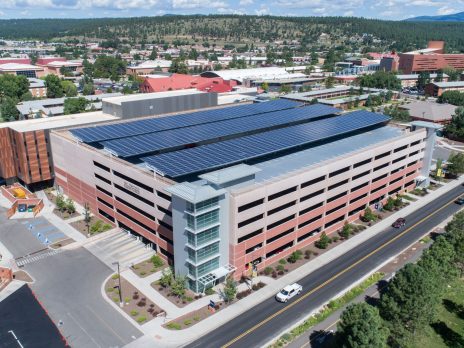
Powering Campus from Above
If you’ve parked on the top deck of the San Francisco Parking Garage on a clear Flagstaff afternoon, you’ve stood directly beneath one of Northern Arizona University’s most effective clean energy investments.
Rather than breaking new ground or sacrificing open space around campus, the project makes smart use of infrastructure the university community uses every day. Elevated steel canopies turn an exposed concrete rooftop into an active 556.38 kW generation hub, capturing high-altitude solar energy while shielding 155 top-level parking spaces from harsh summer heat and mountain snowfall.
What It Powers
Operating data from the garage’s production meters shows the array consistently outperforms its original baseline targets, averaging 873,256 kWh of clean electricity annually. Because the system generates the bulk of its power during long, sunlit summer afternoons, it produces energy precisely when commercial grid electricity is in highest demand and at its most expensive.
For students, faculty, and campus researchers, the system also functions as an ongoing living laboratory. Designed with high-voltage conduit runs and a dedicated sixth-floor inverter room, the facility gives engineering and environmental classes a way to evaluate real-world solar efficiency and weather resilience right in the middle of central campus.
Real-World Campus Impact
By treating sustainability as a long-term asset rather than just an upfront expense, the solar array delivers measurable returns back into university operations. The canopy directly cuts approximately 648 metric tons of greenhouse gas emissions out of the atmosphere every year while insulating the university from rising commercial energy rates.
Now that the initial 10-year operating commitment is fully paid off, the installation has turned a corner. It currently delivers over $86,000 in net utility savings annually—a financial return projected to scale significantly as grid utility rates climb.
The Partnership Behind It
Major renewable installations often stall out over upfront capital, but the San Francisco canopy succeeded through a coordinated funding partnership between campus advocates and clean energy developers:
- $0 in Direct Upfront University Capital: Built through a third-party energy agreement, NAU incurred zero initial construction expenses.
- Driven by the NAU Green Fund: Student leadership committed $1,000,000 distributed over the first 10 years to absorb operating fees, making the project viable from day one.
The result is a project that pays dividends well past its first decade: cleaner campus power, shaded parking for daily drivers, and lasting financial and environmental benefits for the campus.
Please read the full financial analysis here.