December 2023
in very-far-south Puerto Natales, Chile (in the backyard of Torres del Paine National Park).
The Legacy Survey of Space and Time project that will achieve first light on a really big telescope in Chile sometime in the next 18 months.
Congratulations, Maria!
Loren’s major is electrical engineering, but they minored in astronomy (as well as physics and music!) and have made a number of really important contributions to projects in astronomy and planetary science over the past few years, so we get to celebrate Loren as well!
Congratulations, Loren!
Faculty Christopher Edwards, Mark Salvatore; postdocs Ari Koeppel, Aurelien Stcherbinine; and graduate students Helen Eifert, Natalie Jones, Laura Lee. There are many more people who are co-authors on presentations at AGU.
Congratulations to all of you!
November 2023
October 2023
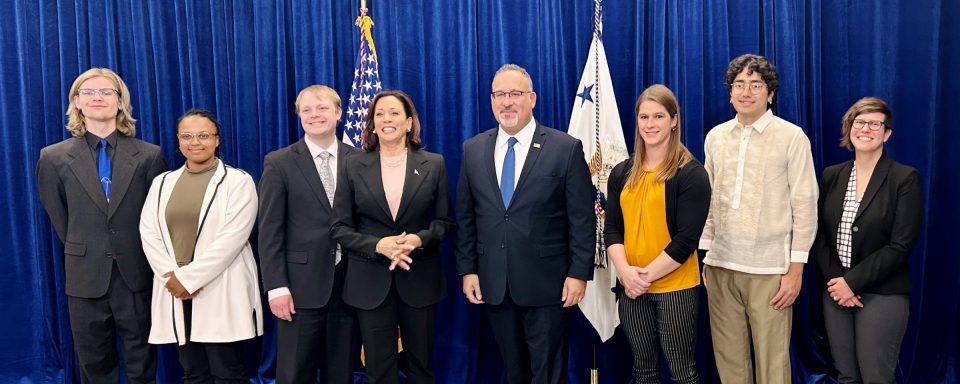
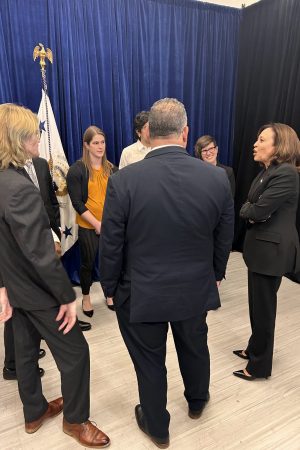
Vice President Kamala Harris visited NAU in mid-October. The White House invited a group of five students plus one postdoc to have a special gathering with the Vice President (and the Secretary of Education, Miguel Cardona), where the students talked about their research, their interests, and their career goals.
David Trilling writes,
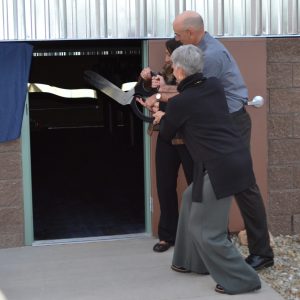
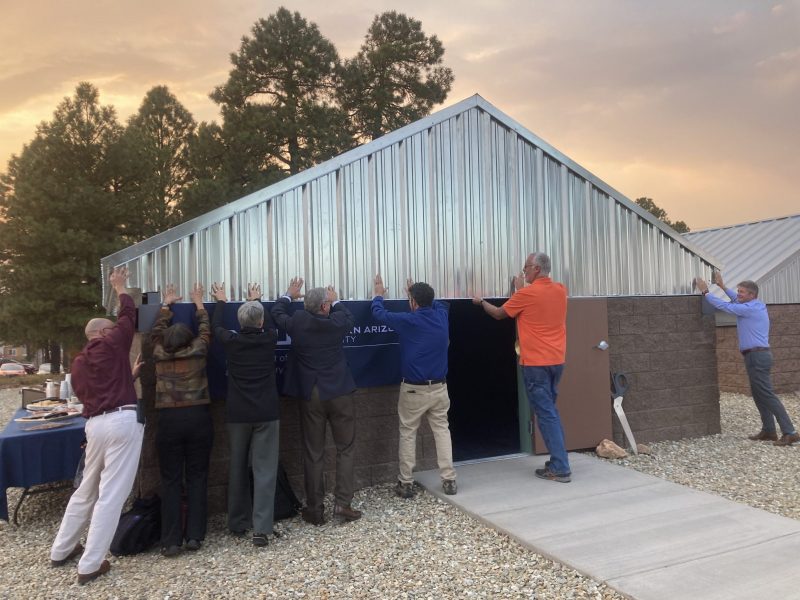
Support for this new facility comes from the university’s Elevating Excellence program, run by the Provost’s office and Laurie Dickson. Thanks to all of them for their outstanding support of our department.
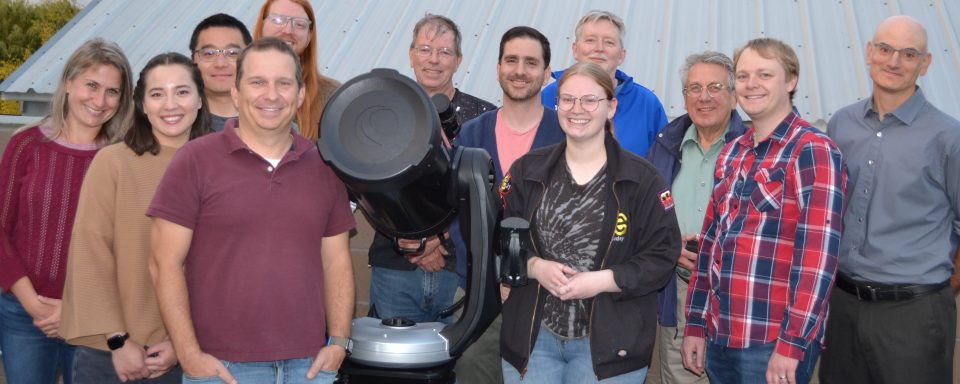
Congratulations, Lisa!
Very cool! Congratulations, Dave!
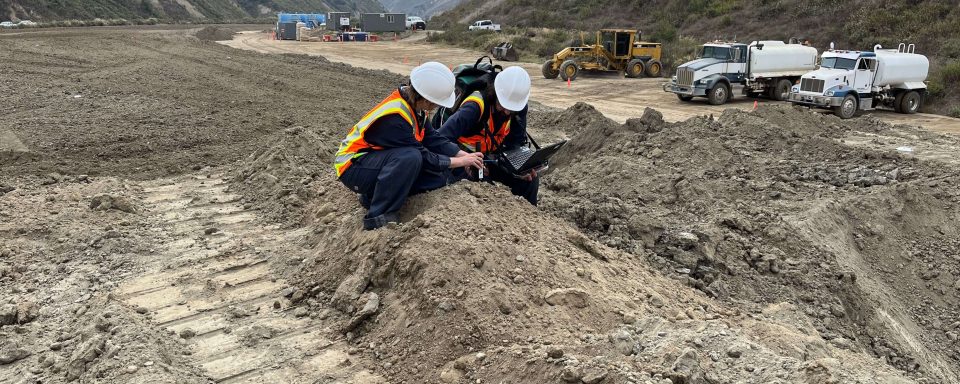
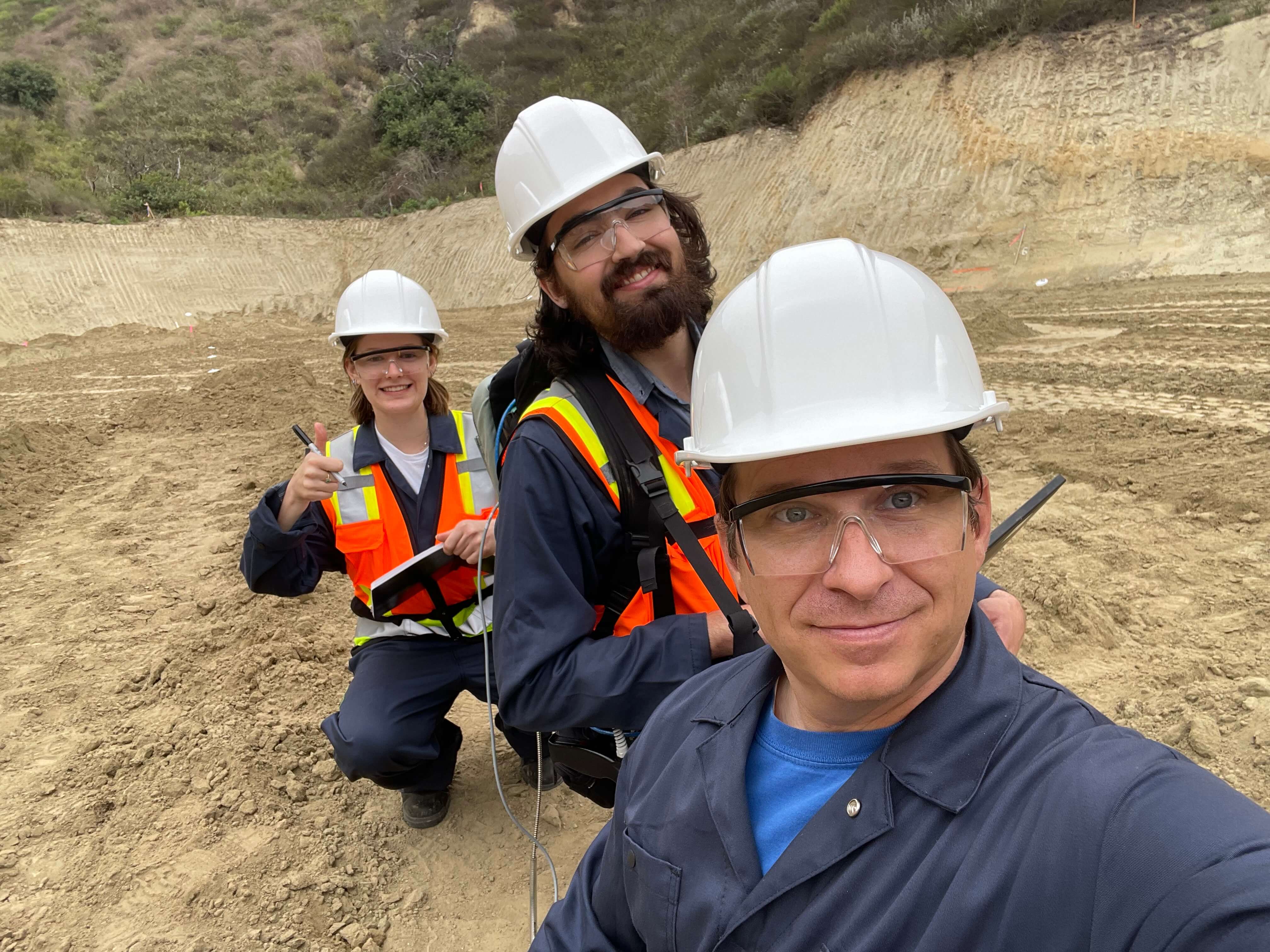
This award fully funds a graduate student and postdoc at NAU for 3 years to carry out UAV-based activities. The award is for ~$500K direct costs. The NAU team will support the remote-sensing based characterization of the mine tailing sites under investigation. They will model the top-layer thermal inertia following methods developed by former grad student Ari Koeppel to determine the likelihood of material mobilization. While carrying out the thermophysical investigation is a primary aspect, characterizing the volume is the second goal NAU will support. They will precisely map the topography of the site using RTK (Real Time Knowledge) providing accuracy down to cm scales and finish by mapping the bottom layer boundary using a to be purchased ground penetrating radar on a UAV.
You can read more about it here: Mining Arizona’s hidden treasure
Congratulations on doing this great work, Claire!
September 2023
A Tale of 3 Dwarf Planets: Ices and Organics on Sedna, Gonggong, and Quaoar from JWST Spectroscopy
Authors also include sabbatical visitor John Stansberry and adjunct faculty Will Grundy.
The group from NAU is providing in-situ measurements to aid in UAS ground truth field validation and will measure a suite of collected samples across multiple sites to determine the best remote sensing technology to identify remediation targets and results.
MIR Spectra and Analysis of Jovian Trojan Asteroids
It’s particularly great to see that Andrew has his own advisee who has joined the author list.
Beginning with papers led by David Trilling and PhD student Ryder Strauss.
This team also includes professor Chad Trujillo, postdoc Will Oldroyd, former postdocs Andrew McNeill and Michael Mommert, and former PhD student Colin Chandler.
Another paper from this team is also available:
Laboratory Measurement of Volatile Ice Vapor Pressures with a Quartz Crystal Microbalance
Co-authors include professors Steve Tegler and Mark Loeffler, REU students Alex Jasko and BP Blakley, PhD students Shae Raposa, Anna Engle, Cece Thieberger, and Aidan Madden-Watson, friend of the department Jennifer Hanley, and affiliate faculty Gerrick Lindberg. What a list!
where the author list includes Josh Emery and our sabbatical visitor John Stansberry.
August 2023
Edwards had a NASA PDAR (Planetary Science Data ARchiving program)funded with JPL which includes funding for a graduate student to derive near-global rock abundance on Mars from Thermal Emission Imaging System data at 100m/px. Total to NAU: $341K.
This program investigates short- and long-term ecosystem dynamics within the Antarctic landscape and uses this cold and dry environment as a terrestrial endmember for understanding how the Earth is more broadly responding to climate change. The Planetary Exploration Lab here at NAU will be contributing remote sensing, spectroscopic, and GIS-based techniques to these investigations to help bridge the gap between the science that must be done in situ and the science that can be done remotely.
The program is entitled, An archival search for faint Trans-Neptunian Objects.
David Trilling is a co-investigator on this project, in which Ana and her team will analyze a decade’s worth of archival HST data for faint objects in the outer Solar System. David notes that “it’s pretty unusual for grad students to lead, let alone win, HST proposals, and I can’t think of another case where a student in their first year (when Ana wrote this proposal) had a selected proposal.”
Congratulations, Ana!
One is archival, and the other is new observations.
Congratulations, Phil!
for the project entitled, Building and Detecting Dust Enshrouded Planets. This is a 3 year program that will support an NAU grad student for two years. The total award is $476,091 and the sub-award to NAU is $178,196.
She is presently a PhD student at Caltech.
July 2023
These are independent graduate fellowships awarded in a very competitive process; FINESST is the Future Investigators in NASA Earth and Space Science and Technology. Congratulations also to their mentors — Mark Salvatore and Josh Emery, respectively — for this terrific result.
Typically NASA selects around 30 planetary science FINESST awards each year, and 2 of them this year are coming to NAU. By our records, NAU has had around 7 planetary science FINESST awards in the past four years, which is probably the highest, or one of the highest, of any university in the country.
They were collecting samples in support of Ian’s recently funded FINESST (see above) proposal entitled Using Trace Elements to Investigate the Role of Serpentinization in Jezero Crater Carbonate Formation. Serpentinization is an exothermic reaction where igneous rocks are altered in the presence of liquid water, making it an interesting process in the context of astrobiology. The team is currently busy preparing rock samples for spectral, mineralogical, and geochemical analyses.
ExoGemS Detection of a Metal Hydride in an Exoplanet Atmosphere
Laura is currently a research associate (senior postdoc?) at Cornell.
Sweeping Secular Resonances and Giant Planet Inclinations in Transition Discs
JJ is currently a postdoc at UC-Berkeley.
Recent PhD and current postdoc Christian Tai Udovicic will soon start a postdoc position at the University of Hawaii.
Recent PhD and current postdoc Ari Koeppel will soon start a postdoc position at NASA Goddard.
- Amber Young (mentor: Ty Robinson)
- Lori Pigue (mentors: Kristen Bennett and Christopher Edwards)
- Chris Wolfe (mentor: Christopher Edwards)
June 2023
A student camera that is designed for the upcoming NASA EscaPADE mission to Mars, at the project’s science team meeting.
Each year, the research librarians of Cline Library review all poster presentations from across the university at the Undergraduate Symposium and select the top research presentation from each college. Riley Williams’ poster was selected as the Librarian’s Choice as top poster for the College of the Environment, Forestry, and Natural Sciences, for work done under Josh Emery’s mentorship. This is quite an achievement considering we had hundreds of presenters this year and only seven were selected for this honor.
Congratulations, Riley!
PhD students Alicia Allen and Maria Chernyavskaya attended and helped lead the star party at Bryce Canyon National Park.
Staff members Ed Anderson and Mary Lara lead monthly star parties for Yavapai Lodge at the Grand Canyon.
Thanks to all of you!
He will be a Full-Stack Software Engineer III for NOIRLab; and will be working on pipelines for Gemini, at least as a starting place. Great to see our alumni landing great jobs!
A Radiative-convective Model for Terrestrial Planets with Self-consistent Patchy Clouds
Co-authors include former NAU faculty Ty Robinson, current PhD student Amber Young and David Trilling.
Kristen, who worked with Christopher Edwards and as is now a USGS Research scientist, was awarded a $1.5M NASA SSW grant to carry out field work in Wildcat Hills (Utah) as a Lunar Silicic Domes analog. This project includes Edwards as a Co-I and funding for a graduate student for 3 years.
David Trilling was the host and chair of the local organizing committee; Nick Moskovitz (Lowell) and former NAU postdoc Maggie McAdam were co-chairs of the science organizing committee.
There were 521 in-person attendees for the meeting, from six continents! This is a major international meeting — previous meetings were held in Uruguay (2017), Finland (2014), and Japan (2012). [No meeting in 2020….] There were 30-50 abstracts that list NAU people as co-authors, which is around 5-10% of all presentations at the meeting. There also were many NAU alumni who presented at the meeting.
Thanks to NAU members of the LOC (including faculty Josh Emery, Cristina Thomas, Chad Trujillo, adjunct faculty Will Grundy, and extra thanks to recent Phd graduate Oriel Humes) and of the SOC (including PhD student Andy Lopez Oquendo and recent PhD alumna Audrey Martin).
NAU hosted a public event during the meeting, featuring our own Cristina Thomas as one of three speakers; the emcee was KNAU’s Melissa Sevigny.
Special shout-out goes to PhD student Ryder Strauss, current undergrad Gavin Moriarty, and recent BS alumna Hannah Zigo for attempting a occultation observation with the campus telescope on the Wednesday night during the meeting.
May 2023


Congratulations to our senior Van Nhi Haong Nguyen, who was chosen as the CEFNS standard bearer.
Congratulations also to our own Jagoda Janiszewska, who graduated with a BA in sociology — her second bachelor’s degree.

Here’s a recent paper that she is on in Nature Astronomy: Spatially resolved imaging of the inner Fomalhaut disk using JWST/MIRI
and some accompanying media attention from the New York Times: Webb Telescope Finds a Star Cloaked in 3 Rings of Ruined Worlds
NAU President Cruz Rivera’s Top 10ish Highlights of the Spring 2023 semester
It’s fun to watch, and you might especially enjoy the “excellence in research” segment that starts at around 3:00 in the video. If you watch carefully you’ll see Mark Loeffler, Josh Emery, Christopher Edwards and former undergrad student Heshani Pieris, as well as a Mars rover, go by.
A proposal led by David Trilling (and including PhD student Ana Morgan) entitled “Searching for ultra-faint trans-Neptunian objects in archival NIRCam calibration data” was selected.
Additionally,
- DAPS adjunct faculty Will Grundy is PI of one successful proposal and CoI on another;
- Josh Emery and Cristina Thomas are CoIs on yet another successful proposal;
- NAU alumna Ryleigh Davis (nee Fitzpatrick) is CoI on two successful Mike Brown/Caltech proposals;
- former NAU postdoc Maggie McAdam is a CoI on a different successful proposal.
April 2023
- Kayla Blair (mentor: Lisa Chien)
- Claire Gibson (mentor: Mark Salvatore)
- Jack Kohm (mentor: Lisa Chien)
Congratulations to these students and their mentors!
NAU had a great showing at the Lunar and Planetary Science Conference last month (with major early career representation). Grad students Laura Lee, Jessica Walsh, Nicole Ozdowski, Oriel Humes, Lori Pigue, Anna Engle, Ari Koeppel; postdocs Will Oldroyd, Christian Tai Udovicic; assistant research professor Ali Rutledge and visiting professor Jennifer Hanley all presented work (not mentioned here are many more DAPS coauthors).
You might even see a couple of familiar faces — Jessica Walsh and Laura Lee — in the highlight reel!
This includes support for a graduate student for 3 years. They will be deriving thermal inertia, conducting Phobos rover operations, and attempting to derive 3µm band depths among other things.
Congratulations Christopher!
Here are some links to articles in the press!
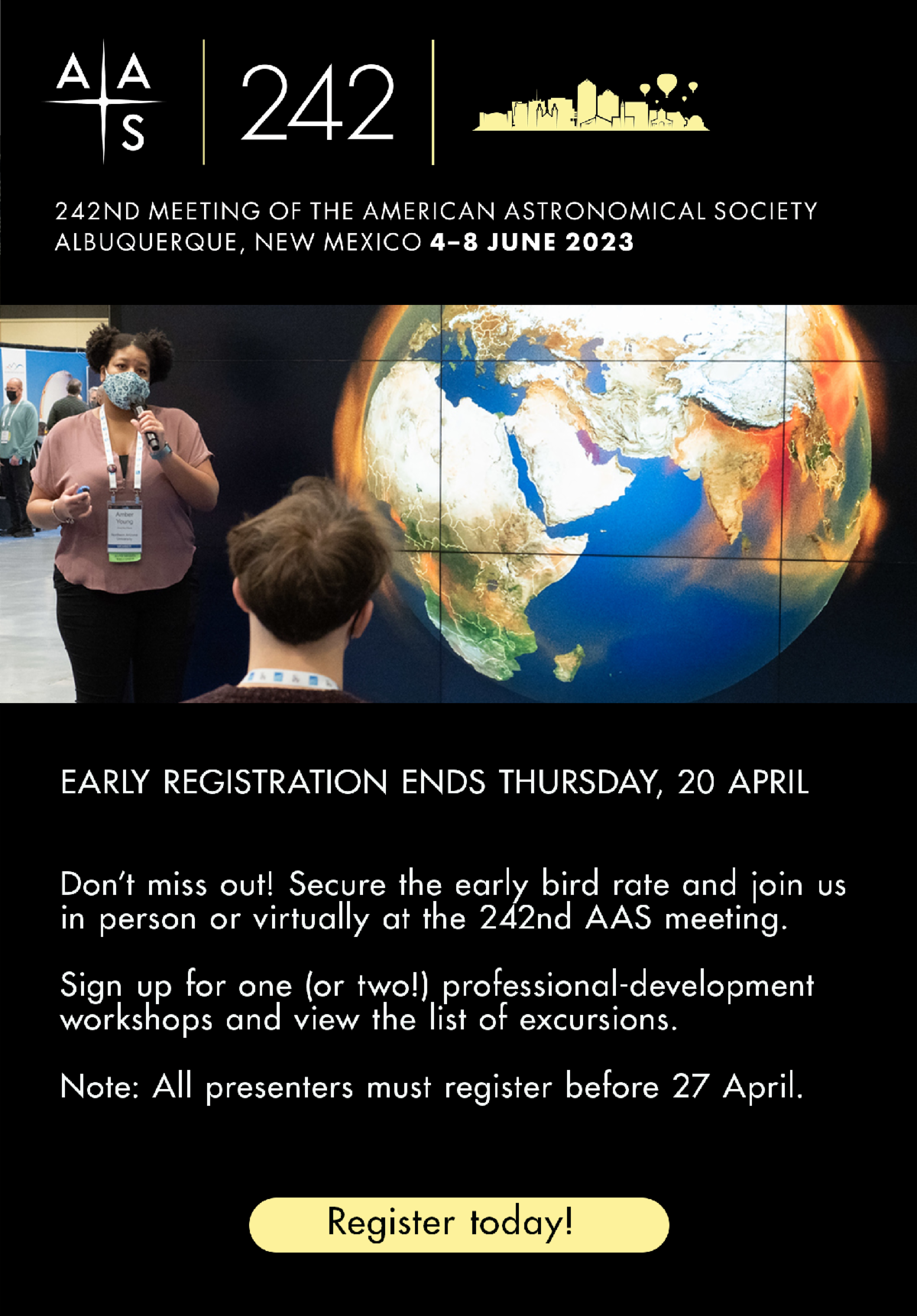
The AAS (American Astronomical Society) sent out remindrs to register for their upcoming meeting, and a familiar face is on the flyer!
GTA/Instructor Ian Marrs led a field trip this past weekend, along with lecturer Jasmine Garani.
They took 18 students went to Meteor Crater and Sunset Crater; and 17 students to the Grand Canyon. Students were asked to make observations about these sites and relate them to the development of, and search for, life in the Universe.
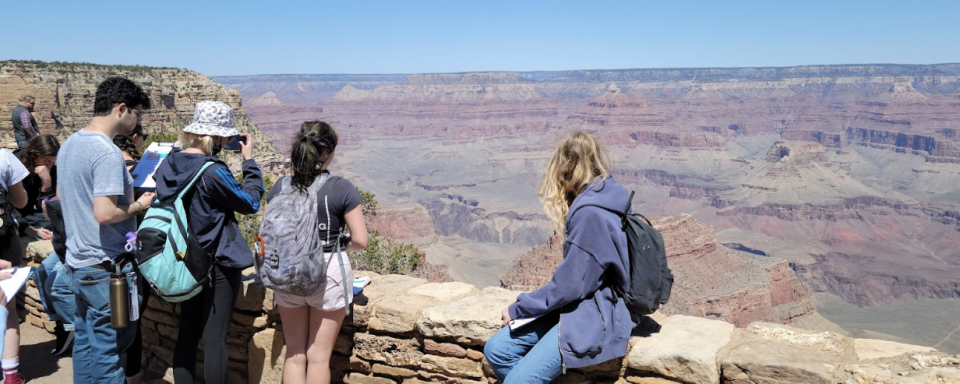
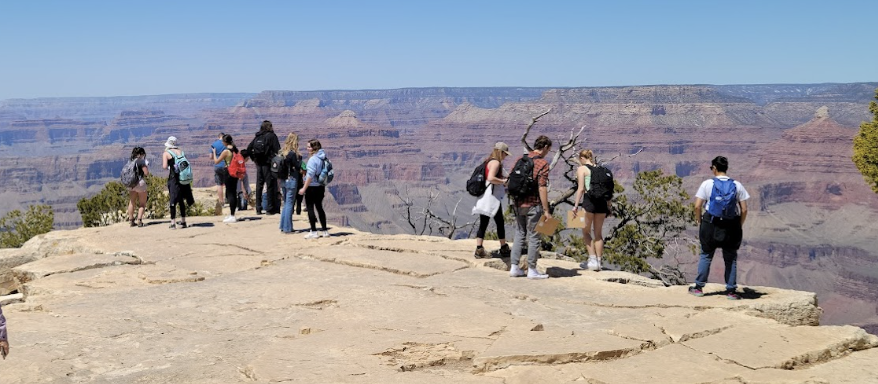
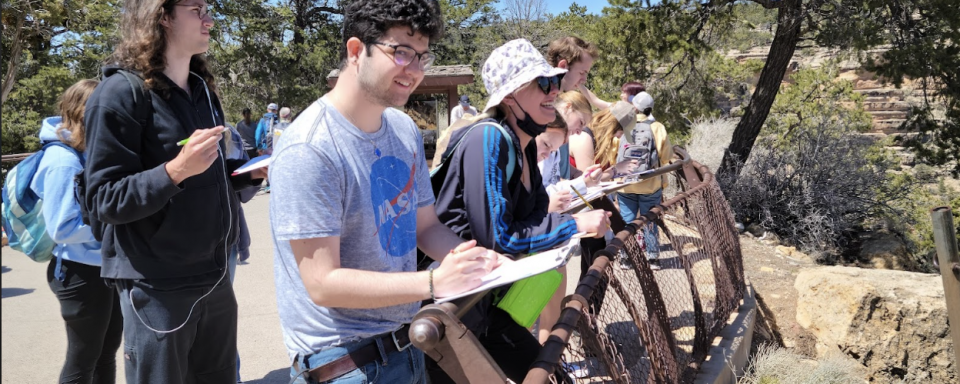
There is no other university in the world where students can visit such a diverse and wonderful set of analog locations and be home in time for dinner.
Congratulations to the many NAU undergraduates, grad students, postdocs, and faculty who presented there!
Christopher Edwards’ presentation about Mars’ moon Deimos got a lot of press attention:
- NASA selects NAU researcher for international mission to Martian moons
- In Photos: Historic Flyby Of Bean-Shaped Martian Moon Casts Doubt On Its Origin
- https://www.nytimes.com/2023/04/25/science/mars-deimos-moon-photos.html
- News at a glance: U.S. rules on carbon emissions, better vehicle batteries, and a Mars moon’s close-up
.
Grad-student Schuyler Borges was on the organizing committee, and several of our students attended/presented.
This is Daniel’s first first-author paper!
March 2023
Featuring Cristina Thomas’s paper that was published in Nature:
Orbital Period Change of Dimorphos Due to the DART Kinetic Impact
as well as these Nature papers:
Successful Kinetic Impact into an Asteroid for Planetary Defense
Ejecta from the DART-produced active asteroid Dimorphos
Other papers include:
Orbital Period Change of Dimorphos Due to the DART Kinetic Impact
Ejecta from the DART-produced active asteroid Dimorphos
Successful Kinetic Impact into an Asteroid for Planetary Defense
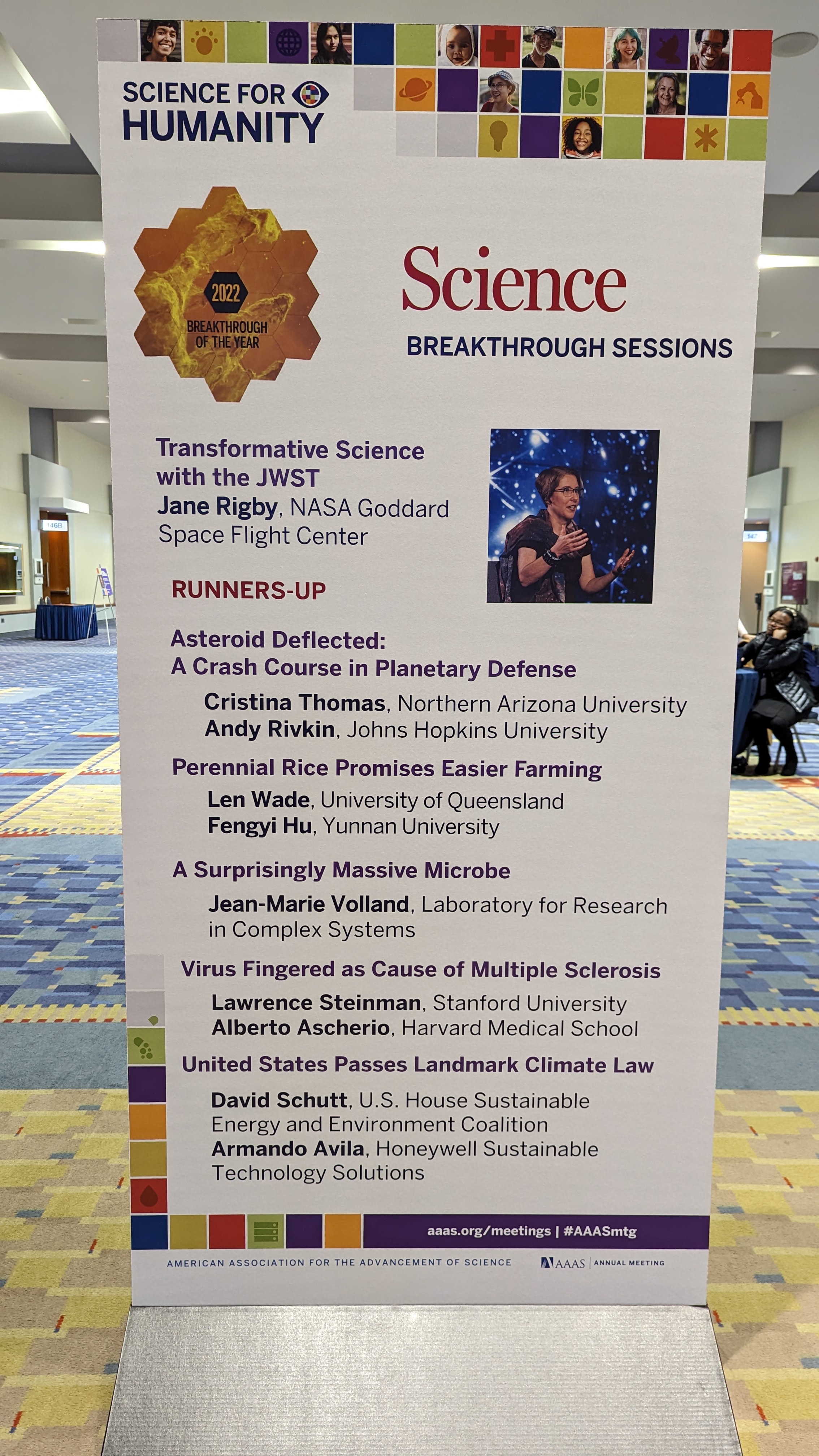
Cristina and Andy Rivkin were invited to present on behalf of DART in the Science Magazine Breakthrough Session. They were one of the runners up for Science breakthrough of the year — JWST was the winner.
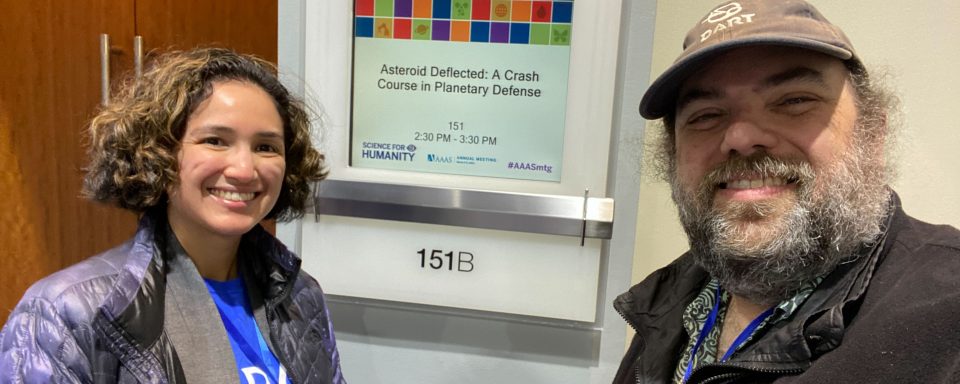
He will be examining the radiation-driven alteration of astrophysical ice analogs containing organic interstellar molecules.
Comet-like Activity Discovered on Quasi-Hilda Asteroid 2009 DQ118
Co-authors include former PhD student Colin Chandler; faculty Chad Trujillo; former REU student Will Burris; former undergrad Jay Kueny; current PhD student Kennedy Farrell; and current undergrad Jarod DeSpain.
Diurnal and Seasonal Mapping of Martian Ices with EMIRS
Co-authors include faculty Christopher Edwards, postdoc Chris Haberle, and data scientists Nathan Smith and Kezman Saboi.
These funds will allow her, Christopher Edwards, Ari Koeppel, Natalie Jones, and collaborators to extend their Summer 2023 field season and gather even more data at the glacier.
Co-authors include current faculty Chad Trujillo, incoming PhD student Will Burris, former undergrad Jay Kueny, current undergrad Jarod DeSpain, and current grad student Kennedy Farrell.
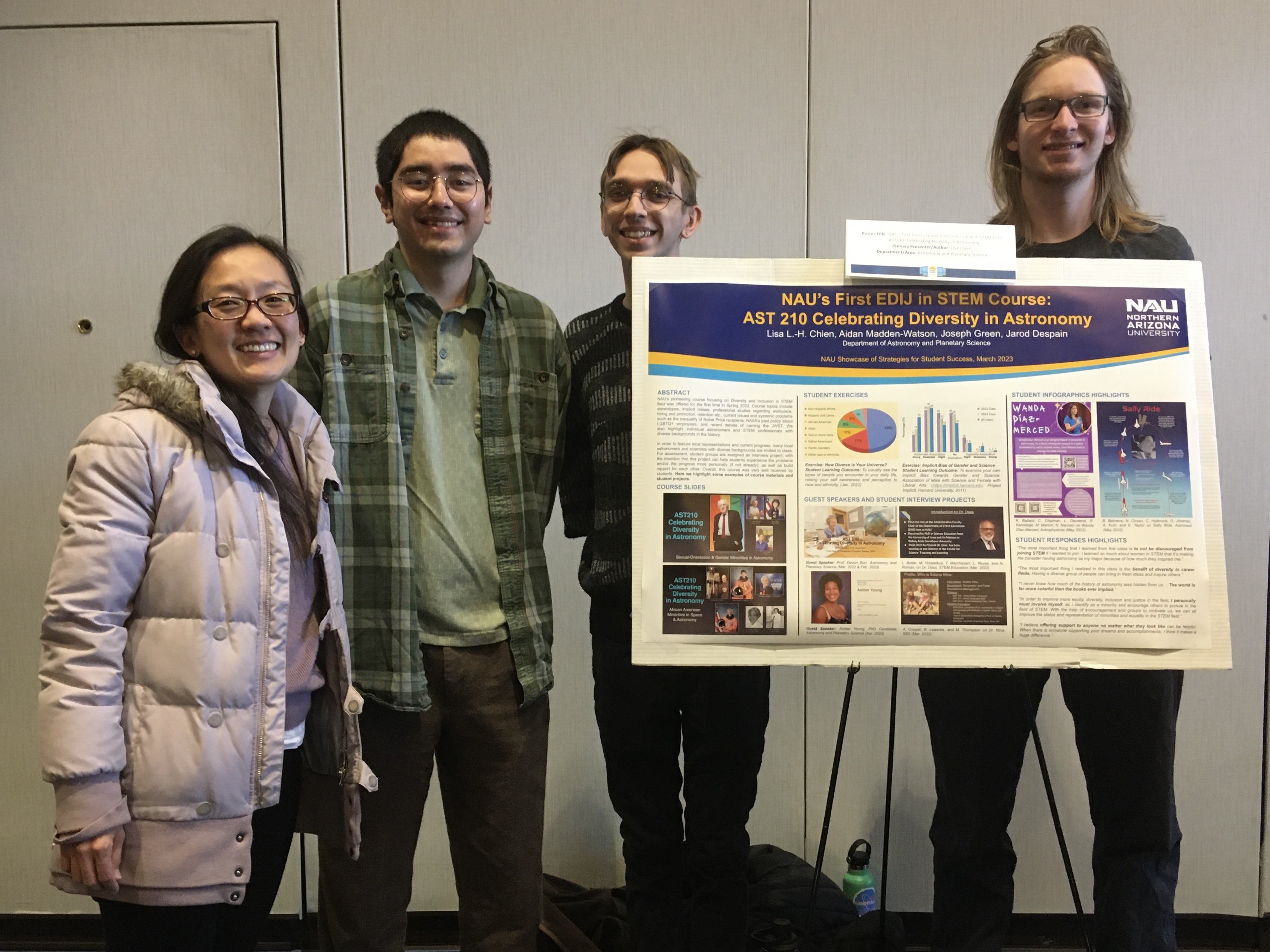
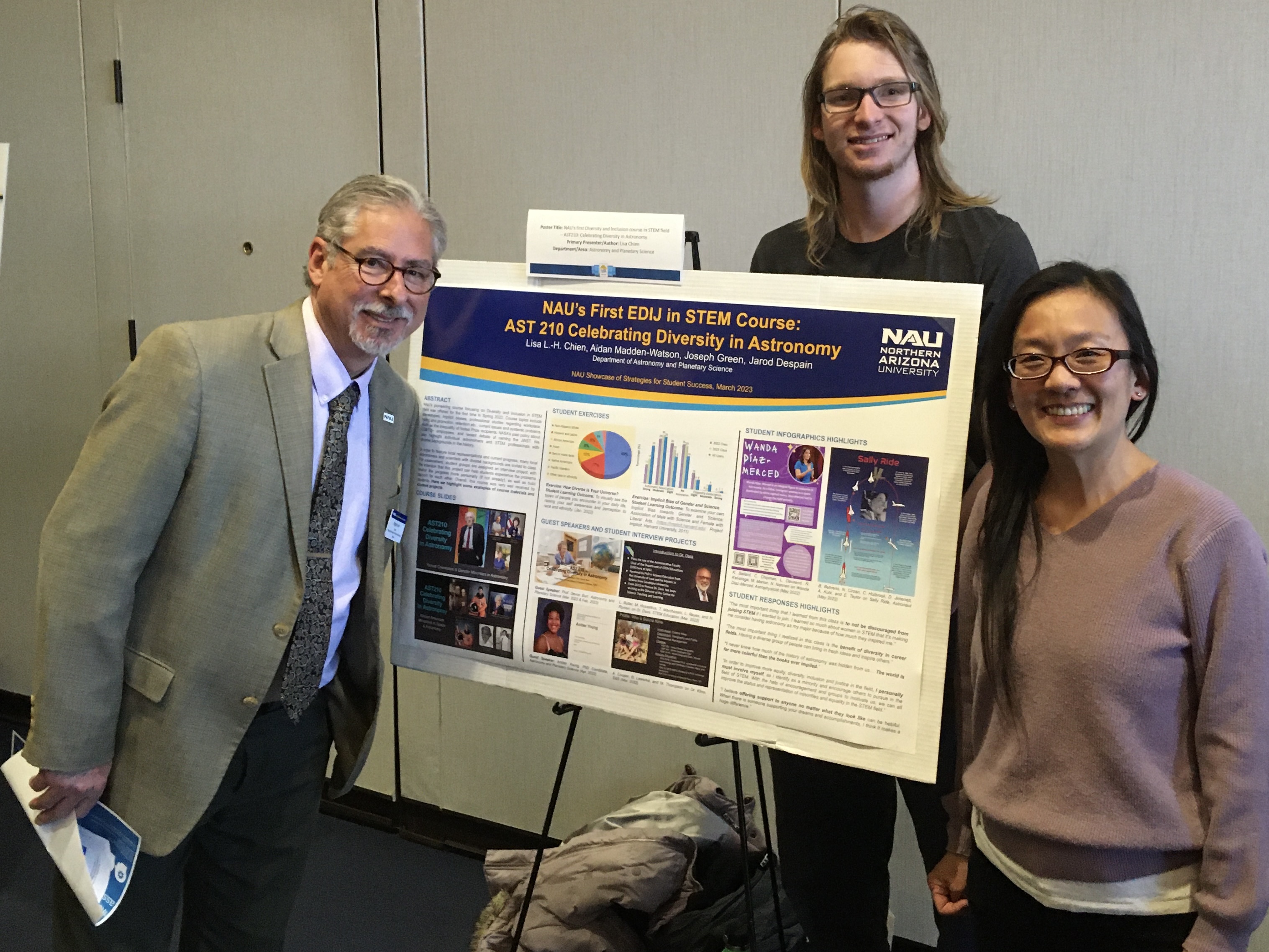
Lisa and her AST210 undergraduate TAs– Aidan Madden-Watson, Joey Green, Jarod Despain, presented their AST210 course to the NAU Showcase of Strategies of Student Success event at the High Country Conference Center. Their poster was titled NAU’s first EDIJ in STEM course: AST210 Celebrating Diversity in Astronomy and they talked about this course to some of the NAU leadership, including the CEFNS Dean and Vice President of Student Affairs.
February 2023
Chris is the PI and Christopher Edwards is the sole Co-I. The title is “Refining the surface composition of asteroid (101955) Bennu through improved derivation of OTES emissivity” and it is a 3-yr project with a start date in June.”
where they watched the Jupiter Trojan asteroid Polymele pass in front of a distant star. Here is Ryder’s summary (with pictures!).
Well done, team!
January 2023
“I came across an article in Radiations, the magazine of the Society of Physics Students (attached), describing my former undergraduate research student’s career track and her work with JWST and exoplanets. Kim made her first study of exoplanets here on campus with me in the early days of the Barry Lutz Telescope. Kim called out her NAU work on exoplanets in the article. She is now an assistant professor at Smith College. I love reading about the success of our students.”
“I remember Kim well — such a smart, capable, hard-working, and positive person. Great to see her continuing to succeed!”
Pore Accessibility in Amorphous Solid Water
The other authors are PhD student Patrick Tribbett and their faculty advisor Mark Loeffler.
Mike Gowanlock is a faculty member of NAU’s School of Informatics, Computing, and Cyber Systems (SICCS) and an affiliate of DAPS; Daniel Kramer is a DAPS Alumnus (BS 2021, Astroinformatics, Astronomy Minor) and is currently a Master’s student at NAU/SICCS; Andrew McNeill is a former DAPS Postdoctoral Scholar and is currently at Lehigh University.
GTAs Jessica Walsh and Ian Marrs report that there were approximately 30-45 students who participated in field trips to Meteor Crater, Sunset Crater, and the Grand Canyon.
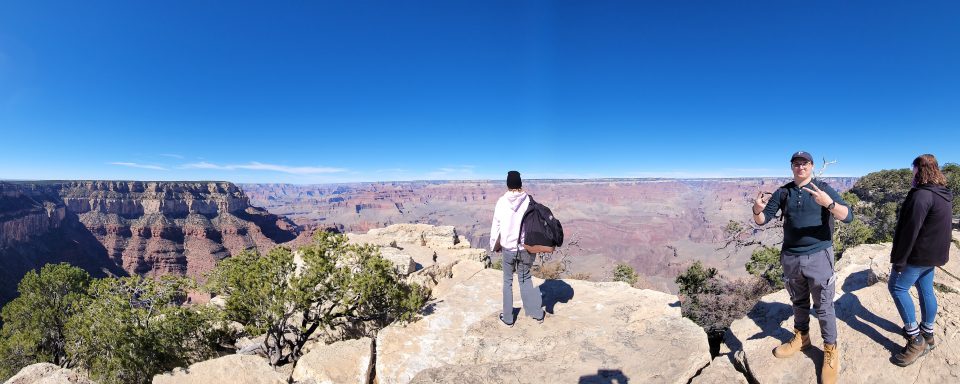
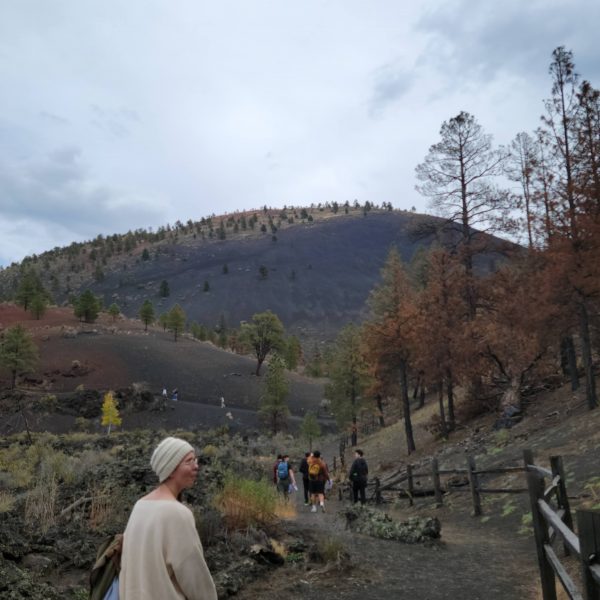
There is no other university in the world that can visit these sites on day trips as part of a regular one credit lab class.
Ian writes:
Meteor Crater: Meteor Crater is relevant for the discussion of life in the universe because it affords us the opportunity to discuss meteor impact events as potential extinction events. While Meteor Crater is not thought to have significantly affected the biosphere (unlike the K-T impact) it is one of the most well-preserved impact craters on Earth and is therefore a useful field location to discuss impact events generally.
Sunset Crater: Sunset Crater and the surrounding volcanic fields are relevant for the discussion of life in the universe because they afford us the opportunity to discuss volcanism as a geologic process that mobilizes biologically relevant elements. Volcanoes are thought to have been critical to the development of life on Earth and the relatively recent lava flows at Sunset give the students a chance to understand the scale and context of volcanic eruptions.
Grand Canyon: The Grand Canyon is one of the best places on Earth to view a largely continuous exposure of the terrestrial geologic record.
This location is relevant for the discussion of life in the universe because it demonstrates to students how investigating geologic material can inform our understanding of the history of a planet in terms of biology, geology, meteorology, etc. Such investigations are how professional planetary scientists search for life on other planets and our understanding of the terrestrial geologic record helps us search for evidence of extraterrestrial life.
Titled: “An Experimental Investigation of Space Weathering Processes on the Surface of Mercury,” 5he proposal is
$1.3 M for 3 years and brings about $100K to NAU.
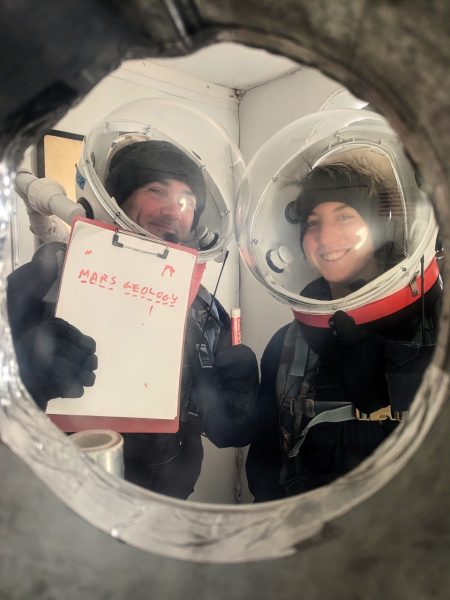
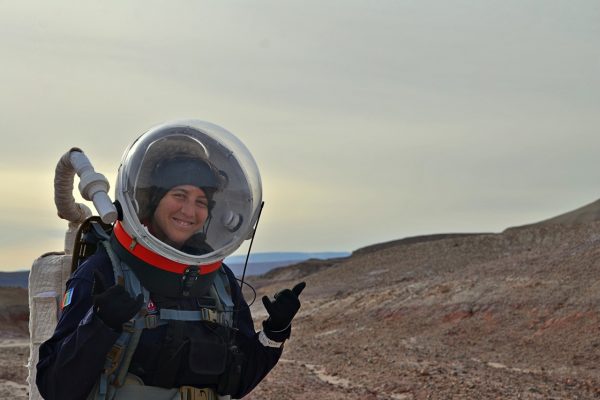
She writes:
“Over the last few years, I have been observing drying trends of saturated surfaces at various Mars-analogous sites in the deserts of the southwestern United States. Over the holiday break, I took this analog research of studying Mars on Earth a step further. I served as the crew geologist for Crew 271 at the Mars Desert Research Station near Hanksville, Utah. After discovering the research facility during a field trip for the DAPS planetary analogs class [taught by Christopher Edwards], I applied to participate in a two week astronaut simulation mission. Here, I acquired supplemental visible near infrared data of drying trends over multiple days in a mission simulated environment. This data will inform one of my dissertation chapters by providing a better understanding of the residence of water in clay mineral structures. As a bonus, I experienced the unique challenges of conducting science on Mars. This work will help to better understand thermophysical properties of geologic surfaces, Mars’ water history, and how we might detect moisture on Mars. All of which should help inform human missions to Mars in the future.”
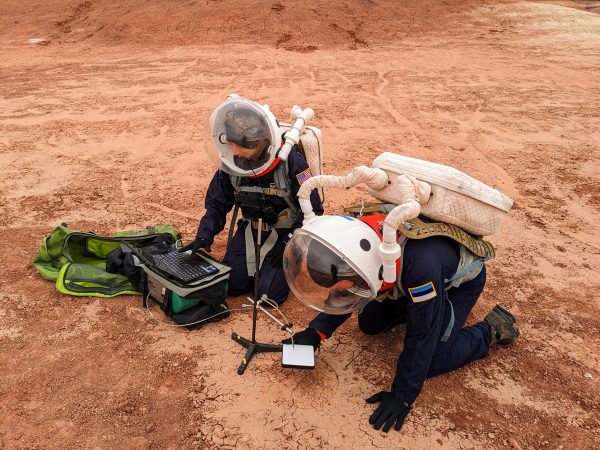
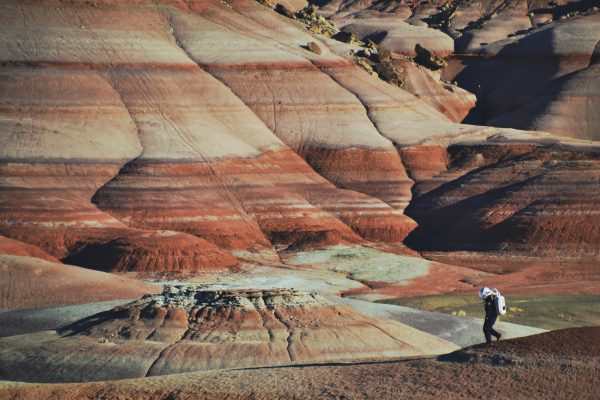
and received a very enthusiastic thank you for bringing her energy, enthusiasm, and experience to our CAL colleagues.
Thank you, Lisa, and congratulations!