December 2021
Unfortunately, a virtual talk 🙂
Solar Contributions to Earth’s Oceans
This was a large collaborative work combining laboratory studies and analysis of grains from Itokawa. The results suggest that much of the water in Earth’s oceans could have originated from water created from solar wind implantation onto rocky airless bodies, such as asteroids.
The work has been picked up by a couple of national/local news outlets:
November 2021
Thanks for doing this, Aaron!
in which the team used multispectral satellite imagery to study a former plantation in the British Virgin Islands that in 1831 became a settlement of free Africans who lived within slavery-based British colonialism. Cool stuff, Mark!
October 2021
Presenters include faculty Christopher Edwards, Josh Emery, Mark Loeffler, Steve Tegler, Cristina Thomas, David Trilling, and Chad Trujillo; PhD students Becks Carmack, Colin Chandler, Anna Engle, Audrey Martin, Lauren McGraw, Will Oldroyd, Shae Raposa, and Patrick Tribbett; and undergraduate students Lonnie Dausend and Beau Prince; and REU student Eleanor Serviss.
There were two press releases from NAU related to this meeting: https://news.nau.edu/astronomy-dps-meeting/
Presenters include faculty Devon Burr, Christopher Edwards, and Mark Salvatore; research faculty Chris Haberle and Allie Rutledge; PhD students Helen Eifert, Natalie Jones, Ari Koeppel, Tony Maue, Christian Tai Udovicic, Aaron Weintraub, and Chris Wolfe; data scientist Nathan Smith; and former REU student Dede Chapline.
about his research on thermal oxidation reactions involving hydrogen sulfide, ozone and water. Reactions such as these are likely important in determining the composition of the surface and subsurface ice on Europa’s trailing hemisphere.
According to and informal survey of faculty and graduate students conducted by Ty Robinson: given the total number of NAU undergraduates involved in LSAMP (Louie Stokes Alliance ofr Minority Participation) in any given year, DAPS accounts for roughly 10% of all combined advising and mentoring, and about 20% of all research advising. These are strong numbers that indicate DAPS’ commitment to increasing diversity in STEM.
Cristina’s program is a three year program with a total budget around $850K. For some 20 years, researchers at MIT have run a program to obtain spectra of Near Earth Asteroids. This project became the premier telescopic program to study these bodies as they pass close to the Earth. Cristina has now taken over as PI of this long-standing program.
This is huge for Cristina and for NAU, not just for the short-term and this terrific proposal, but for the long term as well.
Congratulations, Cristina!
The PI is Joe Hora at Harvard-Smithsonian, and they will carry out one final re-analysis of Near Earth Asteroid observations made by the Spitzer Space Telescope. The total budget of the NAU portion of this project is $213K, and includes support for a PhD student for two years.
(SACNAS): https://legacy.nau.edu/ses/sacnas/#Chapter
Congratulations to everyone who helped push this forward, including, in our department, Cristina Thomas.
Our department was one of the NAU sponsors for a booth at the recent SACNAS national conference.
Ryder was in Spain to observe Jupiter Trojan asteroid Polymele as it passed in front of a distant star. A few weeks later Ryder led an intrepid group of cold NAU students to watch Eurybates’ occultation — measurements that were made in the early morning from Grand Canyon National Park!
The paper is the culmination of three years of hard modeling and analysis effort, under the supervision of Phil Massey (Lowell Observatory).
A fragile record of fleeting water on Mars
Christopher Edwards and former NAU undergraduate Gabriel Carillo are co-authors on this paper.
Space weathering of the 3 micron phyllosilicate feature induced by pulsed laser irradiation.
This work is the first study to look at how the 3-micron absorption band is altered by simulated micrometeorite impacts in meteorite analogs that have undergone high degrees of aqueous alteration. This study suggests that, at least for the most aqueously altered asteroids, this spectral region may be extremely useful for determining the asteroid’s composition even if it
has been heavily processed by space weathering.
The appointment is for a nominal three year term, for the National Observatory.
In this role, and alongside other committee members, Ty will be providing guidance to NASA on issues related to all NASA planetary science programs.
You can learn more about this advisory committee here:
The report highlighted direct imaging of potentially Earth-like exoplanets in the habitable zones of Sun-like stars as a key science goal for the coming decade(s). To support this, the Decadal recommended NASA create a new Great Observatories Mission and Technology Maturation Program, whose purpose is to develop technologies needed for pan-decadal large missions. The first mission recommended to go through this development is a ~6m ultraviolet-optical-infrared space telescope capable of characterizing exo-Earths (ie, halfway between the HabEx 4m concept and the LUVOIR-B 8m).
Ty Robinson had multiple scientific results showcased as figures in the 2020 Decadal Survey on Astronomy and Astrophysics on topics of exoplanet direct imaging and Solar System analogs for exoplanet observations. He’ll be heavily involved in this new program as the mission matures over the next decade(s).
September 2021
at the University of St. Gallen, in Switzerland. Congratulations!
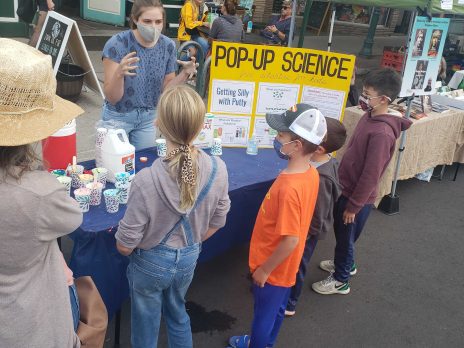
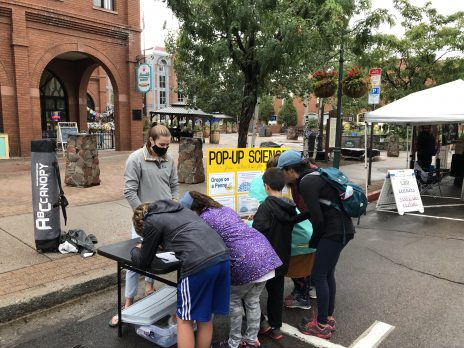
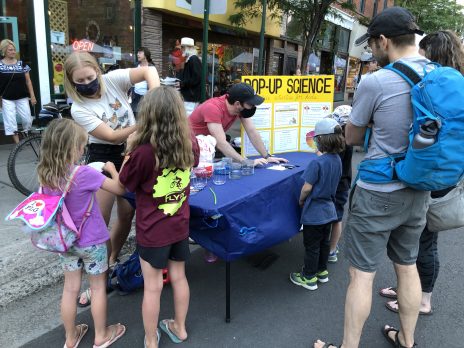
in downtown, where she and a number of friends and colleagues ran a Pop-up Science table (for kids, and adults!). A few pictures are
attached. Thanks for doing this work, Becks!
“I’ll be working on the project for 2 years and it’ll involve tuning DRaGNS’ interpretations to Titan’s Surface.Needless to say, I’m pretty excited about the
opportunity to work on a project featuring the Dragonfly mission!”
[Dragonfly is a super-cool NASA mission that will fly a quadcopter drone around on Saturn’s largest moon, Titan. Launch is in 2027.]
Thanks for doing this, Mark!
August 2021
At the 12th Planetary Crater Consortium Meeting held in August this year, there was a session entitled “Discussion and Nadine Barlow in Memoriam.”
Nadine established the Planetary Crater Consortium and it is great that they honored her this year at their meeting.
which seeks to increase the number of under-represented minority students pursuing graduate degrees in STEM. The NAU application effort was led by Professor Ty Robinson and involved DAPS and APS faculty, Deans Watwood (Office of Graduate and Professional Studies), Wilder (CEFNS), and Wang (CEIAS), and former provost Diane Stearns. NAU’s membership opens up fellowship opportunities for senior undergraduate and graduate students across all STEM fields.
is apparently the biggest single course NAU has ever offered — 489 students. This is an asynchronous online class. Thanks for taking this on, Mark, and good luck!
They have raised more than $250 that will help honor cancer survivors, spread the word about reducing cancer risk, and raise money to help the American Cancer Society save lives.
The paper explores how water latent heat will impact atmospheric structure and observables for Y-class brown dwarfs and free-floating planets:
Impacts of Water Latent Heat on the Thermal Structure of Ultra-Cool Objects: Brown Dwarfs and Free-Floating Planets
for work that includes astroinformatics projects: Prestigious NSF CAREER award supports integration of research, undergraduate training in parallel computing
A fragile record of fleeting water on Mars.
Ari is a fourth year PhD student.
including DAPS current and former members Nathan Smith, Aaron Weintraub, Kathryn Powell, Mark
McAdam, and Kelly Harris-Laurila had a paper accepted in Space Science Reviews entitled “The Emirates Mars Mission (EMM) Emirates Mars InfraRed Spectrometer (EMIRS) Instrument”
Yes, another NASA graduate fellowship award for our department!
This award is similar to NASA’s FINESST awards, though with an MSI focus. The award comes with three years of stipend funds for the fellow, as well as a research budget that includes ample funds to engage in research at NASA Goddard Space Flight Center. Amber’s proposed work will focus on developing techniques to interpret potential biosignatures from directly-imaged exoplanets. Congratulations, Amber, and congratulations also to Ty Robinson, Amber’s mentor!
July 2021
Discovery of Super-Slow Rotating Asteroids with ATLAS and ZTF photometry
This paper includes (former) undergrad Daniel Kramer, postdoc Andrew McNeill, and David Trilling, and presents the discovery of super-slow
rotating asteroids, with periods up to 5000 hours — that’s more than200 days! This previously-unknown population was discovered through analysis of data from two long-term all-sky surveys.
It’s fun to discover a whole new class of objects that has never been seen before!
This is Will’s first first-author paper!
(Oh yeah, Will has a new baby — Claire. Congratulations on that too!)
David Trilling is PI of a 99-orbit coordinated parallel program to measure the colors of very faint objects in the distant outer Solar System. This program leverages his previously-accepted James Webb Space Telescope program to discover those objects. The two telescopes will be used simultaneously to observe these faint objects at two different wavelengths, and from two different perspectives. Professor Steve Tegler is a CoI on this proposal.
Assistant Professor Cristina Thomas is a CoI on a 19-orbit program to observe the ejecta created by the DART impact on Dimorphos.
Probing Microporous ASW with Near-infrared Spectroscopy: Implications for JWST’s NIRSpec
This laboratory study identifies two new absorption bands that should be observable by JWST in microporous water-ice found in the outer reaches of our Solar System as well as on icy mantles found in the interstellar medium.
Hydroxylation of Apollo 17 Soil Sample 78421 by Solar Wind Protons
This study produced OH within the lunar mineral in a manner similar to which it is believed to be formed on the lunar surface.
Thermophysical Investigation of Asteroid Surfaces II: Factors Influencing Grain Size
Eric is an undergraduate alumnus of our department, and was then the PhD student of Josh Emery when Josh was at Tennessee. Now, Josh is a professor here at NAU!
June 2021
Co-authors include Ty Robinson and Lisa Prato.
at the DAPS Social Justice Group Trivia Night. The night featured trivia games and a presentation about how to get involved with the food center.
We have 13 students, and they are all here in person. This feels really great. Ordinarily this wouldn’t really be news but this year it is …..
New Constraints on the Lunar Optical Space Weathering Rate has been accepted for publication in Geophysical Research Letters.
which presents results from his research rotation project with Ty Robinson.
were both selected in NASA’s national fellowship competition entitled Future Investigators in NASA Earth and Space Science and Technology (FINESST). Congratulations to Christian and Natalie!
Congratulations also to their mentors, Christopher Edwards and Devon Burr, respectively! And congratulations to Ty Robinson, whose graduate fellowship writing class continues to produce an enormous number of successful proposals!
We still have a few pending proposals, so we don’t have the final results yet, but so far we have five selections in the past two years. You might recall that last year NAU tied for first place in the country for the number of NASA FINESST fellows selected (UA and NAU had three each).
May 2021
It raised $822 for the Flagstaff Family Food Center and included a talk from James Donnelly about how to get involved (head to https://hotfood.org/ to volunteer or set up a regular donation).
Congratulations to Team Humes for winning 1st place, and to Chris W. and Becks for winning the raffle. We hope to see you all at the next SJG event!” Congratulations on this success, and thank you for your efforts to make the world a better place!
with authors Mike Gowanlock (SICCS, and affiliate faculty in DAPS), David Trilling, as well as a colleague from ASU and Brian Donnelly, and a PhD student in
SICCS who did his research rotation project in Trilling’s research group.
a new emphasis within the undergraduate informatics program in the College of Engineering, Informatics, and Applied Sciences that collaborates with the Department of Astronomy and Planetary Science.
Department chair David Trilling said the work Kramer has done as an undergraduate researcher at NAU is helping to define this emerging sub-industry. “It is not an exaggeration to say that without Daniel’s terrific work, we would not have been able to submit several funding proposals for NASA and NSF,” Trilling said. “In the next 15 years, because of his work, I fully expect that NAU will be the world leader in this particular sub-topic.”
will start her position as a Dunlap Postdoctoral Fellow at U. of Toronto in the fall.
will begin a NASA Postdoctoral Program fellowship at NASA Ames in the fall.
Asteroid Lightcurves and Detection, Shape, and Size Biases in Large-scale Surveys
Samuel completed his PhD at NAU and UNAM last fall and is presently a postdoc in the department; Erin (current PhD student). This paper is the culmination of Erin’s research rotation project.
April 2021
Congratulations, Will!
in the 2021 Research and Creative Activity awards given by the Office of the Vice President for Research. Congratulations, Annika!
Congratulations, Christian!
- Audrey Martin won the “Outstanding GRA” award (doctoral level) from the Office of Graduate and Professional Studies;
- Colin Chandler won the “Outstanding GTA” award (doctoral level) from the Office of Graduate and Professional Studies;
- Will Oldroyd took second place overall for the GSG poster symposium competition.
Congratulations to all three of these students!!
Congratulations, Allie!!
Our understanding is that this award is for $200K and will fund analog studies in cold environments (on Earth) to assess the climate history of planetary surfaces (including Mars). There were only 5 selections this year (and another one is former NAU postdoc Kristen Bennett).
including PhD students Annika Gustafsson and Andy Lopez, postdoc Samuel Navarro Meza, and faculty Cristina Thomas.
- Dominick Ryan — CEFNS Standard Bearer, Gold Axe winner;
- Gabriel Carrillo;
- Daniel Kramer (astronomy minor).
Congratulations as well to our research students from other majors.
March 2021
Congratulations to Andy Lopez-Oquendo (APS PhD Student), Megan Gialluca (undergrad Phys/Astro), and Ethan Taber (SES).
Congratulations also go to Ty Robinson, who once again taught his Fellowship Proposal Writing class” (AST599) in the fall 2020 semester, and who is developing a very long list of successful proposals that have come out of that class over the past few years. Ty reports that the success rate was 60% this year for students in AST599!!!!
Click here for the NAU News article.
Christopher Edwards: promoted to associate professor with tenure.
Josh Emery: promoted to [full] professor
Mark Salvatore: promoted to associate professor with tenure
All three promotions are effective as of the 21/22 academic year.
Christopher, Josh, Mark — our department, college, and university are vastly better because of your contributions to teaching, research, and service. your students and your colleagues thank you. We are very lucky to count you as colleagues. Congratulations!!
The annual Lunar and Planetary Science Conference was held virtually, from March 15 – 19. We had LOTS of presentations.
The following people presented, or were listed authors, at the conference:
Faculty:
Nadine Barlow
Devon Burr
Christopher Edwards
Josh Emery
Will Grundy (adjunct faculty)
Jennifer Hanley (adjunct faculty)
Gerrick Lindberg (affiliate faculty)
Mark Loeffler
Allie Rutledge (research faculty)
Mark Salvatore
Steve Tegler
Cristina Thomas
Jut Wynne (from Biology)
Postdocs:
Jennifer Buz
Grad students:
Schuyler Borges
Becks Carmack
Anna Engle
Ari Koeppel
Lori Pigue
Aaron Weintraub
Chris Wolfe
Undergrad students:
Daphne Chapline (REU student)
Claire Gibson
Michelle Kearney
Mitch Magnusson (graduated last year)
Sanya Mittal (REU student)
Beau Prince
PhD student Lori Pigue was named LPSC2021 Microblogger of the Day for Friday March 19:
This online workshop was held on March 23 – 26. Speakers included Josh Emery, former NAU undergrad Eric MacLennan, and PhD students Patrick Tribbett, Audrey Martin, and Annika Gustafsson. Will Grundy was a discussion moderator.
was picked up by NSF GRFP Twitter and also by the YouTube channel NWN SupremeMasterTV
After graduating from NAU, Eric obtained his PhD at the University of Tennessee in 2019, supervised by Josh Emery, and is now a Postdoctoral Fellow at the Particle Physics & Astrophysics group at the University of Helsinki, Finland.
The National Science Foundation Office of Polar Programs has recently selected a proposal led by Mark Salvatore entitled Moving Beyond the Margins: Modeling Water Availability and Habitable Terrestrial Ecosystems in the Polar Desert of the McMurdo Dry Valleys.
This collaborative project totals more than $1 million and focuses on remotely quantifying habitable environmental conditions throughout the McMurdo Dry Valleys of Antarctica using a combination of satellite imagery, high-frequency meteorological data, and ecological modeling.
Phase Diagram for the Methane-Ethane System and its Implications for Titan’s Lakes
This author list includes adjunct faculty Jennifer Hanley and Will Grundy; former undergrad, MS student, and current APMS PhD student Shyanne Dustrud; former MS student Garrett Thompson; affiliate faculty member Gerrick Lindberg; and faculty member Steve Tegler.
NAU did really, really well. Three faculty were on selected proposals: David Trilling (PI of one proposal, co-PI of another); Cristina Thomas (CoI on 3 proposals); and Josh Emery (CoI on 3 proposals).
There were 22 proposals selected in the sub-area of Solar System Science, and this group of faculty are part of the proposing team for 7 of those 22 (that’s 32%).
These 22 selected proposals together represent 376 hours of telescope time, and this group of faculty are part of the proposing team for 244 of those hours (that’s 65%). Wow — NAU is part of 65% of all JWST Solar System science time allocated in Cycle 1.
Josh points out that PhD student Audrey Martin is a CoI on one of the selected proposals that he is also on, and that she contributed heavily to the proposal by writing the section dedicated to the MIRI instrument.
was recognized with one of this year’s President’s Achievement Awards.
Congratulations, Kerry!
February 2021
The award comes with $150k to help Tyler explore the impacts of precursors masses on exoplanet atmospheric characterization while also studying the role of interdisciplinarity in undergraduate education and building a diversity-focused undergraduate research mentorship program in DAPS.
This is only the second Cottrell Fellowship to ever be awarded to NAU (the first being to John Gibbs!), and details can be found here:
Congratulations, Dom!
published in the journal Icarus: A satellite orbit drift in binary near-Earth asteroids (66391) 1999 KW4 and (88710) 2001 SL9 — Indication of the BYORP effect.
in an article authored by Instructional Designer, Samantha Clifford, and published in The Teaching Professor: Reflecting on Effective Teaching Strategies: Faculty Share Their Successes. The article shares engagement strategies for remote teaching from several NAU faculty and instructors.
January 2021
about the USGS’ virtual STEM education strategy: USGS Astrogeology Embraces Virtual STEM Education During the COVID-19 Pandemic
accepted for publication in Geophysical Research Letters entitled “Compositional Enhancement of Crustal Magnetization on Mars.”
Ahmed is from the UAE and spent two summers working at NAU alongside our REU program, as part of a program led by Christopher Edwards to train Emirati undergraduate students in planetary science research. Ahmed is the lead author of this paper. He participated remotely in our summer research program in summer, 2020 — an 11 hour time difference!
in Surface Science, where they used their laboratory data to show that existing models over predict the sputtering of O2 from H2O-ice by between a factor of five and eight at temperatures relevant to Europa. They were able to make an empirical correction to the existing model to match our new and other previous laboratory data. This correction should allow one to more accurately predict how efficiently exospheres can be produced by energetic ion irradiation of the surface H2O-ice on icy moons in our solar system.
including a long-ago REU student, Tyler Linder, as the fourth author!
Space Weathering within C-Complex Main Belt Asteroid Families
Undergraduate student, Megan Gialluca; Grad students, Catherine Clark, Erin Aadland, Colin Chandler, Will Oldroyd, James Windsor, Amber Young; and Faculty, David Trilling, Ty Robinson, Chad Trujillo.
Thanks for doing this, Aaron!
in which the team used multispectral satellite imagery to study a former plantation in the British Virgin Islands that in 1831 became a settlement of free Africans who lived within slavery-based British colonialism. Cool stuff, Mark!
Presenters include faculty Christopher Edwards, Josh Emery, Mark Loeffler, Steve Tegler, Cristina Thomas, David Trilling, and Chad Trujillo; PhD students Becks Carmack, Colin Chandler, Anna Engle, Audrey Martin, Lauren McGraw, Will Oldroyd, Shae Raposa, and Patrick Tribbett; and undergraduate students Lonnie Dausend and Beau Prince; and REU student Eleanor Serviss.
There were two press releases from NAU related to this meeting: https://news.nau.edu/astronomy-dps-meeting/
Presenters include faculty Devon Burr, Christopher Edwards, and Mark Salvatore; research faculty Chris Haberle and Allie Rutledge; PhD students Helen Eifert, Natalie Jones, Ari Koeppel, Tony Maue, Christian Tai Udovicic, Aaron Weintraub, and Chris Wolfe; data scientist Nathan Smith; and former REU student Dede Chapline.
about his research on thermal oxidation reactions involving hydrogen sulfide, ozone and water. Reactions such as these are likely important in determining the composition of the surface and subsurface ice on Europa’s trailing hemisphere.
According to and informal survey of faculty and graduate students conducted by Ty Robinson: given the total number of NAU undergraduates involved in LSAMP (Louie Stokes Alliance ofr Minority Participation) in any given year, DAPS accounts for roughly 10% of all combined advising and mentoring, and about 20% of all research advising. These are strong numbers that indicate DAPS’ commitment to increasing diversity in STEM.
Cristina’s program is a three year program with a total budget around $850K. For some 20 years, researchers at MIT have run a program to obtain spectra of Near Earth Asteroids. This project became the premier telescopic program to study these bodies as they pass close to the Earth. Cristina has now taken over as PI of this long-standing program.
This is huge for Cristina and for NAU, not just for the short-term and this terrific proposal, but for the long term as well.
Congratulations, Cristina!
The PI is Joe Hora at Harvard-Smithsonian, and they will carry out one final re-analysis of Near Earth Asteroid observations made by the Spitzer Space Telescope. The total budget of the NAU portion of this project is $213K, and includes support for a PhD student for two years.
(SACNAS): https://legacy.nau.edu/ses/sacnas/#Chapter
Congratulations to everyone who helped push this forward, including, in our department, Cristina Thomas.
Our department was one of the NAU sponsors for a booth at the recent SACNAS national conference.
Ryder was in Spain to observe Jupiter Trojan asteroid Polymele as it passed in front of a distant star. A few weeks later Ryder led an intrepid group of cold NAU students to watch Eurybates’ occultation — measurements that were made in the early morning from Grand Canyon National Park!
The paper is the culmination of three years of hard modeling and analysis effort, under the supervision of Phil Massey (Lowell Observatory).
A fragile record of fleeting water on Mars
Christopher Edwards and former NAU undergraduate Gabriel Carillo are co-authors on this paper.
Space weathering of the 3 micron phyllosilicate feature induced by pulsed laser irradiation.
This work is the first study to look at how the 3-micron absorption band is altered by simulated micrometeorite impacts in meteorite analogs that have undergone high degrees of aqueous alteration. This study suggests that, at least for the most aqueously altered asteroids, this spectral region may be extremely useful for determining the asteroid’s composition even if it
has been heavily processed by space weathering.
The appointment is for a nominal three year term, for the National Observatory.
In this role, and alongside other committee members, Ty will be providing guidance to NASA on issues related to all NASA planetary science programs.
You can learn more about this advisory committee here:
The report highlighted direct imaging of potentially Earth-like exoplanets in the habitable zones of Sun-like stars as a key science goal for the coming decade(s). To support this, the Decadal recommended NASA create a new Great Observatories Mission and Technology Maturation Program, whose purpose is to develop technologies needed for pan-decadal large missions. The first mission recommended to go through this development is a ~6m ultraviolet-optical-infrared space telescope capable of characterizing exo-Earths (ie, halfway between the HabEx 4m concept and the LUVOIR-B 8m).
Ty Robinson had multiple scientific results showcased as figures in the 2020 Decadal Survey on Astronomy and Astrophysics on topics of exoplanet direct imaging and Solar System analogs for exoplanet observations. He’ll be heavily involved in this new program as the mission matures over the next decade(s).
at the University of St. Gallen, in Switzerland. Congratulations!
in downtown, where she and a number of friends and colleagues ran a Pop-up Science table (for kids, and adults!). A few pictures are
attached. Thanks for doing this work, Becks!
“I’ll be working on the project for 2 years and it’ll involve tuning DRaGNS’ interpretations to Titan’s Surface.Needless to say, I’m pretty excited about the
opportunity to work on a project featuring the Dragonfly mission!”
Thanks for doing this, Mark!
At the 12th Planetary Crater Consortium Meeting held in August this year, there was a session entitled “Discussion and Nadine Barlow in Memoriam.”
Nadine established the Planetary Crater Consortium and it is great that they honored her this year at their meeting.
which seeks to increase the number of under-represented minority students pursuing graduate degrees in STEM. The NAU application effort was led by Professor Ty Robinson and involved DAPS and APS faculty, Deans Watwood (Office of Graduate and Professional Studies), Wilder (CEFNS), and Wang (CEIAS), and former provost Diane Stearns. NAU’s membership opens up fellowship opportunities for senior undergraduate and graduate students across all STEM fields.
is apparently the biggest single course NAU has ever offered — 489 students. This is an asynchronous online class. Thanks for taking this on, Mark, and good luck!
They have raised more than $250 that will help honor cancer survivors, spread the word about reducing cancer risk, and raise money to help the American Cancer Society save lives.
The paper explores how water latent heat will impact atmospheric structure and observables for Y-class brown dwarfs and free-floating planets:
Impacts of Water Latent Heat on the Thermal Structure of Ultra-Cool Objects: Brown Dwarfs and Free-Floating Planets
for work that includes astroinformatics projects: Prestigious NSF CAREER award supports integration of research, undergraduate training in parallel computing
A fragile record of fleeting water on Mars.
Ari is a fourth year PhD student.
including DAPS current and former members Nathan Smith, Aaron Weintraub, Kathryn Powell, Mark
McAdam, and Kelly Harris-Laurila had a paper accepted in Space Science Reviews entitled “The Emirates Mars Mission (EMM) Emirates Mars InfraRed Spectrometer (EMIRS) Instrument”
This award is similar to NASA’s FINESST awards, though with an MSI focus. The award comes with three years of stipend funds for the fellow, as well as a research budget that includes ample funds to engage in research at NASA Goddard Space Flight Center. Amber’s proposed work will focus on developing techniques to interpret potential biosignatures from directly-imaged exoplanets. Congratulations, Amber, and congratulations also to Ty Robinson, Amber’s mentor!
Discovery of Super-Slow Rotating Asteroids with ATLAS and ZTF photometry
This paper includes (former) undergrad Daniel Kramer, postdoc Andrew McNeill, and David Trilling, and presents the discovery of super-slow
rotating asteroids, with periods up to 5000 hours — that’s more than200 days! This previously-unknown population was discovered through analysis of data from two long-term all-sky surveys.
It’s fun to discover a whole new class of objects that has never been seen before!
This is Will’s first first-author paper!
(Oh yeah, Will has a new baby — Claire. Congratulations on that too!)
David Trilling is PI of a 99-orbit coordinated parallel program to measure the colors of very faint objects in the distant outer Solar System. This program leverages his previously-accepted James Webb Space Telescope program to discover those objects. The two telescopes will be used simultaneously to observe these faint objects at two different wavelengths, and from two different perspectives. Professor Steve Tegler is a CoI on this proposal.
Assistant Professor Cristina Thomas is a CoI on a 19-orbit program to observe the ejecta created by the DART impact on Dimorphos.
Probing Microporous ASW with Near-infrared Spectroscopy: Implications for JWST’s NIRSpec
This laboratory study identifies two new absorption bands that should be observable by JWST in microporous water-ice found in the outer reaches of our Solar System as well as on icy mantles found in the interstellar medium.
Hydroxylation of Apollo 17 Soil Sample 78421 by Solar Wind Protons
This study produced OH within the lunar mineral in a manner similar to which it is believed to be formed on the lunar surface.
Thermophysical Investigation of Asteroid Surfaces II: Factors Influencing Grain Size
Eric is an undergraduate alumnus of our department, and was then the PhD student of Josh Emery when Josh was at Tennessee. Now, Josh is a professor here at NAU!
Co-authors include Ty Robinson and Lisa Prato.
at the DAPS Social Justice Group Trivia Night. The night featured trivia games and a presentation about how to get involved with the food center.
We have 13 students, and they are all here in person. This feels really great. Ordinarily this wouldn’t really be news but this year it is …..
New Constraints on the Lunar Optical Space Weathering Rate has been accepted for publication in Geophysical Research Letters.
which presents results from his research rotation project with Ty Robinson.
were both selected in NASA’s national fellowship competition entitled Future Investigators in NASA Earth and Space Science and Technology (FINESST). Congratulations to Christian and Natalie!
Congratulations also to their mentors, Christopher Edwards and Devon Burr, respectively! And congratulations to Ty Robinson, whose graduate fellowship writing class continues to produce an enormous number of successful proposals!
We still have a few pending proposals, so we don’t have the final results yet, but so far we have five selections in the past two years. You might recall that last year NAU tied for first place in the country for the number of NASA FINESST fellows selected (UA and NAU had three each).
It raised $822 for the Flagstaff Family Food Center and included a talk from James Donnelly about how to get involved (head to https://hotfood.org/ to volunteer or set up a regular donation).
Congratulations to Team Humes for winning 1st place, and to Chris W. and Becks for winning the raffle. We hope to see you all at the next SJG event!” Congratulations on this success, and thank you for your efforts to make the world a better place!
with authors Mike Gowanlock (SICCS, and affiliate faculty in DAPS), David Trilling, as well as a colleague from ASU and Brian Donnelly, and a PhD student in
SICCS who did his research rotation project in Trilling’s research group.
a new emphasis within the undergraduate informatics program in the College of Engineering, Informatics, and Applied Sciences that collaborates with the Department of Astronomy and Planetary Science.
Department chair David Trilling said the work Kramer has done as an undergraduate researcher at NAU is helping to define this emerging sub-industry. “It is not an exaggeration to say that without Daniel’s terrific work, we would not have been able to submit several funding proposals for NASA and NSF,” Trilling said. “In the next 15 years, because of his work, I fully expect that NAU will be the world leader in this particular sub-topic.”
will start her position as a Dunlap Postdoctoral Fellow at U. of Toronto in the fall.
will begin a NASA Postdoctoral Program fellowship at NASA Ames in the fall.
Asteroid Lightcurves and Detection, Shape, and Size Biases in Large-scale Surveys
Samuel completed his PhD at NAU and UNAM last fall and is presently a postdoc in the department; Erin (current PhD student). This paper is the culmination of Erin’s research rotation project.
Congratulations, Will!
in the 2021 Research and Creative Activity awards given by the Office of the Vice President for Research. Congratulations, Annika!
Congratulations, Christian!
- Audrey Martin won the “Outstanding GRA” award (doctoral level) from the Office of Graduate and Professional Studies;
- Colin Chandler won the “Outstanding GTA” award (doctoral level) from the Office of Graduate and Professional Studies;
- Will Oldroyd took second place overall for the GSG poster symposium competition.
Congratulations to all three of these students!!
Congratulations, Allie!!
Our understanding is that this award is for $200K and will fund analog studies in cold environments (on Earth) to assess the climate history of planetary surfaces (including Mars). There were only 5 selections this year (and another one is former NAU postdoc Kristen Bennett).
including PhD students Annika Gustafsson and Andy Lopez, postdoc Samuel Navarro Meza, and faculty Cristina Thomas.
- Dominick Ryan — CEFNS Standard Bearer, Gold Axe winner;
- Gabriel Carrillo;
- Daniel Kramer (astronomy minor).
Congratulations as well to our research students from other majors.
Congratulations to Andy Lopez-Oquendo (APS PhD Student), Megan Gialluca (undergrad Phys/Astro), and Ethan Taber (SES).
Congratulations also go to Ty Robinson, who once again taught his Fellowship Proposal Writing class” (AST599) in the fall 2020 semester, and who is developing a very long list of successful proposals that have come out of that class over the past few years. Ty reports that the success rate was 60% this year for students in AST599!!!!
Click here for the NAU News article.
Christopher Edwards: promoted to associate professor with tenure.
Josh Emery: promoted to [full] professor
Mark Salvatore: promoted to associate professor with tenure
All three promotions are effective as of the 21/22 academic year.
Christopher, Josh, Mark — our department, college, and university are vastly better because of your contributions to teaching, research, and service. your students and your colleagues thank you. We are very lucky to count you as colleagues. Congratulations!!
The annual Lunar and Planetary Science Conference was held virtually, from March 15 – 19. We had LOTS of presentations.
The following people presented, or were listed authors, at the conference:
Faculty:
Nadine Barlow
Devon Burr
Christopher Edwards
Josh Emery
Will Grundy (adjunct faculty)
Jennifer Hanley (adjunct faculty)
Gerrick Lindberg (affiliate faculty)
Mark Loeffler
Allie Rutledge (research faculty)
Mark Salvatore
Steve Tegler
Cristina Thomas
Jut Wynne (from Biology)
Postdocs:
Jennifer Buz
Grad students:
Schuyler Borges
Becks Carmack
Anna Engle
Ari Koeppel
Lori Pigue
Aaron Weintraub
Chris Wolfe
Undergrad students:
Daphne Chapline (REU student)
Claire Gibson
Michelle Kearney
Mitch Magnusson (graduated last year)
Sanya Mittal (REU student)
Beau Prince
PhD student Lori Pigue was named LPSC2021 Microblogger of the Day for Friday March 19:
This online workshop was held on March 23 – 26. Speakers included Josh Emery, former NAU undergrad Eric MacLennan, and PhD students Patrick Tribbett, Audrey Martin, and Annika Gustafsson. Will Grundy was a discussion moderator.
was picked up by NSF GRFP Twitter and also by the YouTube channel NWN SupremeMasterTV
After graduating from NAU, Eric obtained his PhD at the University of Tennessee in 2019, supervised by Josh Emery, and is now a Postdoctoral Fellow at the Particle Physics & Astrophysics group at the University of Helsinki, Finland.
The National Science Foundation Office of Polar Programs has recently selected a proposal led by Mark Salvatore entitled Moving Beyond the Margins: Modeling Water Availability and Habitable Terrestrial Ecosystems in the Polar Desert of the McMurdo Dry Valleys.
This collaborative project totals more than $1 million and focuses on remotely quantifying habitable environmental conditions throughout the McMurdo Dry Valleys of Antarctica using a combination of satellite imagery, high-frequency meteorological data, and ecological modeling.
Phase Diagram for the Methane-Ethane System and its Implications for Titan’s Lakes
This author list includes adjunct faculty Jennifer Hanley and Will Grundy; former undergrad, MS student, and current APMS PhD student Shyanne Dustrud; former MS student Garrett Thompson; affiliate faculty member Gerrick Lindberg; and faculty member Steve Tegler.
NAU did really, really well. Three faculty were on selected proposals: David Trilling (PI of one proposal, co-PI of another); Cristina Thomas (CoI on 3 proposals); and Josh Emery (CoI on 3 proposals).
There were 22 proposals selected in the sub-area of Solar System Science, and this group of faculty are part of the proposing team for 7 of those 22 (that’s 32%).
These 22 selected proposals together represent 376 hours of telescope time, and this group of faculty are part of the proposing team for 244 of those hours (that’s 65%). Wow — NAU is part of 65% of all JWST Solar System science time allocated in Cycle 1.
Josh points out that PhD student Audrey Martin is a CoI on one of the selected proposals that he is also on, and that she contributed heavily to the proposal by writing the section dedicated to the MIRI instrument.
was recognized with one of this year’s President’s Achievement Awards.
Congratulations, Kerry!
The award comes with $150k to help Tyler explore the impacts of precursors masses on exoplanet atmospheric characterization while also studying the role of interdisciplinarity in undergraduate education and building a diversity-focused undergraduate research mentorship program in DAPS.
This is only the second Cottrell Fellowship to ever be awarded to NAU (the first being to John Gibbs!), and details can be found here:
Congratulations, Dom!
published in the journal Icarus: A satellite orbit drift in binary near-Earth asteroids (66391) 1999 KW4 and (88710) 2001 SL9 — Indication of the BYORP effect.
in an article authored by Instructional Designer, Samantha Clifford, and published in The Teaching Professor: Reflecting on Effective Teaching Strategies: Faculty Share Their Successes. The article shares engagement strategies for remote teaching from several NAU faculty and instructors.
about the USGS’ virtual STEM education strategy: USGS Astrogeology Embraces Virtual STEM Education During the COVID-19 Pandemic
accepted for publication in Geophysical Research Letters entitled “Compositional Enhancement of Crustal Magnetization on Mars.”
Ahmed is from the UAE and spent two summers working at NAU alongside our REU program, as part of a program led by Christopher Edwards to train Emirati undergraduate students in planetary science research. Ahmed is the lead author of this paper. He participated remotely in our summer research program in summer, 2020 — an 11 hour time difference!
in Surface Science, where they used their laboratory data to show that existing models over predict the sputtering of O2 from H2O-ice by between a factor of five and eight at temperatures relevant to Europa. They were able to make an empirical correction to the existing model to match our new and other previous laboratory data. This correction should allow one to more accurately predict how efficiently exospheres can be produced by energetic ion irradiation of the surface H2O-ice on icy moons in our solar system.
including a long-ago REU student, Tyler Linder, as the fourth author!
Space Weathering within C-Complex Main Belt Asteroid Families
Undergraduate student, Megan Gialluca; Grad students, Catherine Clark, Erin Aadland, Colin Chandler, Will Oldroyd, James Windsor, Amber Young; and Faculty, David Trilling, Ty Robinson, Chad Trujillo.