December 2018
“Optomechanical cooling in a continuous system,” which will publish in Physical Review on Friday. The paper, based on the theory Behunin contributed to, features a new cooling technique using laser light.
Please congratulate the students, and Buzz Delinger for leading them, when you see them on this honor!
at the TMT Science Forum in Pasadena.
and rank #201 overall. In that letter (Dec. 11) she explicitly called out both astronomy and planetary sciences as areas of research that have contributed to this success.
— the national observatory) entitled “The Deep DECam Outer Solar System Survey.” (DECam is the name of the large-format camera that we will use.) There are 16 co-investigators, including NAU faculty member Chad Trujillo, postdoc Andrew McNeill, and PhD student Will Oldroyd. Former NAU postdocs Michael Mommert and Cesar Fuentes are also CoIs. We have been awarded 46.5 nights of telescope time (that’s a lot!) over the next three years. We will use this time to study the properties of small bodies in the outer Solar System to constrain the formation and evolution of our planetary system.
The new object was announced on Monday, December 17, 2018, by the International Astronomical Union’s Minor Planet Center and has been given the provisional designation 2018 VG18. The discovery was made by Carnegie’s Scott S. Sheppard, the University of Hawaii’s David Tholen, and Northern Arizona University’s Chad Trujillo.
2018 VG18, nicknamed “Farout” by the discovery team for its extremely distant location, is at about 120 astronomical units (AU), where 1 AU is defined as the distance between the Earth and the Sun. The second-most-distant observed Solar System object is Eris, at about 96 AU. Pluto is currently at about 34 AU, making 2018 VG18 more than three-and-a-half times more distant than the Solar System’s most-famous dwarf planet.
We had eight undergrads and two masters students listed in the commencement program, and I think a few more graduates besides those. Congratulations to all the students who graduated, and to all faculty and staff who helped them reach this milestone.
November 2018
The proposed work is aimed at understanding the feasibility of remotely detecting chemical disequilibrium (indicated by large available Gibbs free energy in the atmosphere/ocean system) for Earth-twin exoplanets at different stages in Earth’s 4.5 Gyr evolution. Our efforts will incorporate collaborations with UC Riverside, Georgia Tech, NASA Goddard, NASA GISS, Columbia, University of Washington, and Arizona State. The award will include funds for both my summer efforts as well as 2.67 years of
an NAU graduate student. total: $470k
Megan is the first sophomore to receive this nomination in (at least) the last seven years here at NAU. The research Megan is emphasizing in her application is focused on modeling and characterizing rocky exoplanets around cool stars.
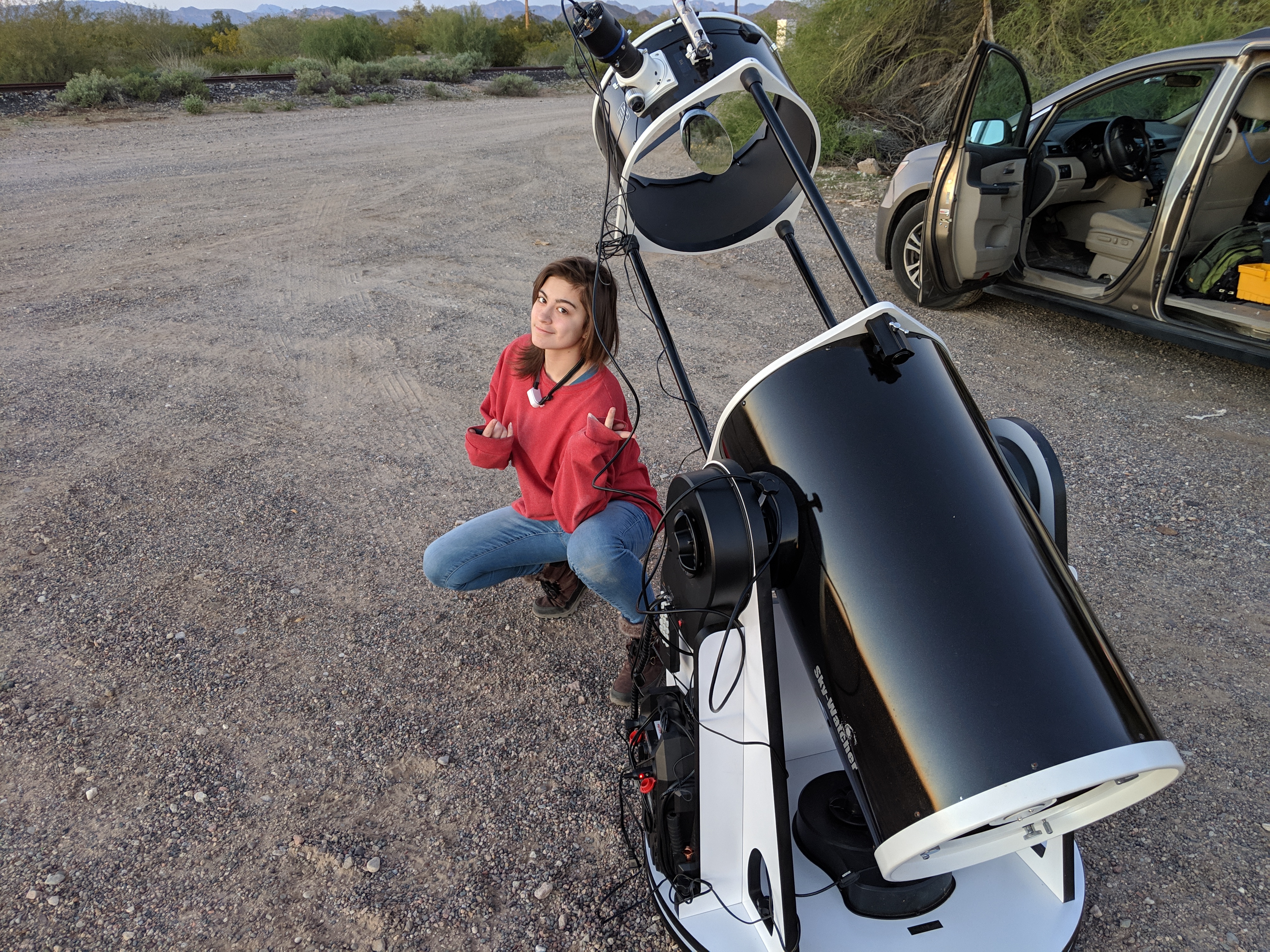
She wrote: “So when we arrived in Tuscon on Monday we met up with our telescope partners, as I had mentioned mine was a man named Ted Blank and he was the head of the New Hampshire Astronomical Society when I had completed my first research paper! So that was pretty cool. We then loaded the car with crates containing the telescope mount parts, the telescope itself, and the data systems (computer, camera, wires, etc). Then we drove out to the practice site in Tuscon and set up the mount, scope, and system and did a practice run (so we aligned the scope, set the PAE, found the star field, and took about 100 frames during the time the occultation would be happening). Then on Tuesday we drove out to our assigned band which was originally predicted to be the first band on the North edge that would get a negative occultation. After setting everything up when the actual occultation time came around (about 8:08 pm AZ time) we took 1715 frames (about 10 min from 8:03 to 8:13) turns out we had a positive Occultation! So the shadow had shifted a little northwards. This viewing was for the upcoming Lucy mission scheduled to be launched in 2021 and the occultation was caused by trojan asteroids. Lucy is going to visit 6 trojan asteroids to hopefully tell us about the formation of the solar system.”
“Spitzer Observations of Interstellar Object 1I/’Oumuamua.” Andrew McNeill, Alissa Roegge, and Nathan Smith are co-authors on this paper.
There was very nice press coverage of this article which received considerable press coverage, of which the following is just a small sample!
-
- NAU News: “NASA telescope’s ‘non-detection’ of first interstellar object in solar system leads NAU team to conclusions about mystery object’s size, reflectivity” There’s a link at the bottom to Colin Chandler’s 3D print-able model of this mysterious object!
- JPL: “NASA Learns More About Interstellar Visitor ‘Oumuamua“
- In China!: “NASA reveals more information on first interstellar object”
This grant is a 3.75M award divided between UCSB, Yale, Stanford, NIST, Microsoft and NAU to create ultra-stable lasers to drastically reduce energy consumed through information processing used to power the internet (currently 10% of the world energy budget).
What does that mean? NOAO is the National Optical Astronomy Observatory — the national observatory headquarters. ELT is Extremely Large Telescopes — a catch-all phrase for telescopes in the coming decade that will be ~30 meters in diameter. And KSP is Key Science Program — identifying some key scientific investigations that could be carried out with these coming giant telescopes.
(First stopping off to visit their respective families.) They’ll be in New Zealand in a week or so, and a few days later land in McMurdo Base in Antarctica. Their field seasons will be 2+ months, and they are hoping to send us pictures/blog posts/etc. AND: PhD student Helen Eifert leaves for a separate field campaign in Antarctica in a few weeks. We can’t wait to hear from all of them about their adventures.
You can follow their adventure on Mark’s Blog.
October 2018
“A New High Perihelion Inner Oort Cloud Object: 2015 TG387” which has received some press attention.
alongside the deans of engineering for ASU and UofA and the Chancellor of Embry Riddle.
at ASU. Christopher Edwards also presented results related to Phobos.
related to the field-analog testing of a variety of technologies: “Incorporation of Portable Infrared Spectral Imaging Into Planetary Geological Field Work: Analog Studies at Kīlauea Volcano, Hawaii, and Potrillo Volcanic Field, New Mexico”
The NExSS group works to connect different research programs in exoplanets across the country, and also organizes workshops and conferences for both NExSS teams and the larger exoplanet community. Additionally, NExSS membership comes with access to funds to support team travel to NExSS workshops and events.
Also, Christopher Edwards and Nathan Smith were shown in one of the slides about research productivity.
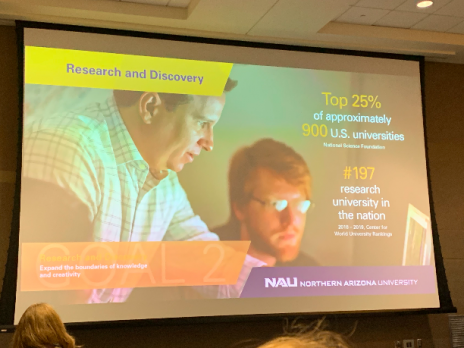
organized by Nadine Barlow, Kathleen Stigmon, and others. President Cheng attended. We had at least nine grad students and at least seven undergraduates who presented posters.
Faculty David Trilling, Cristina Thomas, Chad Trujillo, and Steve Tegler attended the American Astronomical Society/Division of Planetary Sciences meeting last week. Graduate students Samuel Navarro, Robyn Meier, and Annika Gustafsson; postdocs Andrew McNeill and Maggie McAdam; and undergraduate student Mitch Magnuson also attended. Together, NAU people authored/co-authored at least 25 abstracts. [My apologies if I left someone off this list!]
from January 1, 2018 to October 19, 2018. Of these, 9 were for applied research ($5,152,819), 36 for basic research ($14,696,390) and 3 classified as other purposes ($276,868). The total dollar amount of the 49 proposals submitted through October 19, 2018 is $20,126,077.
Good luck to them! Kudos to Ty Robinson for his excellent mentoring of these students through the proposal process.
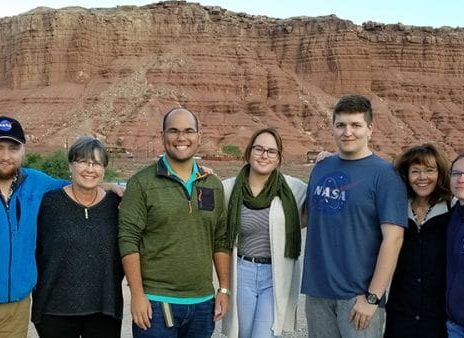
Students Janus Kozdon, Brennah Brown, Ryan Jundt and Emma Garret, along with staff members Kathleen Stigmon, Ed Anderson and Mary Lara attended the Navajo Bridge Star Party Oct. 12-13. The trip, which was sponsored by the NAU/NASA Space Grant, allowed the students to spend the weekend doing outreach with the public, bringing their own telescopes to stargaze both Friday and Saturday night. This is the second year a group from the department has participated in the party.
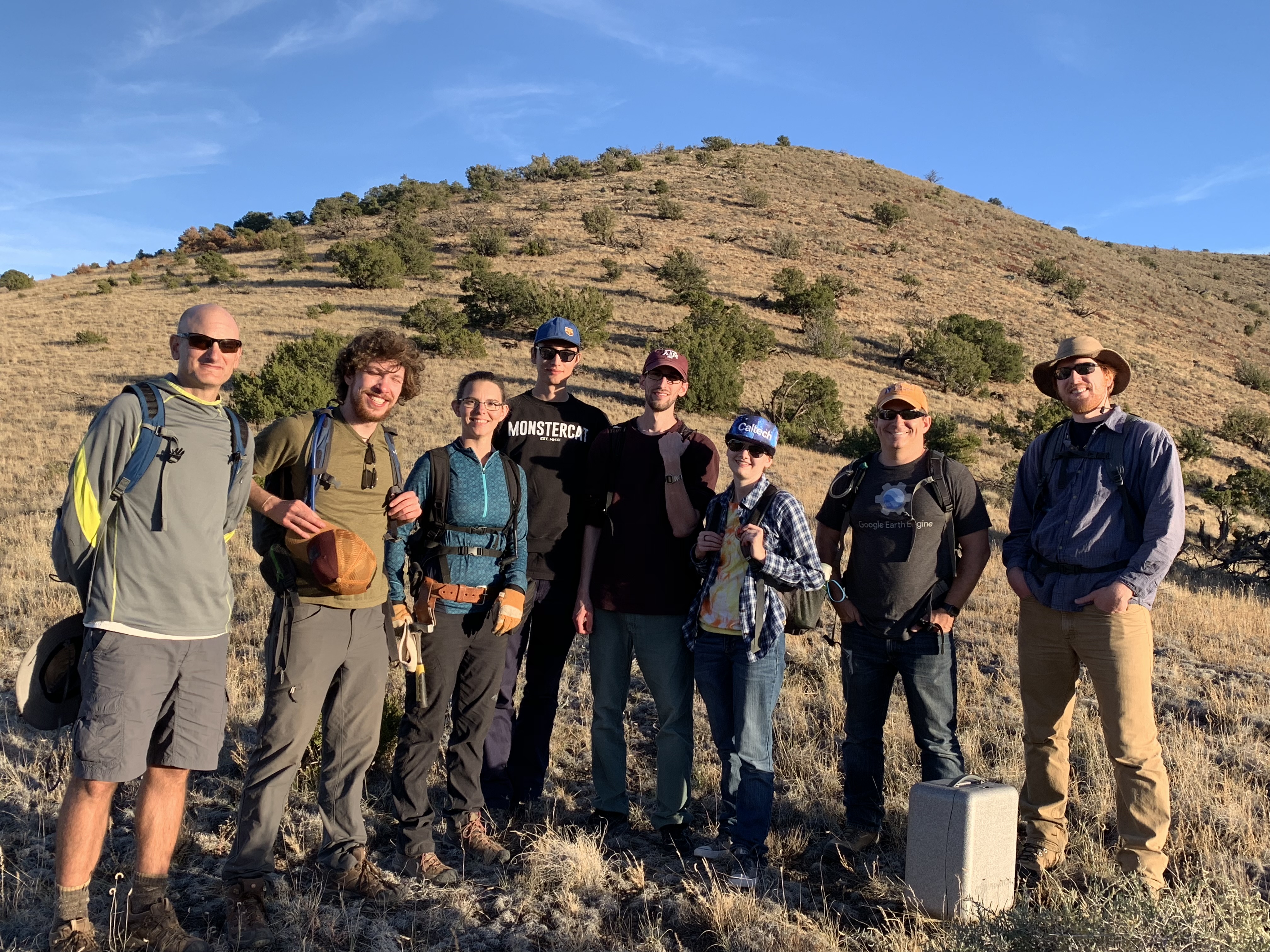
On October 27 a dozen students, postdocs, and faculty participated in the first official Planetary Analogs field trip to SP Crater and Colton Crater; the trip was led by Crhistopher Edwards and postdoc Jean-Francois Smekens.
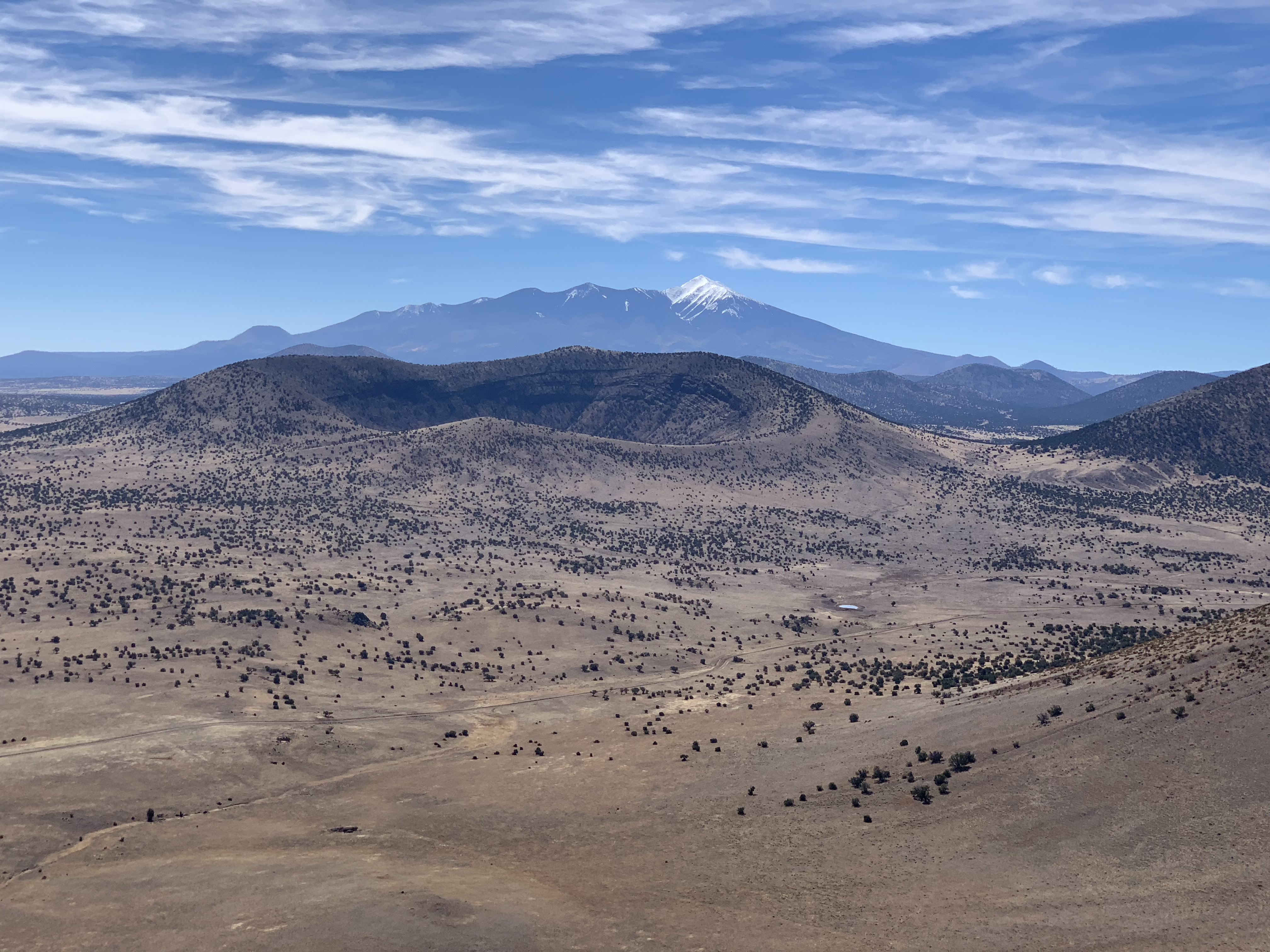
“Extreme asteroids in the Pan-STARRS 1 Survey” David Trilling is a co-author.
‘Quantum Engineering following Nature’s lead: Using genetic algorithms to develop nitride optoelectronic devices’ (Adrian Luna, Robert Voinescu, John Castañeda, and Inès Montaño) at the SACNAS conference in San Antonio.
“Nitride Hyperbolic Metamaterials” (Rachel Sobecki and Inès Montaño) at the NAPSA symposium and will present the same at the SPS Zone Meeting that NAU is hosting.
“The Influence of Many-Body Effects on Light-Matter Interactions in Semiconductor Nanostructures” (Matthew Daunt and Inès Montaño) at the NAPSA symposium.
had a busy October and presented four talks/posters in Mexico and the US:
-
-
-
- 10/01 Colloquium. NEOs: “Rapid-response Spectrophotometric characterization of Near Earth Objects with RATIR” at the Institute of Astronomy, UNAM, campus Ciudad Universitaria, México City, México.
- 10/11 Poster presentation. “Near Earth Objects characterization with the 1.5m telescope from the National astronomic observatory (Caracterización de objetos cercanos a la Tierra (NEOs) con el telescopio de 1.5m del Observatorio Astronómico Nacional)” at the National astronomy meeting (Congreso Nacional de Astronomía), Puebla, Puebla, México
- 10/17 Colloquium. NEOs: “Rapid-response Spectrophotometric characterization of Near Earth Objects with RATIR” at the Institute of Astronomy, UNAM, campus Ensenada, Ensenada, B.C., México
- 10/26 Talk. “First results from the rapid-response spectrophotometric characterization of Near-Earth Objects using RATIR.” at the DPS meeting, Knoxville, Tennessee, USA.
-
-
September 2018
This is a group that will help define projects that could be carried out with the next generation of very large (~30 meter) telescopes. David’s co-convener for Solar System science topics is Tommy Greathouse — presently at SWRI in Texas and a 1997 alumnus of our department!
“Testing the Limits of Spectral Mixture Modeling in the Thermal Infrared: Insights from Radiative Transfer Modeling and Laboratory Spectral Analysis” ($469K with grad student for 3 years).
hosted by the “Next Generation Lunar Scientists and Engineers group” on preparing for interviews and job talks.
, and they had added a STEM education component to it. Knowing that between 1,000-4,000 students might be there, Sam Navarro, Sam Sarkar, and Richard Gaughan volunteered to go and help Kathleen Stigmon. In addition, Allison Vance (a friend of the department), who has planetarium educator background, volunteered to go along as well.” A few pictures from their event are in our Scrapbook. Thank you, Kathleen, Sam, Sam, Richard, and Allison!
NAU speakers included faculty Nadine Barlow, Kathy Eastwood, Cristina Thomas, and Chad Trujillo; postdocs Jennifer Buz and Kathryn Powell; grad students Colin Chandler, Erin Aadland, Robyn Meier, Catherine Clark, and Shy Dustrud; and researchers Anna Engle and Nathan Smith. All the talks were terrific! Phil Massey (Lowell) and David Trilling (NAU) hosted and co-organized the symposium.
She submitted 1 proposal to the IRTF and was Co-I on 7 proposals to observe Didymos around the world (so far). The Didymos proposals are for some of the largest ground-based facilities in the world: GTC, VLT, Gemini N & S, Keck, LBT and the MMT. There are only a couple left to submit after today, including the DCT.
in Buffalo Park.
was hosted by NAU staff Ed Anderson and Mary Lara and students Kathryn Turrentine, Kyle Ghaby, Kirstin Ligon, and Ryan Jundt. Camp Colton is an outdoor education facility run for the Flagstaff school district and they are keen to build more astronomy into their experience for the visiting students. Thank you all for representing our department, NAU, and astronomy so well!
“I will join about a dozen students from all over the world in the rare opportunity to conduct research with Meteor Crater Staff Geologist and LPI Researcher Dr. David Kring. I’ll spend nine days within Barringer Crater, mapping various features of the crater and conducting research in support of impact cratering studies.”
August 2018
“Inventory of CO2 available for Terraforming Mars.” This article and NAU were mentioned in over 120 nationally and internationally recognized news articles. Such as
-
-
-
- AIRTALK — a NPR/KPCC radio show: “A mission to Mars may drive us crazy – but if we can’t terraform it then does it even matter?”
- A 5 minute news piece for KJZZ In Phoenix: “Researcher: Terraforming Mars Not In The Cards Right Now”
- The New York Times: Mars Is Frigid, Rusty and Haunted. We Can’t Stop Looking at It.
- Wired Magazine: Sorry, Nerds: Terraforming Might Not Work on Mars
- Quartz Magazine: NASA says nobody—not even Elon Musk—can terraform Mars
- VICE: Sorry Elon: NASA Says Mars Can’t Be Terraformed With Existing Technology
- NAU News: Think twice before moving to Mars—NAU planetary scientist refutes terraforming in NASA study
- NASA Press Release: Mars Terraforming Not Possible Using Present-Day Technology
-
-
that were submitted to the American Geophysical Union Meeting, including one from Postdoc J.-F. Smekens and Graduate Student N. Smith
and was a co-author one additional abstract related to the Emirates Mars Mission.
at the Southwest Research Institute in Boulder, CO, Aug. 8-10. Michael gave a talk on “Preliminary Investigations of Polygonal Craters on Ceres”. Nadine gave two talks: “Type 1 Ejecta Craters on Mars: Not Restricted to just the Double Layer Ejecta Morphology”, and “Constraints on the Timing of Tectonic Activity on Mercury’s Large-Scale Lobate-Scarp Thrust Faults”.
“New Jupiter Satellites and Moon-Moon Collisions” Press releases about this topic can be found on the APS news page.
(which is redacted until publication time).
July 2018
These are three-campus research programs, typically for seed funding that will culminate in a larger, external funding proposal. One of these (“Seed Funding for an Innovative Three-University Near Earth Object (NEO) Space Mission”) is led by David Trilling. A second project, led by UA, has both Ryan Behunin and Ines Montano as CoIs.
of all ground-based (telescope) observing [both US and Europe] of asteroid Didymos for NASA’s DART mission.
and new observations obtained of Neptune’s moon Triton with the Gemini South telescope in May. Stay tuned for some cool stuff to come …
(also with Michael Mommert, Chad Trujillo, and 2017 REU intern Anthony Curtis) is in press: “SAFARI: Searching Asteroids For Activity Revealing Indicators”
There were 250 people there!
(in Hawaii) to use MIRSI, amid-infrared camera that they have spent the last (many) years retrofitting.
She is the PI on one project; CoI on several more.
titled “Star Cluster Formation and Evolution in Luminous Galaxy Mergers: A Joint JWST-HST Investigation”.
to carry out a project entitled “Near infrared speckle imaging for research on stars, near Earth asteroids, and space situational awareness”
resulting in field work with incoming PhD student Schuyler Borges.
for Antarctic field work for incoming PhD student Helen Eifert.
“The Role of Temperature-Driven Chemical Reactions in the Evolution of Solar System Ices” was selected for
funding. It is a 3-yr award and will involve one PhD student.
Faculty members Nadine Barlow, Ty Robinson, and Mark Salvatore and graduate students Lori Glaspie and Michael Zeilnhofer spent a couple of hours talking to the public about research in the Department and the visit of the astronauts to the campus telescope during their training in Flagstaff. Our impact cratering activity was a big hit with all ages.
June 2018
“First Contact: Making Sense of 1I/‘Oumuamua and Its Implications.” The goal of this team is “to consolidate the existing studies and explore avenues for future investigations” of interstellar objects like `Oumuamua, the interstellar asteroid that was discovered last October.
given last month at the “SKA-Driven Big Data Challenge in Africa: Science, Innovation and Opportunity” Conference in Madagascar. No, he didn’t attend the conference in person.
at the “Fluctuation-Induced Phenomena in Complex Systems” conference in Bad Honnef, Germany.
when he talked at the recent ABOR meeting about all the great things that are happening in our department. Thanks for doing this!
“Mapping the Thermal Inertia of Phobos using Thermal Infrared Spectra and Thermophysical Modeling”
who was awarded four nights on WIYN (telescope on Kitt Peak) in 2018B for her project “NESSI Survey of Potential Low-Mass Exoplanet Hosts.”
are CoIs on an approved NOAO 2018B telescope proposal entitled “The Mission Accessible Near-Earth Object Survey (MANOS),” which was allocated 40 hours of Gemini time.
— totaling 1.1M over 2 years. This will support a 1/2 time coordinator, postdoc, 3 years of graduate students, and a data analyst.
related to mapping the Himalayan mountains using satellite remote sensing data: “Structural relationship between the Karakoram and Longmu Co fault systems, southwestern Tibetan Plateau, revealed by ASTER remote sensing”
Wow!
May 2018
We had ~25 undergraduate majors and 4 masters students who graduated. Congratulations to all of them and to all of us!
Kyle presented his Space Grant project (mentored by Dr. Lisa Prato at Lowell) on “Planet Formation around Binary and Multiple Star Systems” during Friday’s Undergraduate Symposium. He was recognized by the Dean during the CEFNS Pre-Commencement Reception on May 11.
titled “In-Situ Measurement of Forest Soil Gases using Quadrupole Mass Spectrometry” in the International Journal of Earth & Environmental Sciences. This research used a battery powered, portable quadrupole mass spectrometer that was designed and constructed here at NAU with funding from a TRIF grant.
a talk on “Comparing Central Pit Craters across the Solar System: Characteristics and Implications for Formation Models” during the Geological Society of America Rocky Mountain/Cordilleran Joint Sectional meeting in Flagstaff on May 16. She also co-chaired the Recent Advances in Planetary Geoscience session.
for 19 participants of the Geological Society of America Rocky Mountain/Cordilleran Joint Sectional meeting on May 18. The trip included explorations of Meteor Crater, Cinder Lake Crater Field, and SP and Colton volcanoes.
“Nuclear Nonsolution” (Aerospace America, v. 56, p. 44-47).
an abstract submitted to the European Planetary Science Congress, to be held September 16-21 in Berlin, Germany: “Warming Early Mars by Impact Degassing of Reduced Greenhouse Gases“.
This is a big deal (lots of money, and an official approval to move to the next step).
was awarded to incoming PhD student Erin Aadland and Phil Massey and, separately, Chad Trujillo, for the 2018B semester.
She’s working on her PhD at UA.
won the outstanding senior award from his college at U Toledo (the College of Natural Science and Mathematics).
April 2018
and there’s a great article about him in NAU news.
on “What We Know About Mars from its Impact Craters” at the Planetary Science Palooza on March 18, 2018, in The Woodlands, TX.
in the School of Earth and Space Exploration at ASU. She is working with Alyssa Rhoden (who gave a colloquium here a few weeks ago) on crater studies of icy satellites, particularly those in the Saturnian system. Another one of our undergraduate alums who is doing great!
is a graduate student in the Lunar and Planetary Lab at Univ. AZ and expects to do her final dissertation defense this spring.
Entitled “Linking Thermophysical Properties of Mars to Earth: Analog Investigations of Past and Present Habitable Environments”, the grant is for ~$1.2M and will support 2 NAU graduate students for 3 years. Only 6 of 47 (12.7%) proposals were selected.
to conduct exoplanet-themed research next year under the supervision of Ty Robinson.
during an award ceremony a couple of weeks ago. Olivia is the CEFNS Outstanding Senior, and Etude won a Gold Axe award. And at the ceremony Etude found out that he was also awarded the President’s Prize.
in press at the Astronomical Journal, “On the detectability of Planet X with LSST”
to observe comet (formerly asteroid) Don Quixote in June. IRAM is a 30-meter radio telescope in Spain, and this is Trilling’s first ever research-grade radio astronomy project — pretty fun. No, they won’t go there in person to do the observing.
March 2018
March 1, led by Google’s Noel Gorelick. We hear that Flagstaff had one of the largest turnouts for this tutorial session of any place on Noel’s worldwide tour.
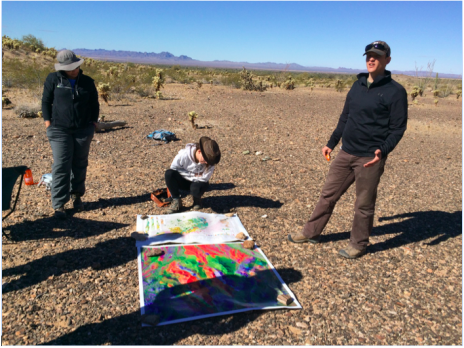
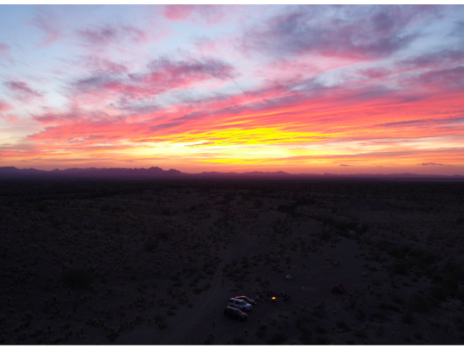
occurred on march 3-4, when three faculty and four grad students went to granite wash, in western Arizona. Mark Salvatore, who led the trip, wrote:
“This area is of great interest to geologists, as a portion of the Grand Canyon sedimentary sequence is well exposed, despite being rotated, metamorphosed, and heavily eroded. The group held several discussions regarding what can be seen from air and space, and how these signatures and features differ in appearance once you arrive in the field. You can imagine how this might be applicable to astronauts eventually walking around on the surface of Mars! We also tested out a few new research tools, including a portable visible/near-infrared spectrometer (to help identify unique mineral phases in the different rock units) as well as an unmanned aerial vehicle (UAV).”
“Working with some very talented undergraduates in our department, we’ve submitted two HURA proposals and one Space Grant proposal (so far!). The topics of these proposals include studying transit and secondary eclipse observations of Earths orbiting M dwarf hosts, and understanding how well mission concepts like WFIRST/rendezvous, HabEx, and LUVOIR will perform when attempting to detect key life and habitability signatures from exoplanet atmospheres.”
with David Crisp (JPL): “Linearized Flux Evolution (LiFE): A Technique for Rapidly Adapting Fluxes from Full-Physics Radiative Transfer Models” in the Journal of Quantitative Spectroscopy and Radiative Transfer (JQSRT). Ty notes that while “the theory-heavy paper is a dense (dull?) read, there are two key points. First, we describe a technique that transforms a high-resolution radiative transfer model into a climate model, and several research teams across the country are already using this tool. Second, as a validation of our approach, we reproduce (for the first time ever, I believe) Venus’ thermal structure without a need for fudge factors or made-up opacities. So, our team is the only group that has the tools to understand the fundamentals of Venus’ greenhouse effect.”
with M. Gouhier, in press in the journal of volcanology and geothermal research entitled “Observation of SO2 degassing at Stromboli Volcano using a Hyperspectral thermal Infrared Imager“.
(the student regent position). to get that far Annika went through a series of interviews on campus (up to and including with the president), and then had an interview with the governor two weeks ago. It’s too bad Annika wasn’t selected; she would have done a terrific job.
He graduated from our department in 2008 with his masters and is now a professor in the physics department at University of Connecticut.
Faculty Nadine Barlow, Mark Salvatore, and Christopher Edwards; postdocs Kristen Bennett and Maggie McAdam; grad students Lori Glaspie, Alissa Roegge, Nathan Smith, Aaron Weintraub, and Michael Zeilnhofer; and incoming PhD students Schuyler Borges, Sarah Lamm, and Will Oldroyd. Together this group (and others from NAU) were first authors or co-authors on around 40 presentations. [My apologies if I missed anybody on this!] Christopher reports from the conference that “every single person I talked to at LPSC was like ‘NAU fantastic!’ Including people I was not expecting to be paying attention. Everyone is paying attention.”
— very slick and great looking — that is being sent to other universities (and whoever else). Trilling, Edwards, and Trujillo are featured, and our Astronomy and Planetary Science program is one of ~10 that are presented in this new brochure.
Dylan Nicholls, Etude O’Neel-Judy, and John Gibbs will give oral presentations, and Raaman Nair will give a poster presentation at the Symposium NM02—Active Colloids with Order.
There were eight finalists for the grad college’s 3MRP (3 Minute Research Presentation) competition, and three are from our department: Sam Sankar, Richard Gaughn, and Trevor Cotter. Richard took second place — $2000 prize and entry into the southwest showdown (Arizona and Nevada schools). The story is here.
in press on the “Constraints on the Density and Internal Strength of 1I/’Oumuamua”
Ty Robinson co-led the exoplanet characterization portions of this report, and the concept will be considered for funding prioritization in the 2020 Decadal Survey of Astronomy and Astrophysics.
submitted a Space Grant application.
Ty Robinson is the team lead on this multi-million dollar grant (led out of the University of Washington) includes five years of graduate student funding here at NAU. [Note from Trilling: A NASA press release and related NAU press activity will be coming soon — probably in the next week or two.]
This project involves researchers at NASA Ames, Washington University, and NAU. The research focus for this work will be understanding the Earth’s atmosphere shortly after the giant impact that led to the formation of our Moon. We know that life originated very early in Earth’s history, and may have been influenced by the Moon forming impact.
February 2018
who graduated in 2013, visited the department last week to say hi. She is working at Raytheon in Tucson. Kristen did her masters research under Chris Mann.
She will start in summer or perhaps early fall. Congratulations!
who is a postdoc at Lowell but who has her second home at NAU in the ice lab, has accepted a staff scientist (what they call tenure track) position at Lowell Observatory. I think this means many more years of continued collaboration, including in ice lab projects. Congratulations!
NAU had the largest non-Canadian contingent at the recent Women in Planetary Science and Exploration meeting in Toronto: Alissa Roegge, Maggie McAdam, Kristen Bennett, and Annika Gustafsson presented at the conference.
In the first eight weeks of 2018—that is, January and February—our department submitted 15 funding proposals for a total proposed amount of $8.3M, with seven different PIs. These submitted proposals include four NESSF proposals submitted by PhD students — congratulations to them and their mentors. This tally includes only proposals that went through Cayuse; there was at least one white paper (pre-proposal) that went in during this time as well, and possibly more.
at NAU/SESES entitled “Unraveling the Martian Paleoenvironment through Orbital and In Situ Investigations”
“Widespread distribution of OH/H2O on the lunar surface inferred from spectral data,” which has received a lot of media attention.
in the field entitled submitted to the AGU Journal of Earth and Space Science.
that has been submitted.
to the AGU Journal of Earth and Space Science: “THEMIS‐VIS Investigations of Sand at Gale Crater“.
that was accepted related to the formation of clays and salts on Mars that was accepted in Astrobiology: “A Complex Fluviolacustrine Environment on Early Mars and Its Astrobiological Potentials“.
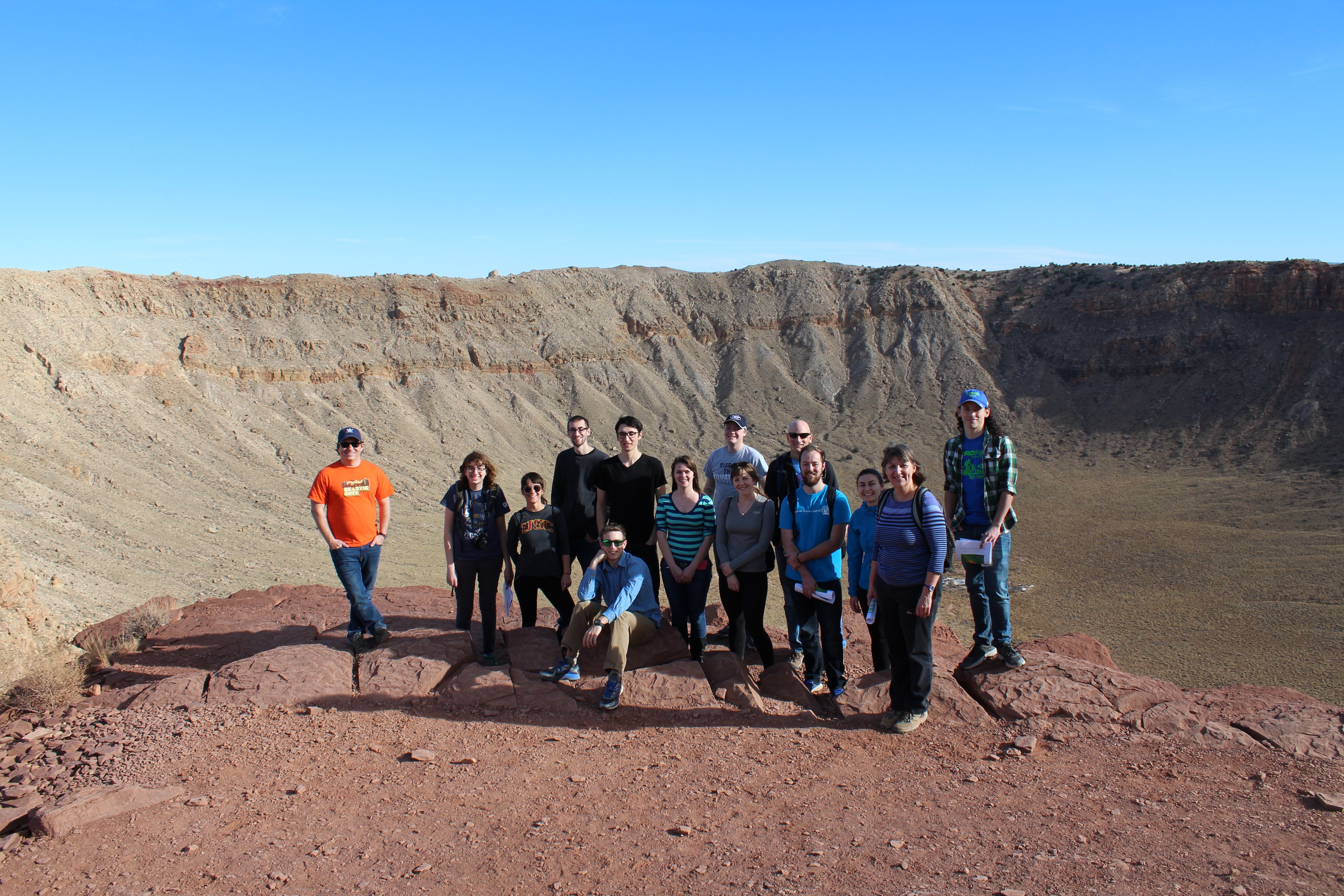
touring DCT and Meteor Crater.
January 2018
Vice President for Research and faculty member in our department: “FYI, the new grant I got is from the NASA Astrophysics Research and Analysis (APRA) program. The rather ponderous title of the work is “Computational laboratory astrophysics to enable transport modeling of protons and hydrogen in stellar winds, the ISM, and other astrophysical environments.”
Trilling’s research mentioned in two articles:
-
-
-
- Scientific American: Oddball Object Tumbling among the Stars Could Disrupt Planetary Science
- National Geographic: Rock From Another Star System Has a Carbon-Rich Coating
-
-
submitted a paper, Effects of Disk Warping on the Inclination Evolution of Star-Disk-Binary Systems.
is in the news with a big result:
presented at the recent AAS meeting. There were probably other REU and NAU alumni who presented as well, but I don’t have the details. Ty Robinson says he gave four (!) talks at the AAS meeting.
to attend and present at NASA’s SBAG (Small Bodies Assessment Group) meeting.
to the annual Lunar and Planetary Science Conference (LPSC) as lead author (Edwards, Bennett X2, Pan, Smith, Weintraub, Kozdon) and Edwards participated on another 8 LPSC abstracts as co-author. I’m sure there are lots of other NAU people on LPSC abstracts; we can hear more about that in March during/after the conference.
regarding the strategy of multiple landed mission for Mars exploration:
Mars as a Linchpin for the Understanding the Habitability of Terrestrial Planets: Discoveries of the Last Decade from Mars and Why a New Paradigm of Multiple, Landed Robotic Explorers is Required for Future Progress in Terrestrial Planet Astrobiology
that was accepted for publication related to the OH/H2O content of lunar regolith: “Widespread distribution of OH/H2O on the lunar surface inferred from spectral data”
on an LPSC abstract that describes our new PhD program (Salvatore et al.).
“For LPSC I submitted two abstracts as 1st author and 2nd year PhD student Michael Zeilnhofer submitted an abstract on the work that he is conducting with me for his PhD. I was a co-author on five additional abstracts, including the one that Mark Salvatore submitted about our new PhD program.”
presented research on Mars’ largest moon at NASA’s Small Bodies Assessment Group meeting on Jan. 25. He spoke on “A Thermophysical Model of Phobos,” explaining how the surface of Mars’ largest moon heats up and cools down over time.
with co-authors, Lowell researchers Lisa Prato (Lauren’s advisor), Joe Llama, and Brian Skiff: “K2 reveals pulsed accretion driven by the 2 Myr old hot Jupiter CI Tau b.”
and a number of USGS folks are organizing a bunch of sessions and a field trip for the Geological Society of America regional meeting to be held in Flagstaff in May.
early on Wednesday morning with TIPSI, the thermal infrared camera on our campus telescope. The goal is to measure the thermal inertia of the moon.
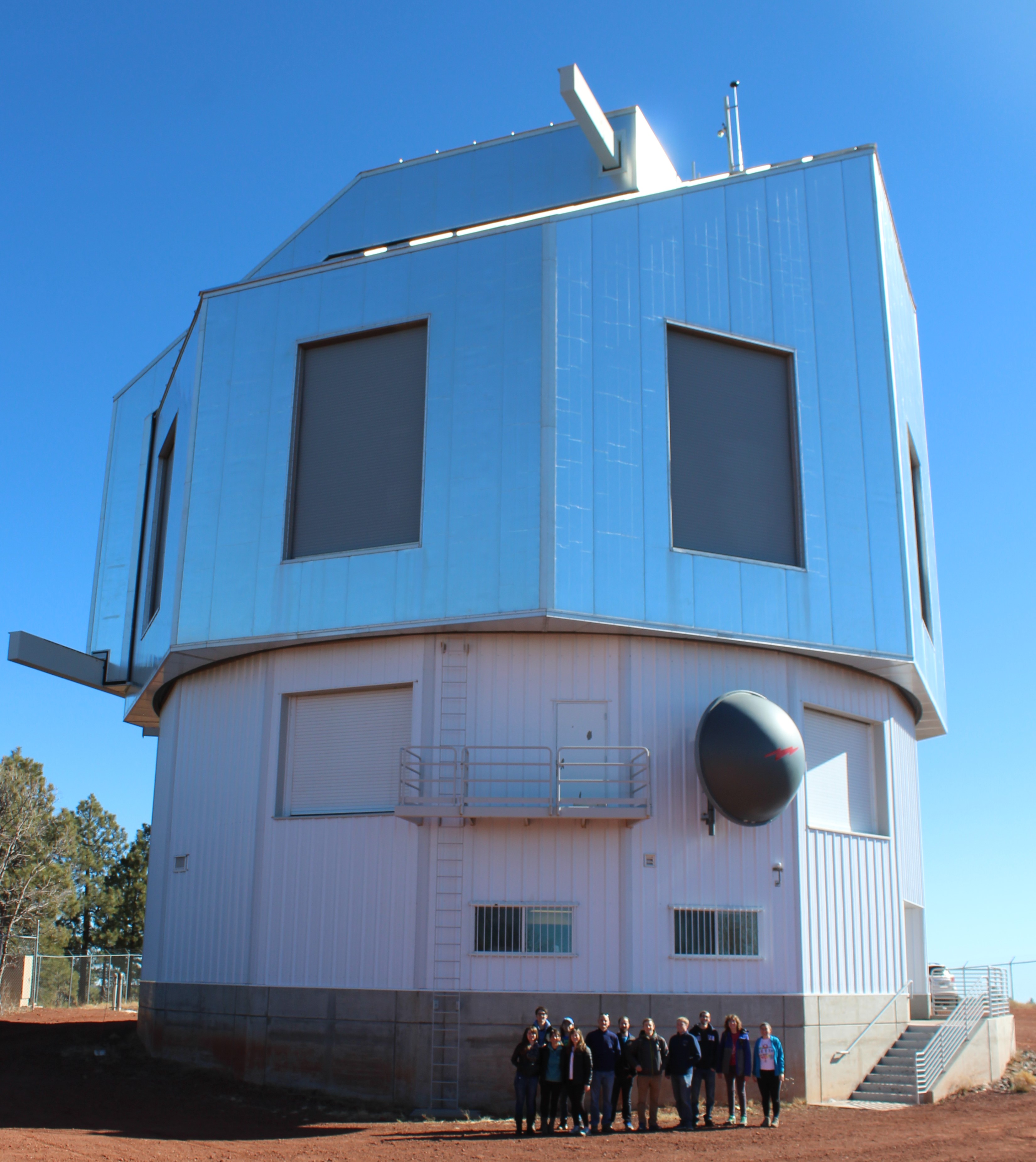
These students, plus a 13th who couldn’t make it this weekend, are being recruited for our third incoming class in our PhD program in astronomy and planetary science and would start in August, 2018. We’ll have them on campus Friday and spend all day Saturday on a field trip to the Discovery Channel Telescope and Meteor Crater.
on Jan. 29. She and Vanessa Fitz-Kesler (CSTL) worked with 4th-6th grade students on an activity to select landing sites on Mars. She also helped provide information and answer questions for the Solar System Scale Model exercise on the school’s playground. Kathleen Stigmon and Mary Lara also participated with telescopes for daytime solar viewing and an evening star party.