Visual Communication, Bachelor of Fine Arts
- Available Emphasis Areas:
- Animation - Emphasis
- Graphic Design - Emphasis
The Bachelor of Fine Arts (BFA) in Visual Communication offers a comprehensive education that integrates art, design, and technology to convey ideas visually. Students cultivate strong aesthetic and conceptual skills, mastering elements such as color, typography, symbols, multimedia, interactivity, and digital imagery. The program provides hands-on experience in graphic design, branding, animation, motion graphics, user interface and experience design (UI/UX), illustration, photography, and project management. This foundation enables students to produce professional, industry-aligned work that communicates, entertains, persuades, innovates, and informs within diverse cultural contexts.
To receive a bachelor's degree at Northern Arizona University, you must complete at least 120 units of credit that minimally includes a major, the general studies requirements, and university requirements as listed below.
- All of Northern Arizona University's general studies, junior-level writing, and capstone requirements.
- All requirements for your specific academic plan(s).
- At least 30 units of upper-division courses, which may include transfer work.
- At least 30 units of coursework taken through Northern Arizona University, of which at least 18 must be upper-division courses (300-level or above). This requirement is not met by credit-by-exam, retro-credits, transfer coursework, etc.
- A cumulative grade point average of at least 2.0 on all work attempted at Northern Arizona University.
The full policy can be viewed here.
In addition to University Requirements:
- 70 units of major requirements which includes 30 units of emphasis requirements.
- Up to 9 units of major prefix courses may be used to satisfy General Studies Requirements; these same courses may also be used to satisfy major requirements.
- Elective courses, if needed, to reach an overall total of at least 120 units.
Students may be able to use some courses to meet more than one requirement. Contact your advisor for details.
| Minimum Units for Completion | 120 |
| Major GPA | 2.5 |
| Highest Mathematics Required | MAT 114 |
| Additional Admission Requirements | Required |
| Fieldwork Experience/Internship | Optional |
| University Honors Program | Optional |
| Progression Plan Link | View Progression Plan |
| Emphasis | An emphasis is required for this major. |
Purpose Statement
The Visual Communications program develops the analytical skills and creative passion in our students to be designers, animators and professional artists who creatively, yet strategically, resolve challenging visual design problems across a variety of media in an artistic, visually compelling manner.
In our program, students begin by building a strong foundation in the elements, principles, and processes of design. They build upon this foundation across their studio classes by engaging in the creation of increasingly complex designs focused on solving real-world problems. As a student progresses through the program, they incorporate a multi-disciplinary approach by applying concepts from art history, communication theory, drawing, and their liberal studies requirements to issues of design. Cutting-edge software and technological applications are then integrated into their experience. Particularly, students learn to apply design principles to software in a manner that provides the skills to adapt to the newest technologies in expectation for the technologies which will emerge in the future.
To be effective in the world of design, our students learn to develop excellent relationships with clients, and work collaboratively to co-create projects in teams. By learning how to communicate effectively with clients and utilize the talents and strengths of design colleagues, our students learn how to creatively navigate relationships to develop the best design products.
Our faculty members know that the elements, principles, and processes of design, the software, the ability to collaborate; all of this is just the beginning. Our program is taught using small, studio-based courses, one-on-one faculty mentoring, and advanced facilities. Yet, the ever-changing world of design requires its practitioners to learn throughout their careers and constantly keep their skills up-to-date. Our program and faculty provide the strategic approaches to learning that will sustain our graduates' abilities in a continually evolving field for years to come.
Overall, our integrative approach develops students who are capable of applying fundamentals to solve increasingly complex design problems in technologically innovative ways, and result in a portfolio of work designed to launch them in their career.
Student Learning Outcomes
- Gain functional competence with principles of visual organization, including the ability to work with visual elements in two and three dimensions; color theory and its applications; and drawing.
- Present work that demonstrates perceptual acuity, conceptual understanding, and technical facility at a professional entry level in their chosen field(s).
- Become familiar with the historical achievements, current major issues, processes, and directions of their field(s).
- Exhibit their work and experience and participate in critiques and discussions of their work and the work of others
- Learn to analyze works of art/design perceptively and to evaluate them critically.
- Develop an understanding of the common elements and vocabulary of art/design, the interaction of these elements, and be able to employ this knowledge in analysis.
- Acquire the ability to place works of art/design in historical, cultural, and stylistic contexts.
- Acquire a working knowledge of technologies and equipment applicable to their area(s) of specialization.
- Work independently on a variety of art and/or design problems by combining, as appropriate to the issue, their capabilities in studio, analysis, history, and technology.
- Demonstrate achievement of professional, entry-level competence in the major area of specialization, including significant technical mastery, capability to produce work and solve professional problems independently, and a coherent set of artistic/ intellectual goals that are evidence in their work.
- Develop a body of work for evaluation in the major area of study. A senior project or final presentation in the major area is required.
- Form and defend value judgments about art and design and to communicate art/design ideas, concepts, and requirements to professionals and laypersons related to the practice of the major field.
- Work collaboratively as appropriate to the area(s) of specialization.
- Learn and apply ethical standards and practices of design to communicate effectively with all audiences and stakeholders through various media.
Graphic Design Emphasis
- Solve communication problems, including the skills of problem identification, research and information gathering, analysis, generation of alternative solutions, and prototyping.
- Describe and respond to the audiences and contexts which communication solutions must address, including recognition of the physical, cognitive, cultural, and social human factors that shape design decisions.
- Create and develop visual form in response to communication problems, including an understanding of principles of visual organization/ composition, information hierarchy, symbolic representation, typography, aesthetics, and the construction of meaningful images.
- Understand tools and technology, including their roles in the creation, reproduction, and distribution of visual messages.
- Understand design history, theory, and criticism from a variety of perspectives, including those of art history, linguistics, communication and information theory, technology, and the social and cultural use of design objects.
- Understand of basic business practices, including the ability to organize design projects and to work productively as a member of teams.
- Understand and be able to apply ethical standards and practices of graphic design to communicate effectively with all audiences and stakeholders through various print and digital-related media.
Animation Emphasis
- Knowledge and skills in the use of basic principles, concepts, tools, techniques, procedures, and technologies sufficient to produce animation from concept to a finished product that communicates ideas and/or stories to a viewer or to an audience. This includes, but is not limited to, the ability to use the competencies listed in items below in professional contexts as appropriate to the needs of specific projects.
- Knowledge of the principles of animation, including its visual, spatial, sound, motion, and temporal elements and features, and how these elements are combined in the development of animation projects.
- Functional understanding of and ability to use narrative, non-narrative, and other information/language structures (linear, non-linear, thematic, cinematic, interactive, etc.) to organize content in time-based media.
- Ability to use concepts and processes for the development, coordination, and completion of animation projects (examples include, but are not limited, to concept, visual, and character development; the use of scenarios and personas; and storyboarding, flowcharting, and layout).
- Functional understanding and ability to use the characteristics and capabilities of various animation methods and technologies in creative and project development contexts.
- Understanding and ability to apply ethical standards and practices of animation design to communicate effectively with all audiences and stakeholders through various digital media.
Additional Admission Requirements
Individual program admission requirements over and above admission to NAU are required.
Admission to the Visual Communication Major is contingent upon:
- Completion of the Visual Communication Pre Major coursework (13 units) with a Grade of 'C' or better and a minimum GPA of 2.5:
Approval of student portfolio submitted online through the VC 181 Portfolio Review class and reviewed by the Visual Communication faculty.
All VC courses at a 200-level or above are restricted to students who successfully complete the first year of Pre Major requirements and pass the Portfolio Review.
Major Requirements
This major requires 70 units distributed as follows:
- Visual Communication Pre-Major Requirements: 13 units
- Visual Communication Common Course Requirements: 27 units
- Select an Emphasis: 30 units
- Animation Emphasis: 30 units
- Graphic Design Emphasis: 30 units
Take the following 70 units with a Grade of 'C' or better in each course. All courses must be completed with a minimum GPA of 2.5:
Visual Communication Common Course Requirements (27 units)
- VC 161, VC 201, VC 202 (9 units)
- Select from the following (3 units):
- ART 136 (3 units)
- ARH 142 (3 units)
- Select from the following (3 units):
- Select an additional ARH course at the 200-level or higher, approved by your advisor. (3 units)
- Select from the following courses which meet the junior-level writing requirement. (3 units)
- Emphasis Requirements - Select one (30 units)
Animation Emphasis (30 units)
- VC 205, VC 265, VC 305, VC 365, VC 405 (15 units)
- Select from the following (3 units):
- VC 345
- Though the course may be repeated for up to 9 units, only 6 units will count towards the major. (6 units)
- VC 455
- Though the course may be repeated for up to 6 units, only 3 units will count towards the major. (3 units)
- VC 495C which meets the senior capstone requirement (3 units)
Graphic Design Emphasis (30 units)
- VC 261, VC 262, VC 303, VC 363, VC 403 (15 units)
- Select from the following (3 units):
- VC 343
- Though the course may be repeated for up to 9 units, only 6 units will count towards the major. (6 units)
- Select from from the following (0 - 3 units):
- VC 453
- Though the course may be repeated for up to 6 units, only 3 units will count towards the major. (6 units)
- VC 493C which meets the senior capstone requirement (3 units)
All majors must earn the Grade of 'C' or better in their freshman composition required course and their foundation mathematics course.
Students in the Animation emphasis must complete ART 136, VC 161, VC 201, VC 202, VC 205, VC 265, and be assigned the Animation Milestone before enrolling in VC 305, and VC 345.
Students in the Graphic Design emphasis must complete ART 136, VC 161, VC 201, VC 202, VC 261, VC 262, and be assigned the Graphic Design Milestone before enrolling in VC 303, VC 343, and VC 380.
You must complete the last five of your emphasis courses at Northern Arizona University.
General Electives
Additional coursework is required if, after you have met the previously described requirements, you have not yet completed a total of 120 units of credit.
You may take these remaining courses from any of the academic areas, using these courses to pursue your specific interests and goals. You may also use prerequisites or transfer credits as electives if they weren't used to meet major, minor, or General Studies Requirements.
We encourage you to consult with your advisor to select the courses that will be most advantageous to you.
Additional Information
- See the School of Communication page for information about the Communication Core, Advising and Student Responsibilities, and Graduation Requirements.
Some courses may have prerequisites. For prerequisite information, click on the course or see your advisor.


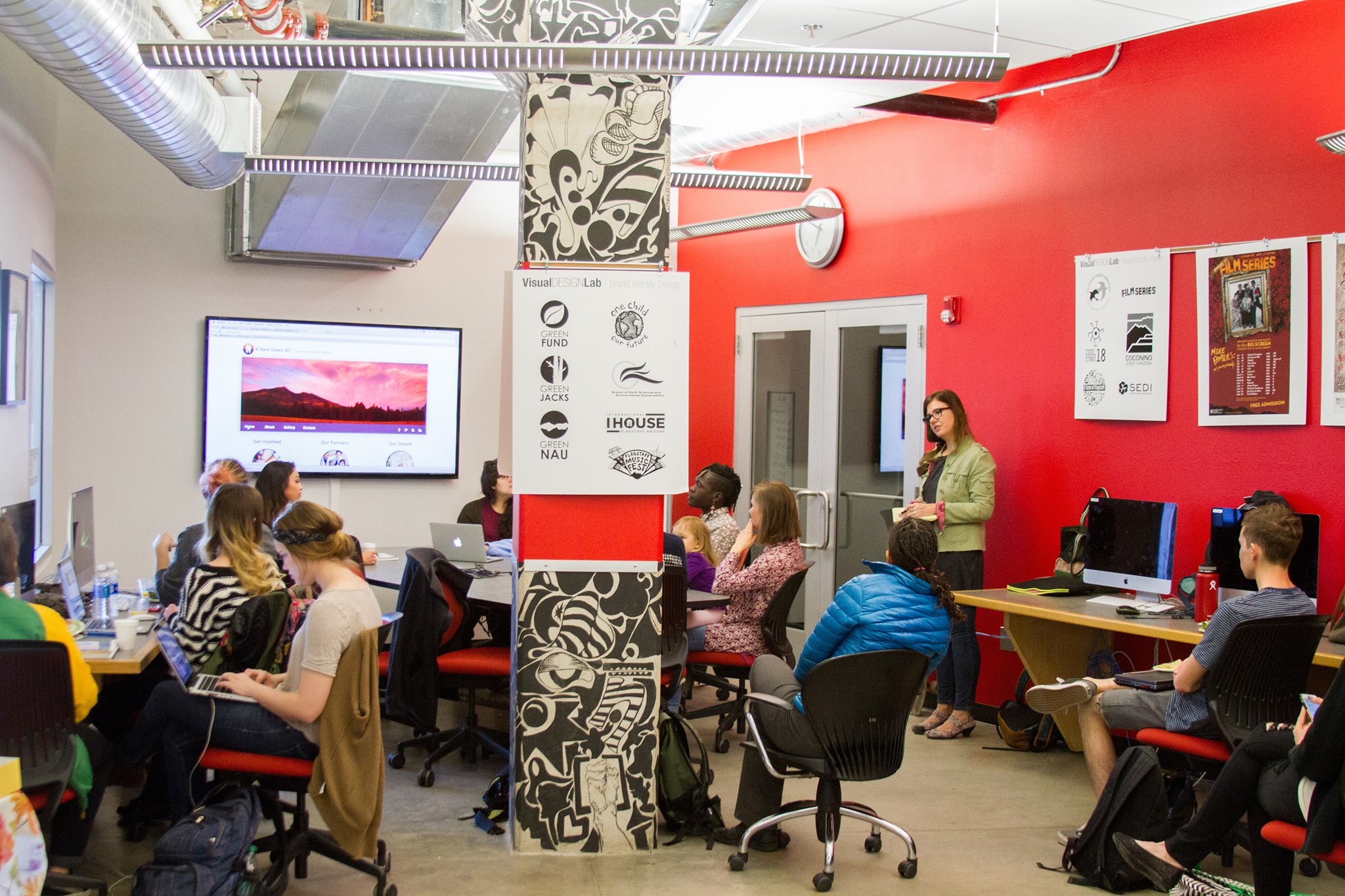
The Visual Communication program at Northern Arizona University combines art, design, and technology in a hands-on studio environment. Students build creative and technical skills while developing a distinctive personal voice.
Choose an emphasis in graphic design or animation. In small, studio-based classes, students work closely with faculty and develop thoughtful approaches to visual communication through experimentation, critique, and production.
Opportunities such as the VisualDESIGNLab and Advanced Media Lab connect classroom learning to collaborative projects. Graphic design students build professional portfolios; animation students develop demo reels and original short films or animations.
Our alumni have gone on to work for companies including Yahoo, Citigroup, Motorola, Netflix, GoDaddy, Amazon Game Studios, Google, IBM, GAP, W. L. Gore, Nike, and L’Oréal.
The Experience
Make It. Refine It. Share It.
Choose Your Path. Focus on graphic design or animation.
Learn in the Studio. Work closely with faculty through hands-on projects and critique.
Develop Your Work. Build a professional design portfolio or an animation demo reel and original short.
Connect Beyond Class. Collaborate through labs, applied projects, and community partnerships.
Student Work
See What Students Create.
Explore design, animation, and emerging-media projects produced by NAU Visual Communication students.
Explore the Student Showcase →Two Creative Pathways
Choose Your Emphasis.
Graphic Design
Solve communication problems through research, analysis, ideation, visual systems, and prototyping.
- Typography, composition, and image-making
- Audience-centered design and visual communication strategy
- Identity, interaction, and professional production workflows
- Design history, theory, and critique
Senior outcome: An individualized professional design portfolio.
Animation
Develop animation from concept to finished work through movement, storytelling, and time-based media.
- Motion, timing, acting, and visual storytelling
- Character design, storyboarding, and visual development
- 2D and 3D animation tools and production workflows
- Sound and editing for time-based media
Senior outcome: An animation demo reel and an original short film or animation.
After Graduation
Where Creativity Can Take You.
Graduates pursue work across design, animation, media, and creative industries. Possible career paths include:
- Graphic designer
- Motion graphics designer
- UI/UX designer
- Interaction designer
- Animator
- Web designer
- Packaging designer
- Illustrator
- Corporate media designer
- Print production designer
- Art director
- Creative director
- Design manager
- Freelance designer
- Advertising designer
- Content developer
Beyond the Classroom
Creative Community & Opportunities.
VisualDESIGNLab
A collaborative environment where students, faculty, and community partners develop creative projects.
Scholarships
Explore funding opportunities available through the School of Communication.
Student Spotlight
Award-Winning Animation.
Road Trip | Anna Keller
Anna Keller's animated film Road Trip earned a Student Emmy, celebrating achievement in student animation and visual storytelling.
Student Work
Creativity in Motion.
See the creative range of NAU Visual Communication students through a fast-paced demo reel and a broader portfolio showcase.
Visual Communication Demo Reel
A look at student creativity across animation, motion design, graphic design, and visual storytelling.
2026 Student Portfolio Showcase
A broader look at graduating students' individual creative directions, technical development, and professional preparation.
More Information
Frequently Asked Questions.
Outcomes align with standards from the National Association of Schools of Art and Design Accreditation.
Studio
- Gain functional competence with principles of visual organization, including work in two and three dimensions, color theory, and drawing.
- Present work that demonstrates perceptual acuity, conceptual understanding, and technical facility at a professional entry level.
- Become familiar with historical achievements, current issues, processes, and directions in the field.
- Participate in critiques, exhibitions, and discussions of creative work.
Art / Design History, Theory, and Criticism
- Analyze works of art and design perceptively and evaluate them critically.
- Understand key elements and vocabulary of art/design and apply them in analysis.
- Place work within historical, cultural, and stylistic contexts.
Technology
- Acquire working knowledge of technologies and equipment relevant to the area of specialization.
Synthesis
- Work independently on a variety of design problems by integrating studio practice, analysis, history, and technology.
Specialization
- Demonstrate professional entry-level competence in the chosen area of specialization.
- Develop a body of work for evaluation, including a senior project or final presentation.
- Communicate ideas clearly and collaborate effectively.
- Solve communication problems through research, analysis, ideation, and prototyping.
- Design for specific audiences and contexts.
- Create visual form using composition, typography, and image-making.
- Use tools and technologies in the production of visual communication.
- Understand design history, theory, and professional practices.
- Develop animation from concept to finished product.
- Apply principles of motion, timing, sound, and visual storytelling.
- Work with narrative and non-linear structures in time-based media.
- Use storyboarding, visual development, and production workflows.
- Gain experience with animation tools and techniques.
Get in Touch
Have Questions About Visual Communication?
Contact our area coordinator to learn more about the graphic design and animation emphases.
Contact Austin Frick →