Journalism, Bachelor of Science in Journalism
- Available Emphasis Areas:
- Multi-Platform News and Storytelling - Emphasis (beginning Fall 2027)
- Sports and Adventure Media - Emphasis (beginning Fall 2027)
Beginning fall 2027, the major will be redesigned to add an emphasis requirement. Students will select from the following emphases: Multi-Platform News and Storytelling, or Sports and Adventure Media.
This degree has evolved as the needs of the modern journalist have changed and escalated. The program gives students essential professional experiences, as well as practical and philosophical tools such as ethics, reporting, editing, and publication law.
To receive a bachelor's degree at Northern Arizona University, you must complete at least 120 units of credit that minimally includes a major, the general studies requirements, and university requirements as listed below.
- All of Northern Arizona University's general studies, junior-level writing, and capstone requirements.
- All requirements for your specific academic plan(s).
- At least 30 units of upper-division courses, which may include transfer work.
- At least 30 units of coursework taken through Northern Arizona University, of which at least 18 must be upper-division courses (300-level or above). This requirement is not met by credit-by-exam, retro-credits, transfer coursework, etc.
- A cumulative grade point average of at least 2.0 on all work attempted at Northern Arizona University.
The full policy can be viewed here.
In addition to University Requirements:
- 43 units of major requirements.
- Up to 9 units of major prefix courses may be used to satisfy General Studies Requirements; these same courses may also be used to satisfy major requirements.
- Elective courses, if needed, to reach an overall total of at least 120 units.
Students may be able to use some courses to meet more than one requirement. Contact your advisor for details.
| Minimum Units for Completion | 120 |
| Major GPA | C |
| Highest Mathematics Required | MAT 114 |
| Fieldwork Experience/Internship | Optional |
| University Honors Program | Optional |
| Progression Plan Link | View Progression Plan |
Purpose Statement
The Journalism Program provides students with the knowledge, skills, and hands-on experience to tell compelling nonfiction stories across a variety of media platforms. We've built a strong foundation in the history, philosophy, and ethics of journalism, while emphasizing how these disciplines serve varied communities and facilitate the free flow of information essential in a democratic society. Our new curriculum will prepare students to cover breaking news and tell the types of stories that inform and resonate with local and global communities alike. These abilities equip students for careers in journalism, multimedia content creation, podcasting, radio, television, and public relations.
Students produce and publish journalism for real audiences through classwork and in our state-of-the-art Media Innovation Center, which integrates a digital newsroom, TV studio and FM radio station. Internships and independent study projects allow students to report in depth on subjects important to Flagstaff and the entire Northern Arizona region. This real-world experience promotes career success.
Our updated program was created with a goal to directly align with NAU's emphasis on the success of underserved students, transfer students, and non-traditional students, regardless of ethnicity, age, sexual orientation, or religion. We have streamlined the JLS program, eliminated the required minor, and established partnerships with community colleges to create a value proposition that promotes success for all of our students.
Student Learning Outcomes
- Students will appreciate and explain the role of journalism in society.
- Students will synthesize foundational theories and journalism ethics to evaluate the newsworthiness of information used to create journalistic stories.
- Students will demonstrate a strong foundation in the history, philosophy, laws, and ethics of journalism, and use this knowledge to appropriately evaluate what material should be included in their reporting work.
- Through the practice of journalism, students will learn to analyze and evaluate potential ethical issues in real-world newsroom lab environments, and through internships.
- Students will integrate and apply diversity by utilizing information and sources that reflect an understanding of cultural differences in storytelling and the effects of cultural, political, historical, religious, ideological, and economic forces on the dissemination of information.
- Students will demonstrate proficiency by preparing journalistic material that conforms to industry standards in style, design, and display.
- Students will utilize and apply the fundamentals of storytelling and nonfiction narrative to a variety of traditional and innovative media platforms.
- Students will produce complete news stories from concept to finished product under tight deadlines, while choosing the appropriate media platform to tell the best story.
- Students will identify and apply research and reporting techniques to assemble stories on local governments, police, courts, schools, and other public or citizen entities using the Freedom of Information Act and other tools.
- Students will create and maintain their personal brand and use social media to promote their work.
Transfer Block
- Students may transfer up to 75 units of community college and/or university credit from regionally accredited institutions of higher education.
Major Requirements
Take the following 43 units:
- The following coursework must be completed with a Grade of 'C' or better in each course.
- COM 400, COM 402 (6 units)
- JLS 104, JLS 105, JLS 131, JLS 205, JLS 231, JLS 250 (16 units)
- PHO 100 (3 units)
- Select from the following which meet the junior-level writing requirement (3 units):
- JLS 431C which meets the senior capstone requirement (3 units)
- Select from the following (6 units):
- Students must complete any 6 units with a Grade of 'C' or better from the courses below, based on their interests. We recommend students take all 6 units from one of the four areas below. (6 units)
You may not use the same course to satisfy more than one degree requirement
Although a minor is not required for the Journalism degree, we strongly encourage you to consult with your advisor or a JLS faculty member about a minor that could equip you with the knowledge to specialize in a specific journalism topic. Such minors could include a foreign language, business, ethnic studies, political science, women's and gender studies, sociology, sustainability, various science disciplines and more.
General Electives
Additional coursework is required if, after you have met the previously described requirements, you have not yet completed a total of 120 units of credit.
You may take these remaining courses from any of the academic areas, using these courses to pursue your specific interests and goals. You may also use prerequisites or transfer credits as electives if they weren't used to meet major, minor, or General Studies Requirements.
We encourage you to consult with your advisor to select the courses that will be most advantageous to you.
Additional Information
- See the School of Communication page for information about the Communication Core, Advising and Student Responsibilities, and Graduation Requirements.
- All majors must earn a Grade of "C" or better in their freshman composition required course, and their foundation mathematics course.
Some courses may have prerequisites. For prerequisite information, click on the course or see your advisor.


School of Communication | Journalism
Sports & Adventure Media Certificate
Get closer to the action. Tell the stories that move us.
From collegiate athletics and professional sports to outdoor adventure and recreation, Northern Arizona University's Sports & Adventure Media Certificate prepares students to tell compelling stories across broadcast, digital, print, and emerging media platforms.

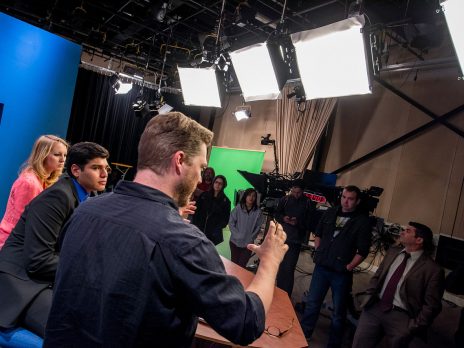
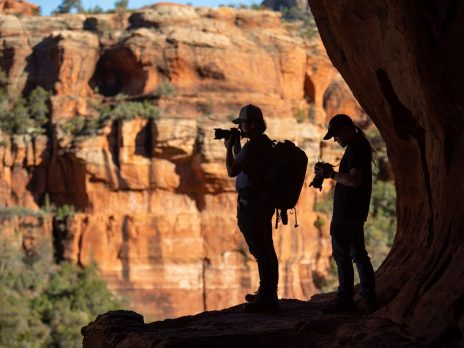
Learn by Doing. Report from the Field.
Sports media is about more than covering the final score. It's about capturing human stories, documenting defining moments, and connecting audiences to the people, places, and experiences that shape the world of sports.
At NAU, students gain hands-on experience in the School of Communication's Media Innovation Center, developing professional storytelling skills in a collaborative, multimedia environment.
Broadcast & Production
Anchor and produce sports segments, report from the sidelines, and help create television coverage through NAZ Today and other student media productions.
Sports Journalism
Develop reporting, interviewing, writing, and multimedia storytelling skills through sports recaps, athlete profiles, feature stories, and coverage for The Lumberjack.
Radio & Digital Media
Produce live sports coverage, host sports talk programming through KJACK Radio, and develop content for digital and social media audiences.
Real Experience. Real Opportunities.
Students gain experience covering high school, collegiate, and professional athletics while learning to work under deadlines, collaborate with production teams, and develop professional media portfolios.
Previous NAU sports media students have covered major sporting events, including the Super Bowl, NCAA men's basketball Final Four, NBA, Major League Baseball, and NASCAR championship weekend.
Northern Arizona's remarkable landscapes also create opportunities to explore outdoor adventure storytelling, documentary production, photography, and field reporting.
Award-Winning Student Media
NAU sports media students have earned recognition for their reporting, broadcasting, and production work at regional and national levels.
- Multiple top-10 finishes in the Jim Nantz Award competition recognizing outstanding collegiate sportscasters.
- Regional Emmy recognition for student media production.
- First-place awards in the Broadcast Education Association Festival of Media Arts.
- National recognition for the Media Innovation Center's sports media program.
These accomplishments reflect a learning environment where students can develop professional skills, build portfolios, and gain valuable experience before graduation.
About the Certificate
The Sports & Adventure Media Undergraduate Certificate is a 15-credit program combining journalism, sports reporting, media production, and practical professional experience.
Coursework includes sports journalism, reporting, and elective options that support specialized interests in media, athletics, and adventure storytelling. The certificate may be completed alongside a degree or as a standalone credential.
Note: Federal financial aid cannot be used for this certificate when completed as a standalone program. Consult the current NAU Academic Catalog and your academic advisor for complete requirements and eligibility.
Where Can Sports Media Take You?
Graduates can pursue opportunities across broadcasting, journalism, digital storytelling, sports communication, and media production.
Discover Sports & Adventure Media at NAU
See how students develop their skills through hands-on media production, sports coverage, and storytelling.
Get Involved
Interested in sports broadcasting, journalism, or adventure storytelling? Learn how the certificate can complement your degree and help you gain professional media experience.
Program Contact
Rory Faust
Rory.Faust@nau.edu
Follow NAU Sports Media
Instagram
|
X / Twitter