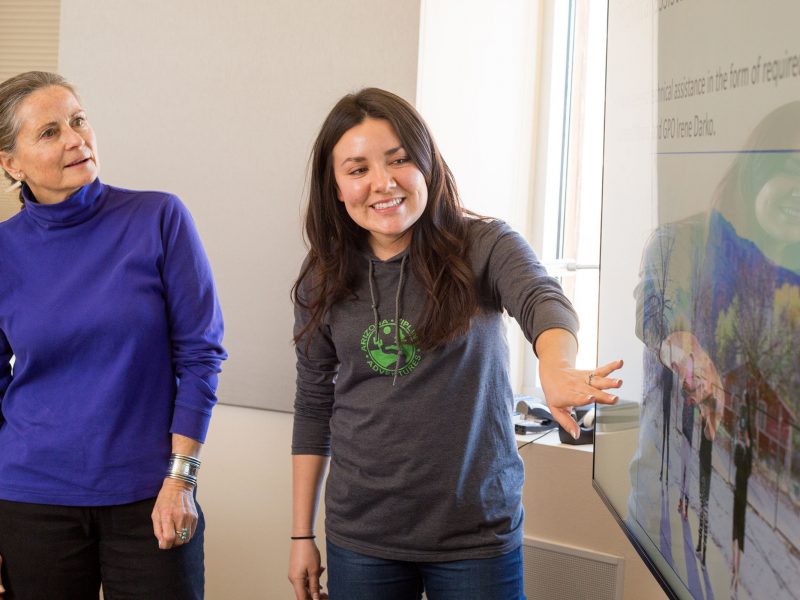
 Amanda Hunter is the first NAU postdoc to receive an NIH Pathway to Independence Award
For Amanda Hunter, an Indigenous scholar from the Pascua Yaqui Tribe, empowering American Indian teens to embrace their cultural values and practices has been her mission as a graduate student and now as a postdoctoral scholar for the Center for Community Health and Engaged Research (CHER).
During the years in which she was earning her master’s and doctoral degrees, the rising public health leader built a new program, Native Spirit, with the Arizona-based, Native Nation Boys & Girls Club. Native Spirit is an innovative, resilience-building program developed in partnership with community members.
Together, these clubs and Hunter built their positive youth development program that serves 30 Indigenous adolescents, ages 9-18, at three Boys and Girls Clubs in two Arizona Native nations, one rural- and one urban-based.
Hunter recently received a prestigious National Institutes of Health Maximizing Opportunities for Scientific and Academic Independent Careers (MOSAIC) K99-R00 award, called a Pathway to Independence Award, which will assist her in expanding and supporting Native Spirit. She is the first postdoctoral scholar at Northern Arizona University to receive a K99-R00 for her work titled, “Native Spirit: Culturally-grounded Substance Use Prevention for Indigenous Adolescents.”
“We are so proud of Dr. Hunter for receiving this award; it’s an outstanding accomplishment and a testament to her hard work and dedication as a young scholar,” said Regents’ Professor and CHER director Julie A. Baldwin. “This award will help Amanda become an independent researcher while also making very important contributions to the health and well-being of Native youth. It’s an honor to be one of her mentors. We are so excited for her and so grateful to have her working with us in CHER.”
Hunter will have eight mentors through the K award; the NIH will choose four, and she has already selected four scholars who are leaders in Indigenous health.
Hunter’s mentors are Baldwin; Nicolette Teufel-Shone, associate director of CHER and professor in the Department of Health Sciences; Nancy Whitesell associate professor at the University of Colorado Centers for American Indian and Alaska Native Health and the Department of Community and Behavioral Health Indian Center and co-director of the Colorado School of Public Health’s Native Children’s Research Exchange (NCRE) and the NCRE Scholars program, mentoring early career Indigenous researchers; and Melissa Walls, director of the Great Lakes Hub for the Johns Hopkins Center for American Indian Health and associate professor of International Health at the Johns Hopkins Bloomberg School of Public Health.
“Each of the mentors I asked has different areas of expertise that will help me to be successful in my proposed research,” Hunter said. “Additionally, each of my mentors has extensive experience working on research in collaboration with Indigenous communities.”
The K award also gives her financial stability—a rare boon for a postdoc. The award guidelines require her to transition into an assistant professor position during her last three years to enhance her career.
“I will have the funds to continue growing the Native Spirit program with Indigenous communities, and that’s very exciting for me,” Hunter said. “When I first started with Native Spirit as a graduate student, I applied for small grants and scholarships and paid for things on my own to keep the program going. I’m grateful to all of my community partners, my mentors, and NIH for trusting me to continue growing this program.”
Developing Native Spirit through committed mentoring and collaboration
Hunter said that Teufel-Shone introduced her to the Native Spirit project for her master of public health internship when both were at the University of Arizona.
“Dr. Teufel-Shone worked with this community for decades,” Hunter said. “The Boys & Girls Club in this community reached out to her to find a student that was interested in getting the project going.”
Hunter said her MPH research was her first experience working with an Indigenous community in a research capacity. She continued to develop her research skills by expanding the Native Spirit program for her doctoral research in 2018.
The results from research published in Hunter’s dissertation, “Native Spirit: Development of a Culturally Grounded After-school Program to Promote Well-being Among American Indian Adolescents,” showed increases in youth resilience, cultural identity, and self-esteem since the program began.
Through the 1.5 hours a week, 13-week Native Spirit program, students learn important values such as responsibility, teamwork and service from cultural knowledge holders in their community.
These leaders teach their students the language, traditions, cultural identity, creation stories and other history while illustrating the significance of respect, community, patience, growth, and recognition.
Activities include introducing themselves in their native language, storytelling, learning about their community’s history, developing personal responsibility through actions such as seed planting and cultivating respect for the land and other people through harvesting and gathering.
“Amanda’s developing expertise and commitment to the mental health of Indigenous adolescents is inspirational and will advance culturally grounded approaches to health promotion,” Teufel-Shone said.
The future of Native Spirit
Hunter’s main collaborators now include two tribal communities in Arizona. Within those tribal communities, she will work with the Department of Youth Services, four Boys & Girls Club locations and the staff of each of those departments.
“It would not be possible if my collaborators were not excited about the project, so really, they chose to allow me to work with them,” Hunter said. “I will also spend time speaking with traditional knowledge holders who have been involved with the program as session leaders to get their perspectives on the relationship between cultural engagement and health.”
Together, their goal for Native Spirit expansions is to tailor each one to fit the individual community and to monitor the program’s influence on cultural identity, self-esteem, resilience and substance use in its youth attendees.
Hunter said that Native Spirit has already expanded organically. One community started using the program in a juvenile detention center as a form of therapy or rehabilitation to prevent recidivism, and another community plans to use the program with teens and young adults involved in the justice system.
“That is something I did not expect at all but I am excited about the impact the program could make in that setting,” Hunter said.
In 2017, Hunter received a Certificate of Special Congressional Recognition from Congressman Raul Grijalva for service and commitment to Native Americans in cultural enrichment, community leadership and cancer prevention. Two years later, Hunter was named a Native Children’s Research Exchange Student Scholar, a position she will hold until 2022.
Her community service includes mentoring for the Native Student Outreach, Access, Resiliency (SOAR) program; and the American Indian & Indigenous Health Alliance. She is also co-founder of the Yaqui Student Alliance, and she has volunteered at the Boys and Girls Clubs of America, the Tucson Indian Center youth programs and as a soccer coach.