Think about two people moving a table together. Without saying much, or sometimes anything at all, they can adjust their movements, anticipate what the other person is trying to do and work together to get the job done.
Or think about dancing with a partner. A small shift in movement or pressure can communicate where you are going next.
These seemingly simple interactions point to a complex question: How do humans communicate information about movement through nonverbal cues, and could robots learn to do the same?
That is the question at the heart of a new three-year, $690,000 National Science Foundation (NSF)-funded research project led by Reza Sharif Razavian, assistant professor of mechanical engineering in NAU’s Steve Sanghi College of Engineering.
The project, which began Sept. 1, 2026, brings together researchers from NAU, the University of Delaware and UT Health to explore how robots can better understand a person’s movements, intentions and physical state using haptic information — essentially, information gathered through motion, touch, and force.
Teaching robots to understand humans
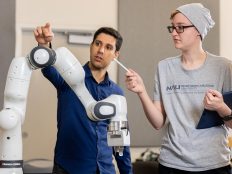
Today’s robots can perform increasingly sophisticated tasks, but physical interaction between people and robots remains challenging.
When humans work together, we naturally pick up on subtle physical cues. We can sense when a partner is changing direction, struggling with a task or preparing to move. We do much of this without consciously thinking about it.
Robots, however, generally need additional sensors, interfaces or large amounts of task-specific data to understand what a person is doing and what they intend to do. Razavian’s research seeks to change that.
The project will investigate whether a robot can estimate a rich range of a person’s sensorimotor states — from muscle activity to higher-level movement strategies — using only information gathered through physical interaction. The research combines biomechanics, neuroscience, robotics and control theory to create a computational model of how humans move and then use that model to help a robot interpret its human partner.
The long-term goal is a more natural form of human-robot interaction: rather than telling a robot what to do through a screen, keyboard or other interface, a person could communicate through movement and touch.
Razavian’s Raz Lab is already focused on bridging robotics, neuroscience and biomechanics to develop human-aware robotic systems that can respond to a person’s behavior, capabilities and limitations.
From human-to-human interaction to human-robot interaction
One of the most interesting parts of the project begins not with a robot, but with people.
Researchers at the University of Delaware will study how two humans communicate during physical tasks when one person knows the goal and the other does not. By examining how effectively the second person can infer their partner’s intentions and movement through physical interaction, the researchers can establish a human-level benchmark for the information that can be communicated through touch.
That information will then help inform the robotics work being conducted at NAU.
At NAU, Razavian and his team will use computational modeling to develop methods for a robot to estimate the human user’s state and intent and adjust its own actions accordingly. Dr. Mohammad Shourijeh at UT Health contributes expertise in modeling, while the University of Delaware team led by Dr. Joshua Cashaback brings expertise in human-human interaction and neuroscience.
The result is a genuinely interdisciplinary collaboration: each institution contributes a different piece of the puzzle, with the findings from human-human interaction informing the development of human-robot interaction.
That kind of collaboration is also reflected in Raz Lab’s broader research approach, which brings together biomechanics, motor neuroscience and robotics to better understand both human movement and robotic control.
Why NSF funding matters
The project is supported by the U.S. National Science Foundation, a federal agency that funds research and education across science and engineering. NSF specifically supports both fundamental research that advances knowledge and use-inspired research with the potential to create solutions that improve people’s lives.
NSF proposals undergo a formal merit-review process that considers both intellectual merit — the potential to advance knowledge — and broader impacts, or the potential benefits to society.
For this project, those two dimensions come together.
At the fundamental level, the researchers are asking questions about how humans control movement and communicate information through physical interaction. At the same time, the work could eventually inform technologies that help people interact with robots more safely and intuitively.
Potential applications include industrial robotics, where workers may physically collaborate with robots in complex environments, as well as assistive and rehabilitation robotics. For example, a future rehabilitation robot could potentially use information gathered through interaction to better understand a patient’s movement and adapt its assistance to the individual.
A research experience that reaches students
For NAU students, one of the most significant aspects of this project is the opportunity to participate in research happening at the forefront of robotics, neuroscience and biomechanics.
The project currently supports one Ph.D. student on the NAU team, who is leading the robotics and computational work. Razavian also plans to involve undergraduate students as resources and the project budget allow.
That involvement can take different forms, including volunteer research, paid research when funding allows or academic credit.
Razavian has structured undergraduate research opportunities around focused projects with clear beginnings and endings. Rather than asking an undergraduate student to tackle the entire open-ended research question, students can contribute to a specific piece of the larger project — gaining experience while working on a manageable research problem.
That approach gives students a chance to see what research actually looks like: asking questions, working through complex problems, contributing to a larger team and producing something they can point to as their own contribution.
And this isn’t new territory for Raz Lab. Students have previously worked on projects involving robotic rehabilitation, prosthetics and human-robot interaction, including undergraduate research presented at NAU’s Undergraduate Symposium and the NAU STEM Poster Session.
For students interested in engineering, robotics or research, experiences like these can connect classroom concepts to problems that researchers are still actively trying to solve.
Looking ahead
The project is just beginning. Over the next three years, the research team will work across the three institutions to better understand how humans exchange information through touch, develop computational methods for estimating human sensorimotor states and ultimately integrate those methods into a robotic control framework.
The team hopes to reach a first publishable research milestone within about a year, with additional results expected as the project progresses.
There is still a lot researchers don’t know — about how the human brain and body coordinate movement, how people intuitively understand one another during physical interaction and how those abilities might be translated into robotic systems.
For Razavian and his collaborators, that uncertainty is the point.
“Every researcher … [is] moving the field a little forward in understanding better this complex machinery,” Razavian said during a recent discussion of the project.
And at NAU, students have the opportunity to be part of that process — helping explore questions that don’t yet have all the answers.