Contact Information
Chris Moreno, Academic Program Coordinator
-
- (928) 523-8471
Western Region Graduate Program
Master of Public Health in Health Promotion – Online
The fully online Master of Public Health in Health Promotion is ideal for allied health and public health professionals interested in managing public health programs that address health behavior, disease prevention, and health equity. Students graduate with the ability to plan, implement, and assess public health programs.
The program includes online didactic coursework and applied practice experience in public health, along with the ability to tailor the program to align with students’ specific interests and career goals in public health. Our instructors and applied practice experience supervisors are dedicated to preparing students to serve the public health needs of the communities they serve.
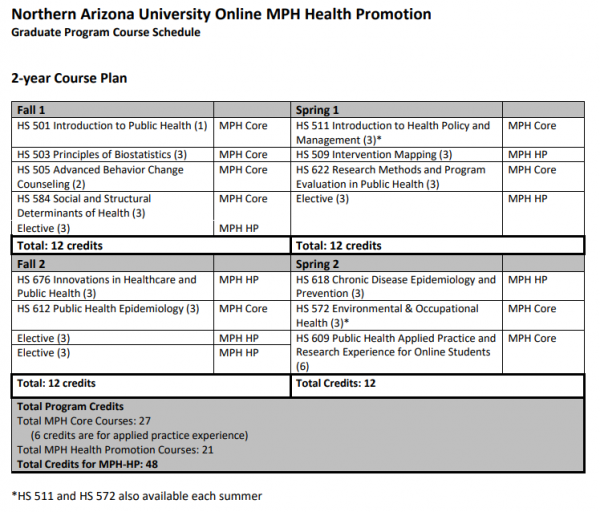
The online Master of Public Health in Health Promotion program prepares students for careers in a variety of public health areas. The MPH program can be completed in as little as 2 years, or stretched out and completed at a part-time pace.
Students progress through 9 core MPH courses, 3 concentration-specific courses, and 4 elective courses. Students also participate in a 6-credit applied practice experience and integrated learning experience at a public health agency in their area.
MPH core courses include topics in biostatistics, epidemiology, social and structural determinants of health, behavior change counseling, environmental health, health policy and management, and research methods and program evaluation.
Students also complete coursework in the health promotion concentration with topics in chronic disease epidemiology and prevention, innovations in healthcare and public health, and intervention mapping.
Students plan their coursework to meet personal learning objectives and career goals by completing four online electives from disciplines such as Anthropology, Fitness/Wellness, Nutrition, Psychology, Educational Psychology, Sociology, and Applied Indigenous Studies.
Courses include innovative uses of service learning activities, simulation, and case studies, so that students don’t just learn about public health, they learn how to apply these concepts into real world settings.
Mission
To train a highly qualified public health workforce through teaching, community service and scholarship to improve public health through practices, policy changes, leadership and management work, and creative interventions in Arizona with a focus on rural, tribal, and border communities.
Vision
To improve health, well-being and quality of life in Arizona with a focus on rural, tribal, and border communities.
Goals
1) Teaching goal:
Provide students with hands-on learning experiences, mentoring, and opportunities for leadership development to promote health equity, the needs of marginalized communities, tribal communities and/or rural communities.
2) Community service goal:
Work with community partners to identify and address public health needs and provide students with opportunities to gain hands-on experience in community-based projects; Support partnerships that engage students, staff and faculty in community service and provide expertise to support community organizations in meeting the needs of regional populations.
3) Research goal:
Engage faculty, staff and students in scholarship partnerships with public health agencies and community partners to address regional public health needs; Conduct research and provide students with opportunities to work on research related to health equity.
4) Student-focused goal:
Train students to become culturally immersed, aware, knowledgeable, and skillful public health practitioners.
A Master of Public Health degree provides graduates with the opportunity to improve the health and well-being of their community and beyond. Public health professionals explore public health challenges and propose solutions that are specific to the population affected. They conduct community needs assessments, develop and implement public health programs to address those needs, and evaluate the programs to determine effectiveness.
A graduate degree in public health strengthens depth of knowledge and builds competence in the skills necessary to be effective in the public health field. More experience and graduate degrees lead to higher salaries within the public health field. Employees with MPH degrees often manage public health programs, staff, and budgets.
Public health careers typically fall into one of the following six categories:
- Food, nutrition, and health (visit our MPH Nutrition program site, for more information)
- Health leadership and management
- Epidemiologic and biostatistical methods for research
- Global environment sustainability and health
- Health systems and policy
- Aging and public health
Check out this list of 100 career ideas in public health and careers and public health and salaries.
Baccalaureate degree. Applicants must hold a baccalaureate degree from a four-year college or university, or its international equivalent with a 3.0 GPA or better in any subject. The baccalaureate degree can be in any subject.
Required pre-requisite courses
Prior to applying please complete the following pre-requisite course:
1 semester of an intro or basic statistics course.
Students who have not completed the pre-requisite course prior to submitting their application will still be considered for the program as long as the applicant can demonstrate proof of enrollment in the course. (Upload a screenshot demonstrating course enrollment to the application.)
Students with an outstanding pre-requisite course must demonstrate that they completed the course with a C or better prior to the start of the program. Students will be dropped from the program if the pre-requisite course is not complete, or if a C or better was not earned, prior to the start of the program.
A pre-requisite course completed more than 10 years prior to the application deadline may need to be retaken.
Each year, for admission to the program in the following Fall, the priority deadline is January 15th. If a student applies by January 15th, they should expect to hear back by the end of February. If any places in our programs remain after the applications are considered that met the priority deadline then applications that are submitted between January 16th and April 1st may be considered to fill any remaining openings. If a student applies between January 16th to April 1st, they should expect to hear back by the beginning of May. International applicants: Applications submitted after January 15 will not be evaluated for admission, please apply to the next available admission term.
The online MPH Health Promotion program can be completed full-time in 2 years, or spread out over a longer period of time at a part-time status.
To apply, visit the SOPHAS website to start the NAU MPH application. The application opens on August 12th. The priority application deadline is January 15th. Applications that are submitted between January 16th and April 1st may be considered to fill any remaining openings. Questions? Contact us at (928) 523-8471 or email christopher.moreno@nau.edu.
Program cost
Tuition
Learn more about up-to-date tuition, fees, and estimated living expenses for all NAU graduate programs.
Financial aid
The NAU Office of Scholarships and Financial Aid can help students apply for Direct Unsubsidized Loans.
Scholarships, fellowships and awards may also be available. Visit the Office of Graduate and Professional Studies website and hover over Resources in the navigation bar for more information.
Graduate assistantships are typically not available for online graduate students. Learn more about current assistantship openings.
Students will be placed in a single public health site or agency for their 6-credit course that will include an Applied Practice Experience (internship) and an Integrated Learning Experience project designed to benefit the agency. Students are eligible to complete the HS 609 course once they have completed a minimum of 75% of their MPH core courses.
Students are required to complete extensive paperwork requesting permission to enroll in HS 609 at least 1 semester prior to the semester they wish to enroll in the course. The documents the student is required to fill out prior to the Applied Practice Experience and Integrated Learning Experience invite the student to carefully think through the type of experience that will best align with their career goals, preparing them for work in the public health field.
Students will be able to select an agency they wish to work with or ask for assistance from the Academic Program Coordinator, Intermediate to find an agency that aligns with their career goals and interests. The Academic Program Coordinator, Intermediate contacts an agency representative to ask if they are willing to take an intern.
Once a site has been identified and permission has been granted from the agency overseeing the Applied Practice Experience and Integrated Learning Experience, the student works with their agency preceptor to select at least three CEPH core competencies and two additional CEPH core competencies or MPH-Health Promotion competencies they wish to achieve for their Applied Practice Experience while working with the agency. Students also select at least 3 CEPH competencies to work on integrating in their Integrated Learning Experience.
During the semester that the student completes the 6-unit Applied Practice Experience and Integrated Learning Experience, students complete pre-planned tasks and deliverable products to demonstrate attainment of and integration of their selected CEPH competencies.
You can work with public health agencies in your geographic region, such as your local health department, or if you live in Northern Arizona consider the following agencies:
- Coconino County Public Health Department
- Flagstaff YMCA
- Pinnacle Prevention
- Native Americans for Community Action
- North Country Healthcare
Q: Is this program offered online?
A: Yes, this is an online program.
Q: Do I need to have an undergraduate degree in public health to be eligible for this program?
A: No, your bachelor’s degree can be in anything. The only requirement is that you have a bachelor’s degree and that you have taken an intro/basic undergraduate-level statistics course (or passed the AP Statistics Exam).
Q: How many hours of public health experience is required to apply?
A: None. While gaining experience in public health prior to applying will certainly help you determine your fit within the profession, public health experience is not a requirement to apply.
Q: How do you evaluate applicants? What do you look for in applicants?
A: Applicants are evaluated based on their GPA; writing ability (as demonstrated in the personal statement); general fit for the program based on career goals and interests; previous experience managing multiple commitments along with evidence of initiative and self-discipline necessary for online programs; interest, experience and readiness to serve underserved communities; and letters of recommendation.
Q: Can I count previous courses taken from other institutions towards my degree?
A: Up to 9 credits may be transferred from another master’s degree, however, these requests must go through several levels of approval and stipulations apply. Learn more about the university policy regarding graduate course transfers.
Q: Are there assistantship opportunities or other opportunities for funding?
A: Typically online graduate students are not eligible for graduate assistantships within the department, although students should check with the program director about possible funding opportunities. Indigenous students typically apply for scholarships through their tribal communities. Once accepted into the program, the MPH program director can provide the tribal community with necessary documentation for proof of enrollment in the program. For information about financial aid and NAU scholarships, visit the Office of Graduate and Professional Studies webpage. Click on “Resources” to view a list of financing options. In addition, there are many external groups who provide scholarships for Native American students, such as the American Indian Graduate Center.