Contact information
Dawn Clifford, Program DirectorJosie Carter, Program Coordinator
- jocelyn.carter@nau.edu
- 928-523-9190
Western Region Graduate Program

Master of Public Health, Nutrition
Become a Registered Dietitian with NAU’s Master of Public Health, Nutrition Program
Learn from people with real experience. All nutrition courses in this program are taught by Registered Dietitians.
The MPH Nutrition Program at NAU is a 24-month residential program that integrates graduate courses in public health and dietetics along with supervised experiential learning, preparing graduates for eligibility to become Registered Dietitian Nutritionists (RDNs).
Our small cohort model allows faculty to get to know students individually and support their unique interests and career goals. Students can explore their interests through coursework, projects, research, and supervised experiential learning while developing public health skills that are valuable across diverse areas of dietetics practice.
Through applied coursework, simulation, service learning, and experiences with nutrition and public health organizations throughout Northern Arizona, students learn to approach nutrition from both individual and population health perspectives and apply what they learn in real-life settings.
Mission
The mission of the NAU Master of Public Health Nutrition program is to prepare graduates, through learner-centered educational strategies, research, and public service, to practice as Registered Dietitian Nutritionists who support the advancement of population health and the prevention of disease for diverse, underserved communities.
Vision
The MPH Nutrition program’s vision is to advance population health and achieve global health equity through education, research, and public service.
Degree and GPA
- Bachelor’s degree from an accredited four-year college or university, or international equivalent
- Have a cumulative undergraduate GPA of 3.0 or higher*
*Applicants with a cumulative GPA below 3.0 may still be considered. The MPH Nutrition program uses a holistic admissions process and considers factors such as GPA in the most recent 60 credit hours, upward academic trends, relevant work and life experiences, and overall readiness for graduate study.
Prerequisite courses
Applicants do not need an undergraduate degree in nutrition or dietetics. However, the following prerequisite courses must be completed:
- Introductory nutrition
- Introductory statistics
- General chemistry
- Organic chemistry
- Anatomy and physiology
- Microbiology
- Biochemistry (must be taken before Spring of first year in program)
- Food safety and sanitation (or ServSafe certification)
Applicants who are completing prerequisite coursework at the time of application may still apply and should provide documentation of enrollment in any remaining prerequisite courses
Special Opportunities for NAU Undergraduates
We love our NAU undergrads! We offer several benefits to help current NAU undergraduate students take the next step toward becoming Registered Dietitian Nutritionists.
- Guaranteed interviews: NAU undergraduate students who meet the minimum GPA and prerequisite course requirements are guaranteed an admissions interview.
- Reserved spots: Four spots in each incoming cohort are reserved for competitive NAU Nutrition undergraduate applicants who submit a letter of recommendation from an NAU Nutrition faculty member. These reserved spots are not a limit on NAU student admissions! Additional qualified NAU Nutrition students may be admitted, and we welcome applicants from all undergraduate majors.
- Simplified application: NAU undergraduate students only need to submit the NAU Office of Graduate and Professional Studies (OGPS) application. A separate DICAS application is not required.
The MPH Nutrition program follows a 24-month cohort model, with coursework intentionally sequenced to build students’ skills in public health, nutrition, and dietetics before they begin full-time supervised experiential learning rotations.
While students follow a shared course sequence, there are opportunities throughout the program to pursue individual interests through applied projects, research, the Integrated Learning Experience, and supervised experiential learning.
Supervised experiential learning
Supervised experiential learning (SEL) is integrated throughout the program through classroom-based simulation, applied projects and experiences with nutrition and public health organizations. During the final six months of the program, students will complete full-time rotations in:
- Clinical nutrition: 8 weeks
- Foodservice management: 5 weeks
- Public health nutrition: 4 weeks
- Elective: 2 weeks
Rotation experiences are available in Flagstaff and communities throughout Arizona, including opportunities to gain experiences in rural and tribal communities. Students share their interests and preferences prior to rotations, and the program works to connect students with experiences that support their professional goals when possible.
Rotation partners
Recent and current rotation partners include organizations such as:
Clinical nutrition
-
- Flagstaff Medical Center
- US Renal Care
- Summit Healthcare
- Verde Valley Medical Center
- Tuba City Regional Health Care
- Whiteriver Indian Hospital
Foodservice management
- Aspire Transitional Care
- Coconino County Senior Services (Congregate Meals/Meals on Wheels)
- Flagstaff Medical Center
- NAU Campus Dining (Sodexo)
- Flagstaff Unified School District
Public health nutrition
- Coconino County programs (WIC, Senior Services)
- AM Nutrition
- Winslow Indian Health Care Clinic
- Pinnacle Prevention
- Flagstaff Family Food Center
- Flagstaff Office of Sustainability
- Flagstaff Community Market
- Inspire
- Native Americans for Community Action
- Evolve Nutrition
Elective Experience
The two-week elective rotation gives students additional flexibility to explore an area of dietetics that aligns with their individual interests and career goals. Students may use this experience to explore a specialty area, gain experience in a setting they have not previously encountered, or extend their time in an area of particular interest. Past elective experiences have included areas such as sports nutrition, oncology, pediatric nutrition, bariatrics, and eating disorder care.
Rotation sites vary from year to year based on availability and student learning needs
Integrated learning experience
The Integrated Learning Experience (ILE) is a culminating graduate project that allows students to integrate public health competencies with an area of professional interest. Students begin developing their project during the first year of the program and partner with a public health or community organization to address a real organizational or community need.
Students work with a Health Sciences faculty mentor throughout the process and have flexibility to develop a project that aligns with their interests and professional goals. The ILE culminates in a written product and presentation at the MPH Conference.
Recent student projects have included developing a nutrition box program proposal focused on diabetes and hypertension prevention for a rural and Indigenous-serving clinic; assessing nutrition and breastfeeding needs among participants in a local doula organization; evaluating RED-S prevalence and nutrition interventions within a collegiate athletics program; and researching the use of chatbots to train health coaches to identify potential eating disorders and disordered eating patterns.
Applied practice experience
The Applied Practice Experience (APE) is completed as part of the public health supervised experiential learning rotation. Students work with their rotation organization to develop practical deliverables that address an identified organizational or community need while demonstrating attainment of required CEPH public health competencies.
APE projects provide students with hands-on experience applying public health skills while creating products that are useful to the organizations and communities they serve.
Applications for the MPH Nutrition program open in the fall for admission the following fall. January 15 is the priority application deadline. Applications may be submitted through April 1 and will be considered if space remains available.
The admissions committee begins reviewing applications and conducting interviews in November, with some admission offers extended before January 15. Because we typically fill our available spots from applicants who apply by the priority deadline, we strongly encourage students to apply early.
How to apply
Applicants must submit two applications:
- NAU Office of Graduate and Professional Studies (OGPS)
- Dietetics Centralized Application Services (DICAS)*
*Exception for NAU undergraduates: Current NAU undergraduate students only need to complete the NAU OGPS application. A separate DICAS application is not required.
Application materials
Applicants should be prepared to submit:
- Resume or CV
- Personal statement (1–2 pages) describing:
- Academic and professional interests in health, nutrition, and wellness
- Professional goals
- How the NAU MPH Nutrition program aligns with those goals
- Supplemental DICAS essay (200–250 words): Describe your understanding of public health, why public health knowledge and skills are important for dietitians, and how earning an MPH would enhance your abilities as a dietitian.
- Official transcripts from all colleges and universities attended
- Three letters of recommendation:
- At least one from a faculty member
- At least one from a supervisor or manager
- The third from either a faculty member or supervisor/manager
- Documentation of prerequisite coursework in progress, if applicable
- ServSafe certification, if used to meet the food safety and sanitation prerequisite
The GRE is not required and is not considered in the admissions process.
Interviews and admission decisions
Selected applicants are invited to a 30-minute virtual interview. Interviews are conducted on a rolling basis, generally from November through February.
Admission decisions are also made on a rolling basis. Some applicants may receive an offer shortly after interviewing, while others may remain under consideration as the admissions committee reviews additional applications.
In accordance with ACEND Dietetics Applicant and Program Traffic Rules, applicants who receive an offer of admission are not required to make a decision before March 10th.
Learn more about the ACEND Dietetics Applicant and Program Traffic Rules.
International applicants
International applicants must submit a complete application by January 15.
International applicants must also meet NAU’s graduate admission and English language proficiency requirements, unless eligible for an exemption. Visit NAU’s international graduate admissions webpage for current requirements.
Program cost
Tuition and fees vary based on residency status and other factors. For the most up-to-date information, visit NAU’s graduate tuition and fees webpage, which also provides estimated living expenses.
Students from participating Western states may qualify for reduced tuition through the Western Regional Graduate Program (WRGP).
Financial aid and funding opportunities
Several funding opportunities may be available to help students offset the cost of graduate education.
Graduate assistantships
A limited number of graduate assistantships may be available to MPH Nutrition students. These positions are highly competitive, and typically only 1–3 students in each cohort secure an assistantship. Students should plan to finance their education without relying on a graduate assistantship.
Past positions held by MPH Nutrition students have included:
- Wellness initiatives through Campus Health and NAU Campus Dining
- NAU Athletics
- Employee Assistance and Wellness
- Graduate research assistantships with NAU faculty
Additional opportunities, such as positions with Louie’s Cupboard and other departments across campus, may also be available. Students are encouraged to explore NAU’s university-wide graduate assistantship postings.
Availability varies by year and depends on departmental needs and funding.
Scholarships and financial aid
Students are encouraged to explore scholarships and funding opportunities through:
- NAU Office of Scholarships and Financial Aid: Information about federal student loans, financial aid, and scholarships available through ScholarshipUniverse.
- NAU Office of Graduate and Professional Studies: Additional scholarships, awards, and funding opportunities specifically for graduate students.
- Academy of Nutrition and Dietetics Foundation: Scholarships for students pursuing careers in nutrition and dietetics (Note: Must join as a member to be eligible to apply for scholarships).
Support for rural and tribal rotations
Funding opportunities may be available to help offset travel, housing, and other expenses associated with supervised experiential learning rotations in rural and tribal communities. Eligibility and funding availability vary by placement and year.
Loan repayment opportunities
Graduates who work in eligible healthcare settings may qualify for student loan repayment programs. The Indian Health Service (IHS) Loan Repayment Program offers up to $50,000 in repayment of qualifying educational loans in exchange for an initial two-year service commitment at an eligible Indian health facility.
Several of our supervised experiential learning rotation partners are eligible IHS Loan Repayment Program sites and have hired MPH Nutrition graduates, providing opportunities to explore potential career pathways while completing the program.
Learn more about the IHS Loan Repayment Program.
The MPH Nutrition Program is an accredited Graduate Program in Nutrition and Dietetics by the Accreditation Council for Education in Nutrition and Dietetics (ACEND). Upon completion of the program, graduates are eligible to sit for the Registered Dietitian Nutritionist Examination. Contact information for ACEND: 120 South Riverside Plaza, Suite 2190, Chicago, IL 60606-6995. 800/877-1600, ext. 5400. 312/899-0040. Fax: 312/899-4817. acend@eatright.org. www.eatrightpro.org/acend.
While the state of Arizona does not currently have licensure for registered dietitian nutritionists, we understand that you may end up moving out of state following completion of our program. For more information on licensure in other states for the Health Sciences MPH in Nutrition, view NAU’s Professional Licensure by State. While state interpretations of statutes may vary, it is ACEND’s considered opinion that the program meets the educational requirements for dietetics licensure and certification in all states. However, completing an ACEND-accredited academic program alone does not qualify an individual for licensure or certification as a dietitian in any state. Individuals should review their state’s licensing statutes and regulations to understand the specific requirements, including supervised practice and examinations, needed to obtain a dietetics license. Learn more about state licensure and certification.
Q: Is this program offered online?
A: No. The majority of courses are taken on the Flagstaff Mountain campus and courses are typically Monday-Thursday in the afternoon and/or evening. Supervised experiential learning rotations – completed in the final Spring and Summer semesters – are also located in Flagstaff and surrounding communities. However, the following courses in the summer and during supervised experiential learning rotations are provided as asynchronous online courses: HS 511, HS 572, HS 698, NTS 657.
Q: Will I be eligible to sit for the RD exam when I am finished with this program?
A: Yes. Once the program is completed and all competencies have been passed, you will be eligible to sit for RD exam through the Commission on Dietetic Registration (CDR). Verification statements and test eligibility will be issued after the degree is conferred by NAU.
Q: Do I need to have an undergraduate degree in nutrition or dietetics to be accepted into this program?
A: No! We welcome applicants from all undergraduate majors. Applicants must have a bachelor’s degree and complete the required prerequisite coursework before beginning the program. See Admission Requirements for details.
Q: How do I determine if a course I took will “count” as a pre-requisite course?
A: If the course was a college-level course taken at an accredited university and the title of the course is similar to the titles of our pre-requisite course requirements, then chances are good that the course will “count” as a pre-requisite. If you have any concerns or questions about a specific course, contact the program coordinator at jocelyn.carter@nau.edu and include the course number, institution, and course description in your email.
Q: I’m having a hard time finding the food safety and sanitation pre-requisite course at my local community college. Any suggestions?
A: You may take a ServSafe course online and sit and pass the ServSafe exam in lieu of taking a college level food safety and sanitation course. Please upload the ServSafe certification in your application.
Q: How many students do you accept into your program each year?
A: We typically admit 12 students each year. Our small cohort model allows for individualized faculty support and opportunities to get to know your classmates throughout the program.
Q: Do you accept students into your program in the fall to start in the spring?
A: No. The MPH Nutrition program follows a cohort model, with a new class beginning each fall.
Q: If I miss the priority deadline of January 15 will you still have openings?
A: Yes! January 15 is our priority application deadline, but applications may be submitted through April 1 and will be considered if space remains available. We begin reviewing applications and conducting interviews in November, with some admission offers extended before January 15. Because we typically fill our available spots from applicants who apply by the priority deadline, we strongly encourage applying early.
International applicants must apply by January 15.
Q: How do you evaluate applicants? What do you look for in applicants?
A: Applicants are evaluated based on their GPA; writing ability (as demonstrated in the personal statement); general fit for the program based on career goals and interests; previous experience managing multiple commitments; interest, experience and readiness to serve underserved communities; and letters of recommendation.
Q: Do you consider applicants with GPAs lower than 3.0?
A: Yes, we will still be able to review your application. We have a holistic approach to reviewing applicants, meaning that we consider life and work experiences, writing abilities, and overall fit for the program, and not just overall GPA. We also look at GPA of the last 60 units and general grade trajectory. Students with inconsistent grades in their last few semesters of their undergraduate program will likely not receive interviews. Note: International applicants cannot be considered if they have a GPA lower than 3.0
Q: Do you interview applicants? If so, how many do you interview?
A: Yes. Selected applicants are invited to a 30-minute virtual interview. Interviews typically take place from November through February, with admission decisions made on a rolling basis.
Q: If my undergraduate degree is in nutrition and dietetics, will I be able to skip out on taking some of the courses you have in the course plan which are similar to courses I’ve already taken?
A: No. The NAU program uses different accreditation standards than your undergraduate program and therefore you must take all courses on the course plan as listed regardless of previous coursework.
Student Spotlight
Brittany Dawn Jim
Learn more about Brittany, a class of 2025 Nutrition alum.

Marco Cazzato
Learn more about Marco, a class of 2028 Nutrition student.
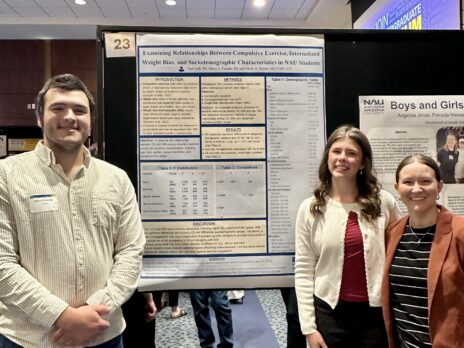
Rachel Negovan
Learn more about Rachel, a class of 2028 Nutrition student.