April 17, 2026
Spotting the Signs: Making Rocky Mountain Spotted Fever Information Accessible
A Conversation with Dr. Nathan Stone and his research team
This month we’re observing National Health Literacy Month, a time dedicated to emphasizing “the importance of making health information clear, accessible, and actionable.” For his SHERC Pilot Project, Dr. Nathan Stone and his team – Elizabeth Franks, Heidi Stevens, and Katie Francesconi – work to understand and map how Rocky Mountain spotted fever looks and moves within rural communities across Arizona.
About the Researchers
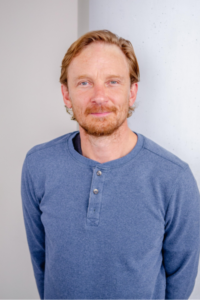
The project brings together a team of researchers operating throughout the research process: collecting and analyzing tick DNA, developing new methods, and mentoring the next generation of scientists. Nathan Stone, assistant research professor in NAU’s Department of Biological Sciences and the project’s principal investigator, guides the scientific direction of the work while leading technique development, undergraduate training, and dissemination.
Undergraduate researchers Heidi Stevens and Katie Francesconi help substantially throughout the research process. Heidi is developing and testing a genetic fingerprinting system for brown dog ticks, helping the team trace how tick populations move Rocky Mountain spotted fever (RMSF) across Arizona. Katie focuses on understanding other aspects of the ticks’ DNA, contributing to the genetic analyses that make this tracking possible.
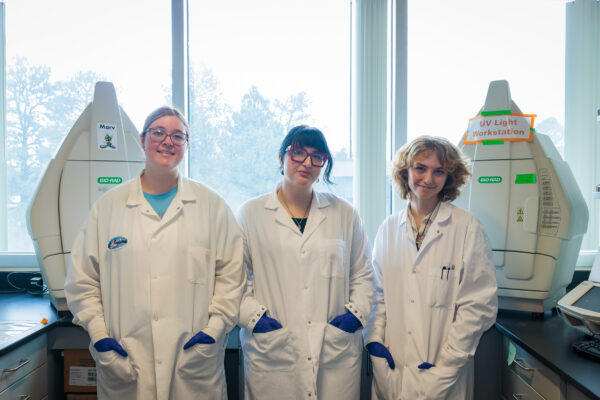
Elizabeth Franks, the project’s research technician, works alongside Heidi and Katie to extract and prepare tick DNA for sequencing and RMSF detection. Elizabeth further serves as a mentor and teacher, helping undergraduate researchers build the laboratory skills and scientific knowledge needed to contribute meaningfully to the project. Together, the team is not only advancing our understanding of RMSF transmission but also creating hands-on opportunities for students to grow as researchers.
About the Research
Across the rural Southwest, Rocky Mountain spotted fever is an understudied public health challenge. Tribal communities are especially impacted and community-engaged approaches are important for addressing health concerns. Through his work, Dr. Nathan Stone contributes knowledge to improve disease control strategies for RMSF by examining and analyzing the movement patterns and distribution of its primary spreader: the brown dog tick. By examining local tick populations and disease presence within tribal communities, this Pilot Project works to improve prevention efforts in areas with higher rates of RMSF. Dr. Stone works in collaboration with San Carlos Apache Tribe and the Centers for Disease Control and Prevention (CDC),and is expanding his relationships with other tribal communities and public health agencies across the state of Arizona.
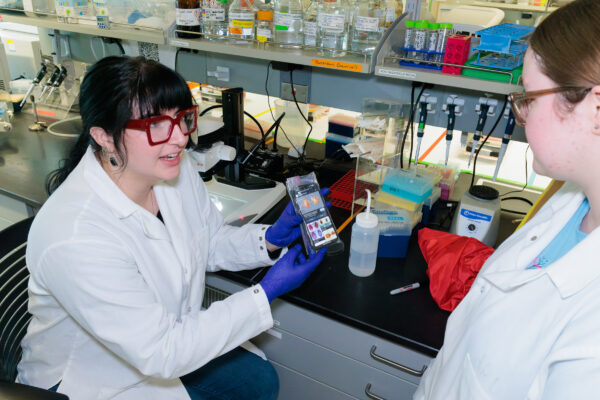
Understanding RMSF to Guide Action and Policy Changes
Heidi: Rocky Mountain spotted fever is a bacterial infection carried by ticks. While dogs host the ticks, ticks carry the bacteria and spread it to humans through tick bites. It can often be a pretty serious infection, especially if the infection isn’t caught early.
Nathan: The brown dog tick, the tick we’re focused on, bites dogs as its main source of food. Humans are incidental hosts and can get sick when they get a tick bite. Awareness is one of the biggest challenges; RMSF is treatable, but it has to be treated very quickly. Otherwise, it can become very serious and often fatal, especially in children.
Elizabeth: Our work focuses on looking at the very specific genetic information of the ticks. This gives us more information about the connection or relatedness of tick populations and the spread of disease, which will enable more focused prevention efforts and give more specificity in how prevention efforts can be applied across different communities. It also helps us understand if current prevention efforts are working or what might need to be improved.
Nathan: Because the disease is only transmitted through a tick bite, the best angle for prevention is eradicating or reducing tick populations. To do that, we’re using the genetics of the ticks to understand how they are moving around a community. If we understand how they’re moving – or not moving – we can better understand how prevention efforts are working. We screen all the ticks we collect for the bacteria that causes RMSF so we can also identify disease hotspots. If a specific tick population has a lot of RMSF, that could indicate a high-risk area. That information can be communicated to the communities to then guide changes in practices and policy.
Personal Research Motivations
The team weighs in on how they connect to their research on Rocky Mountain spotted fever.
Katie: I grew up in a really rural area and a lot of the reasons we’re doing this research resonate with me personally because there were a lot of undetected diseases in my community. Additionally, it was hard to get medical access for complex medical issues. I’m really excited about the work we’re doing.
Elizabeth: I have a slightly different perspective. A lot of my family is in the healthcare industry and I grew up hearing about their work that often included rural communities. I personally found that very motivating and I think emphasis on rural communities and trying to increase knowledge about areas that are understudied is really important. Growing up hearing about health and medicine from my family members helped me understand my own health and how to look after myself. I’m very excited to be able to connect with communities and help other people better understand their health.
Heidi: I have been enjoying this research on a multi-faceted scale. In one sense, it’s been fun to look at the genetics of the ticks and see the data we’re collecting about their spread and distribution. Additionally, my grandmother and other family members are from the area of Utah that’s just north of one community where we’re studying. Throughout my childhood I would pass by the area and I think it’s really interesting to connect with that side of my family through this research. It’s also fun and I appreciate the work that we do for these rural communities.
Nathan: From a scientific perspective, I love disease ecology* and understanding the full picture. If you’re focusing on the clinical side, you’re looking at how to treat or prevent a disease. If you’re focusing on the pathogen** you’re studying the organism that causes the disease. But I think it’s really cool to be able to understand the disease ecology more completely by also looking at the tick (the vector***) and the connection between communities. My scientific curiosity is very engaged in this project because of that. I’ve lived in Arizona since 1994 – my family moved here when I was younger and I had never heard of RMSF. We still don’t really hear about cases outside of these rural communities. That’s fascinating and horrifying all at the same time. It is definitely a disease that impacts specific communities, and as a health disparity, it’s really highlighted here. There’s a lot of unfairness in this disease, so being able to work on it and hopefully provide some insights that will help the communities that are most in need is very important. Understanding RMSF transmission and the disease ecology more holistically is really important so that we can tailor prevention methods and better understand the disease in general.
*Disease ecology: The study of how germs, hosts, and the environment interact to affect the spread, persistence, and evolution of infectious diseases.
**Pathogen: Commonly known as “germs.”
***Vector: A term in epidemiology: any living organism that can carry and transmit an infectious disease from itself to another host.
Community Collaboration and Engagement
Nathan and Heidi share how they partner with tribes and other organizations and share research findings with community members.
Nathan: Our tick collections come directly from several tribal communities. We have long-standing relationships with the San Carlos Apache Tribe and have been working with them since 2022. We’ve had several joint publications and work with the tribe directly to collect and disseminate* information. Another exciting part of this project is that it has connected us with other tribal communities. In addition to San Carlos, we’re now working with Hopi, White Mountain Apache, and starting to work with Navajo as well. We’re expanding our network and are able to work directly with community members and people that are working directly with animals and finding ticks. Through our research collaborations, we’re able to provide relevant information directly back to them.
We also share our work in community settings by reporting back to our community partners directly or in partnership with our CDC and academic collaborators at the University of Arizona. Additionally, we attend the annual RMSF meeting that occurs every year; this year it is in San Carlos. I’ve attended this meeting every year for the last three or four years to present results and engage with community members. Heidi had the opportunity to present recently as well.
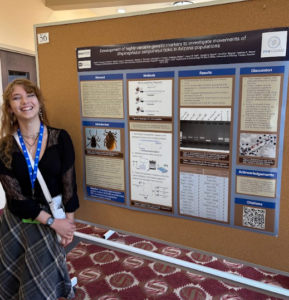
Heidi: I presented a poster on my research in April at the annual meeting for the Arizona branch of the American Society of Microbiology. The conference was held in Tuba City, which is on the Navajo Nation. It was an amazing opportunity to share the research we do and spread awareness of RMSF. It was really fun connecting with the members of the Navajo Nation, Hopi, and Diné College.
*Research dissemination: The intentional sharing of research information, study processes, and results. Research can be shared with other researchers, practitioners, and community members. The Fairness First Campaign is an example of research dissemination!
Team Building through Learning and Mentorship
Elizabeth: I have learned a lot from Nate. I didn’t know about RMSF when I first started, and it’s been interesting to learn about the disease and the techniques surrounding its study. Now I get to teach those same techniques to Heidi and Katie. It’s been nice getting to teach them; I’ve found that teaching has helped me understand our work and the disease even more and it’s been great seeing them grow the research skillset so quickly.
Katie: I love the research we’re doing. I came into research wanting to be a doctor, and throughout my mentorship with Elizabeth and others, I’ve realized that infectious diseases, especially these more unknown diseases – studying their genetics, their transmission patterns – are my passion. It’s really an amazing team that we have here. They’ve taught me so many skills within and outside of research.
Heidi: A lot of the time that I have spent here at the lab has been focused on this research project. There’s been a large learning curve for the number of things that I have learned, whether it be techniques, data analysis, primer design*, etc. I’ve appreciated Nate and Elizabeth and everyone we work with. It’s been really fun to be a mentee and learn all of these new techniques.
Nathan: One thing that the rest of the team will hopefully get to experience soon is doing the tick collections. I went out in the field with community members from the San Carlos Animal Control Team and CDC colleagues to learn how to do tick collections, see the landscape, and experience first hand the scope of the tick problem. That was very impactful. I learned a lot doing this type of field work and hearing the personal stories about the impacts of RMSF in the community. We’re also in discussions to bring some students from Diné College here to NAU to learn some of the techniques that we’re employing. Our goal is to share not only knowledge of the disease so people can protect themselves, but also to teach some of these research techniques to empower communities to do some of the collecting and testing themselves.
*Primer design: The process of creating a short, custom-made piece of DNA (called a primer) to help scientists find and copy a specific gene.
Actionable Science: Bridging the Health Literacy Gap this Health Literacy Month
Nathan: One way to share complicated information is by collaborating with community communicators. In our work, the CDC is great at this, and they do a lot of community education, including translating this type of work into flyers that they distribute in the community. When we were performing tick collections in San Carlos, we learned that the tribe had an emphasis on teaching children about ticks. They would have specific class material or discuss ticks during school sessions, teaching students what a tick looks like and how to check themselves for a tick. Translating research into simplified language and sharing it in accessible formats is something we like to do and others could do in their projects as well.
Elizabeth: I believe that it’s very important to not come across as condescending. You need to be able to provide information while still respecting who you’re giving the information to. Focusing not only on the data, but what to do about the data, why it matters, and how that can be of use to your regular non-specialist is very important as well. We’re obviously incredibly interested in genetics and very specific details, but people I’ve talked to in the community often talk about their dogs, or their dog that got sick, or their dog that died when conversations about managing dog tick populations come up. It’s important to understand why the research that matters to us matters to community members, and being able to cater to community members is crucial.
Katie: I’ve found that analogies are really useful. Nate talked about “DNA fingerprinting.” Everyone knows what a fingerprint is. Being able to translate our jargon-heavy work into something that’s understandable is really important, and metaphors and analogies are great ways to condense heavier topics into something more readily understandable.
Heidi: I also think analogies are beautiful. I love them. They’re my go-to when doing posters as well. I also use visual representations; graphs are very useful, especially if you give enough explanation of their context and meaning.
“It’s like you’re a detective:” Reflecting on Growth and Learning
The team reflects on their love of learning, problem solving, and exploring new ideas through research.
Elizabeth: I want to keep working in research. I love variety and problem solving. I have found I don’t like doing the same thing every day. I kind of like when things go wrong and I have to figure out new strategies and balance multiple things. New challenges pop up all the time and I really like that. It keeps me engaged.
Katie: I completely feel the same way. I also like that we’re learning more about why things happen. When I wanted to be a doctor, I thought it was really cool to understand the symptoms and to solve a diagnosis that way. But I’ve come to be more interested in learning why those symptoms happen, and why certain people get particular diseases. I like learning how the gears in the machine are working. I really love that part of research.
Heidi: What I like about research and what stands out to me is the idea that we’re creating new information. We don’t know the secret lives of ticks, but with this project we get to better understand how ticks inhabit an area and potentially spread disease.
Nathan: For me, it’s great to be getting paid to learn. As an investigator, it’s like you’re a detective – and that’s never boring. I’ve been doing this since 2009 when I started as an undergrad at this lab. It’s been 17 years and I have never once looked at the clock and said “When is my day going to be over?” I’ve only ever looked at the clock and thought “Shoot, I’m not going to have enough time to finish this analysis before I have to head out!” It’s an incredibly rewarding career.
Reach out to learn more!
Nathan Stone: Nathan.Stone@nau.edu
Elizabeth Franks: Elizabeth.Franks@nau.edu
Katie Francesconi: Kdf242@nau.edu
Heidi Stevens: Hes277@nau.edu
Interested in learning more about community health research at NAU?
Visit CHER’s social media for short stories that highlight SHERC researchers, students, lab spaces, and more! Look for “Fit it in a Minute” posts.


