Travel Updates
Current Travel Team Update Accordion Closed
November 2025
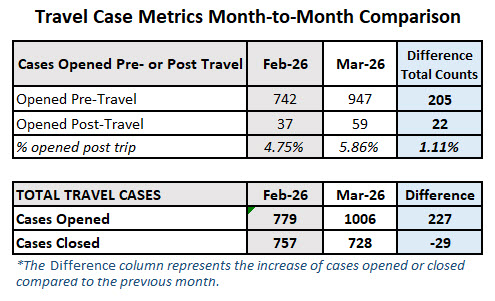
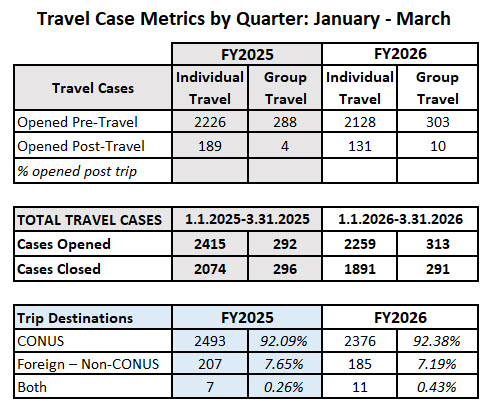
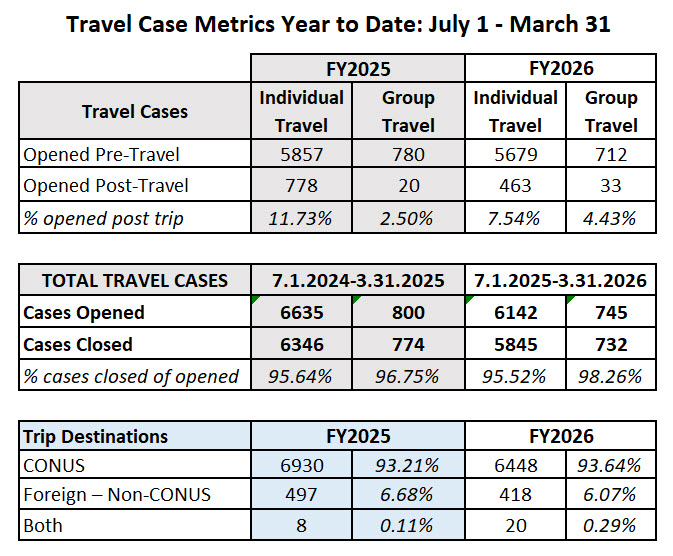
Travel Metrics
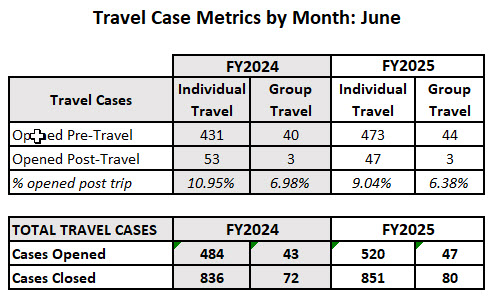
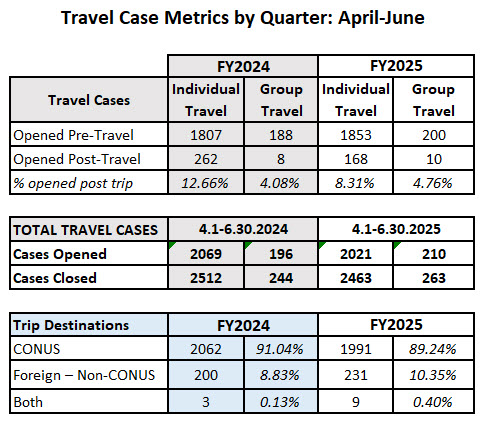
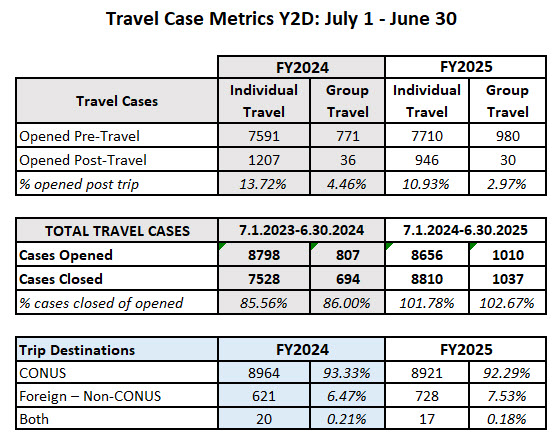
Metrics are grounded in data that is specific and measurable. In travel reimbursement cases we measure the case count, percentage, and duration from the time a case is submitted until it is closed. By tracking the previous fiscal year’s baseline, we are able to set goals for improvement.
Not all metrics have the necessary data to achieve the intended level of detail. Therefore, we are planning enhancements to expand the level of data available by implementing additional data points.
Planned Data Expansion Accordion Closed
We are planning data and system enhancements to capture additional measures. Examples include:
- Duration to Receive Documentation – This data point helps us understand how much time a case spends waiting for documentation to be submitted for a case in re-work status.
- Incomplete Submission – This helps us differentiate between cases with all the information needed to process vs. those without. The duration of a re-work case can differ significantly from that of a case with all information.
Travel Case Trends by Trip Type Over Time Accordion Closed
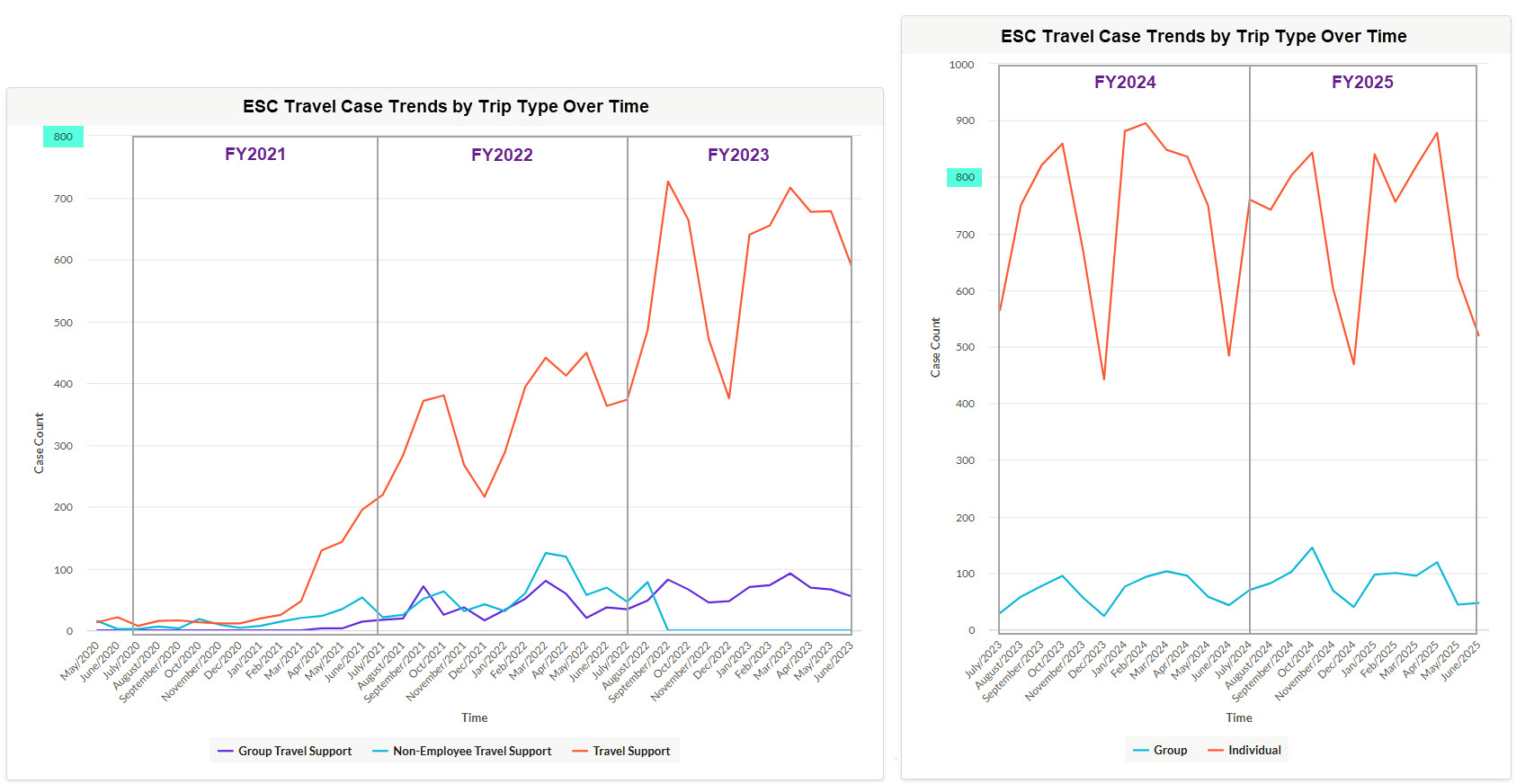
The above graph displays travel case trends by traveler’s classification over time.
Please note the following changes to ESC travel case types:
- Employee Service Center Travel Support Service went live March 19th, 2020.
- At go-live there were three service types: Group Travel Support, Non-Employee Travel Support, and Travel Support.
- Group Travel cases from March 2020 – June 2023 could be opened for employees, students, and community members or a combination of the three.
- Non-Employee Travel Support cases were for community members and non-employee students.
- Travel Support cases were submitted for NAU employees, including student employees.
- September 2022, fall of FY2023, the Non-Employee Travel Support service type was discontinued, leaving only two types of travel cases – Travel Support for individual travelers/trips and Group Travel, where all travelers are represented under one ESC case.
- At the start of FY2024, the Travel Support service became the only travel service type. However, we continue to categorize cases as individual or group travel.
- Also, effective July 1, 2023 – Group Travel cases are only for NAU students and/or community members. NAU employees (non-students), must have an individual case whether or not multiple travelers are attending the event.
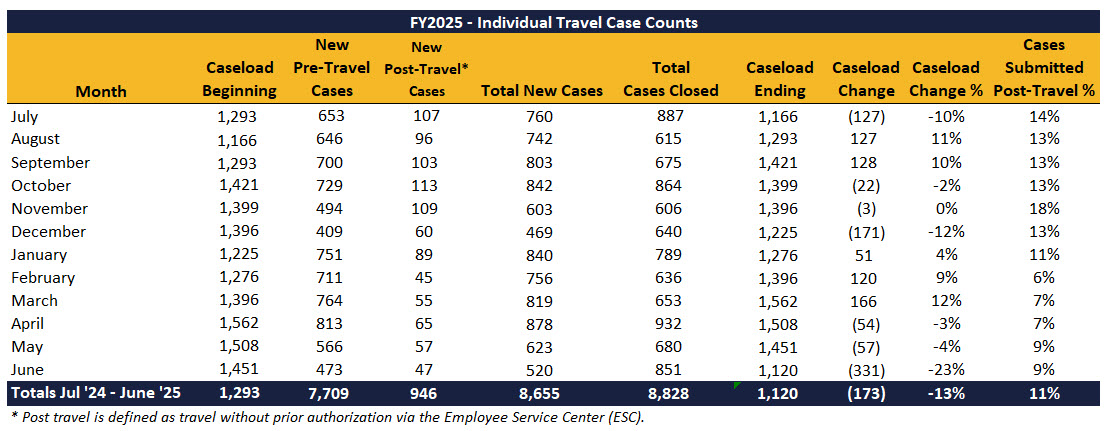
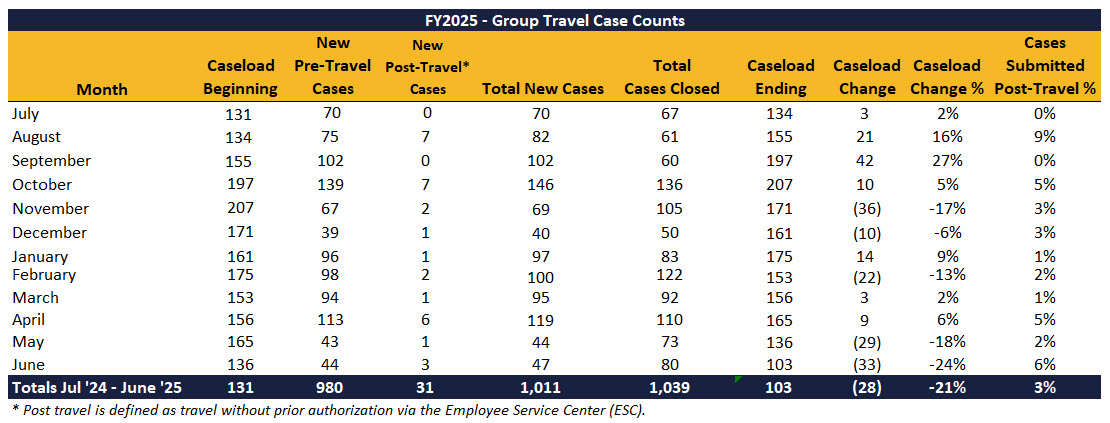
General Analysis: FY2022-FY2025
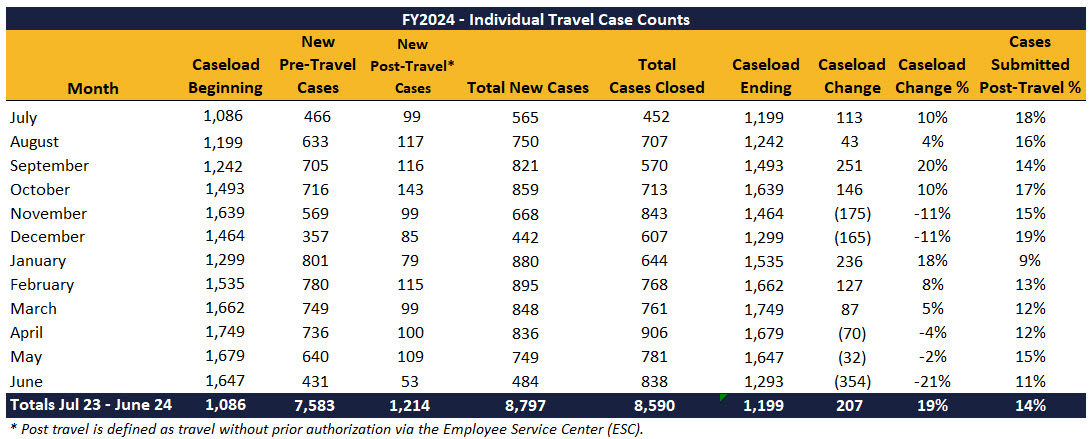
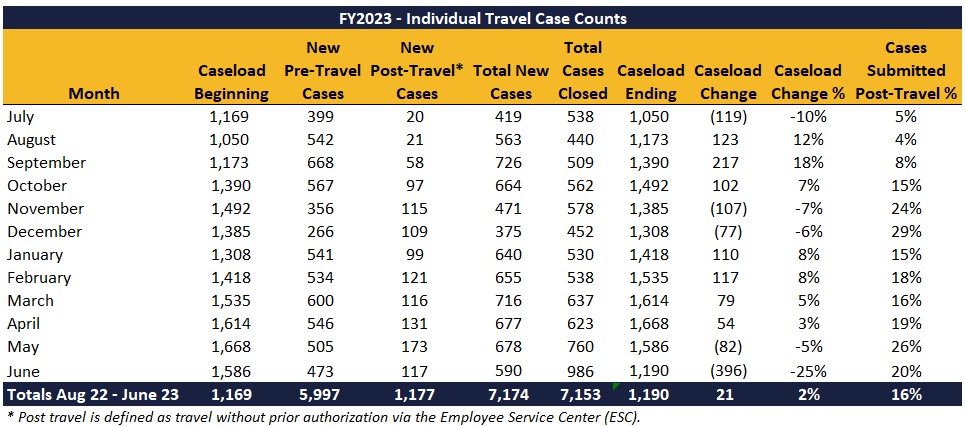
- Individual case submissions increase steadily and dramatically the first three month of each fall and spring academic semesters: August-October and January-March.
- In November, case submissions sharply decrease, with December being the ‘slowest’ month annually.
- Most travel cases are submitted each spring semester.
- The summer session (May-July), sees a slight decrease in overall case submissions but stays fairly consistent with monthly averages similar to that of early fall semester.
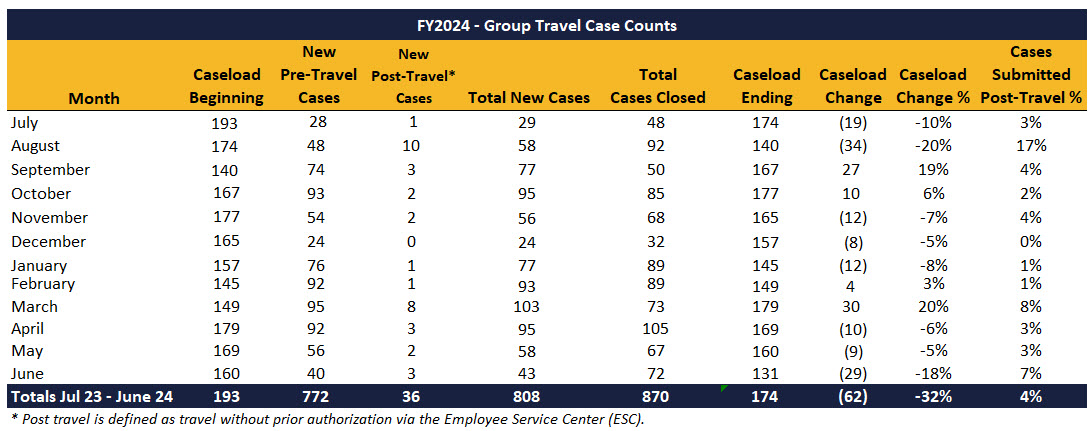
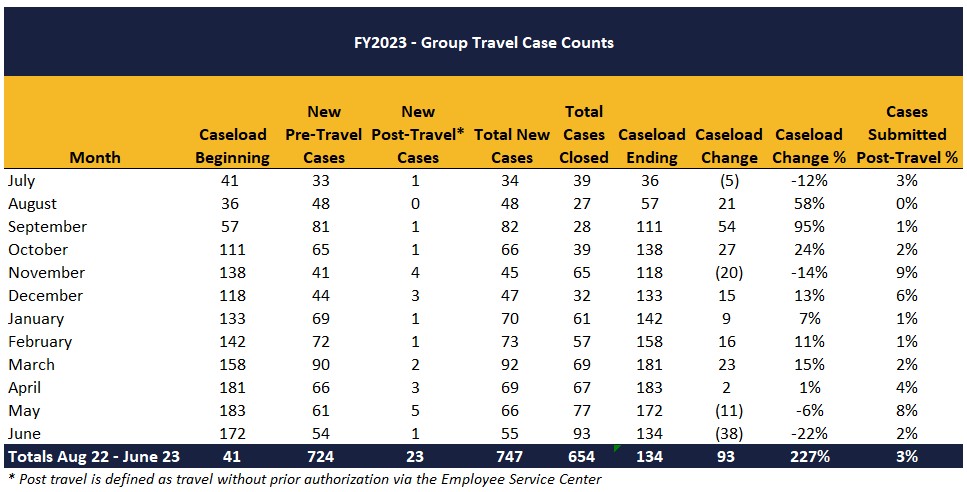
- Group Travel case are submitted steadily throughout the fall and spring semesters, resulting in less dramatic submission rate spikes.
- December and July consistently have the fewest Group Travel cases submitted from year to year.
- Spring semester has the most Group Travel cases submitted.
- Group Travel case submissions stay constant the beginning of each summer session, from May-June, and taper off significantly in July.
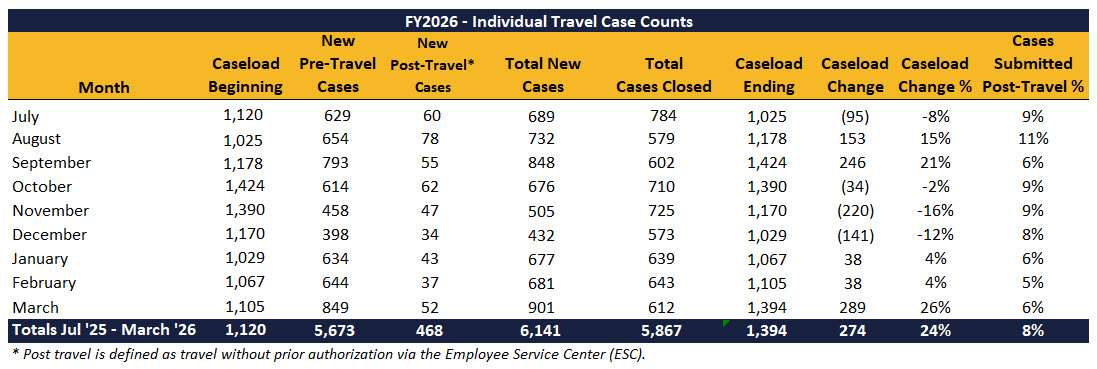
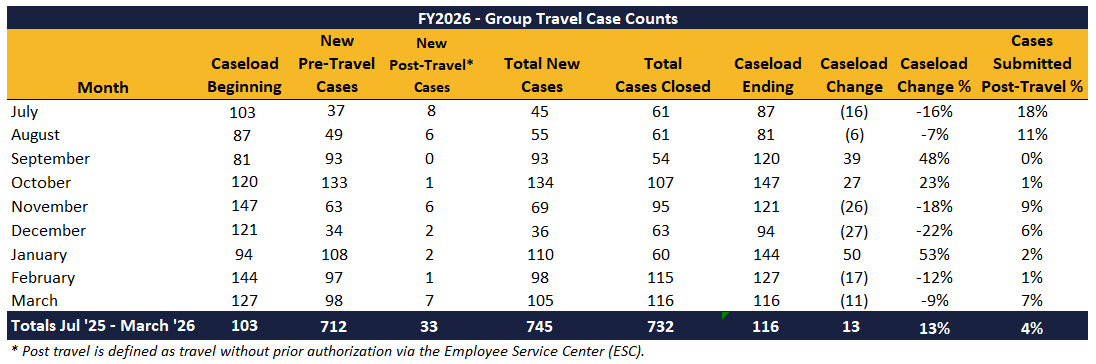
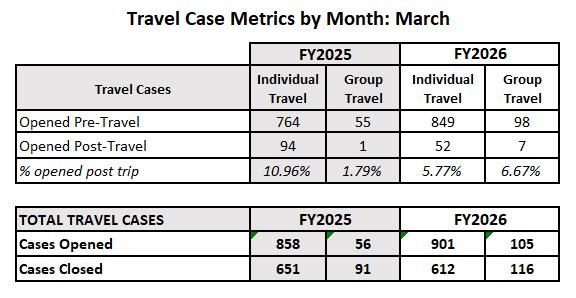

Reimbursement Process Flow Accordion Closed
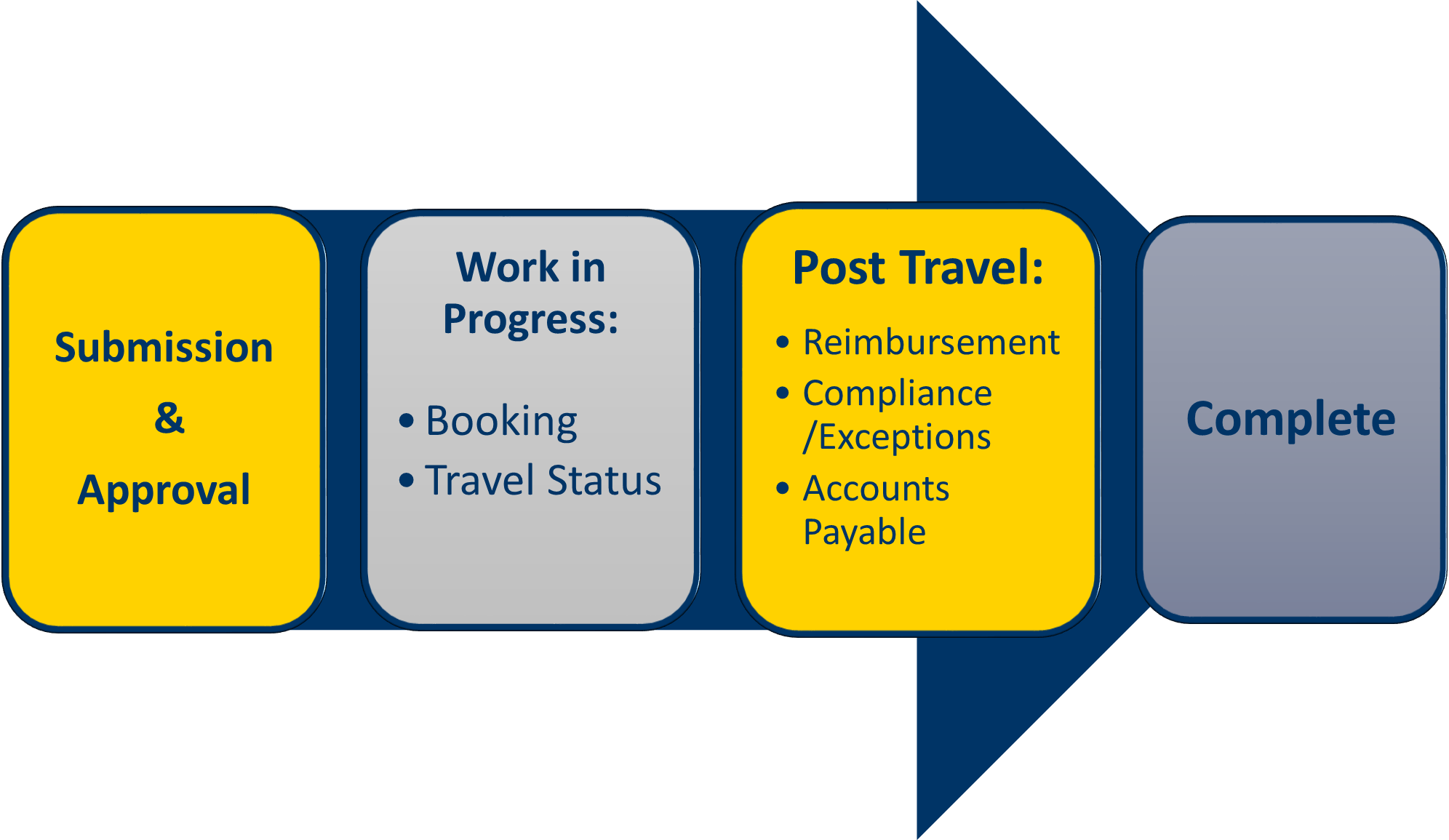
There are many steps in the lifecycle of a travel reimbursement.
Current In Progress & Priorities Accordion Closed
- Work in Progress
- Itinerary Task – Enable traveler or submitting department to provide/confirm trip details at time of case submission, significantly cutting down on the back and forth of information requests in order to expedite travel booking and reimbursement processing.
- Pipeline
- Metrics and Reporting – Identify and develop metrics to enable efficiency and operational reporting; including durations for approvals and processing, measuring volume of cases submitted with missing documentation, and overall throughput measures.
- Future Development
- Expense Claim Automation – Fully automate the Expense Claim into the ESC providing better transparency and tracking of university paid expenses, and reduction of redundant processes.
Completed Enhancements Accordion Closed
- Annual Travel Certification – The Annual Travel Certification, or ATC, was converted from an OnBase form to a service in the Employee Service Center.
- Expense Claim (EC) Approval Task – Allows RPSU travel specialist to attach the Expense Claim and route it to the traveler, supervisor, and others (as requested) for final reimbursement approval within the ESC case – no more responding through Outlook email. This improves efficiency by eliminating manual EC email approvals.
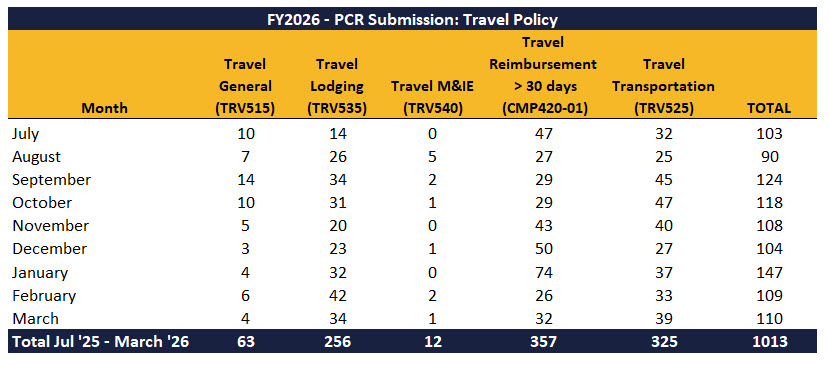
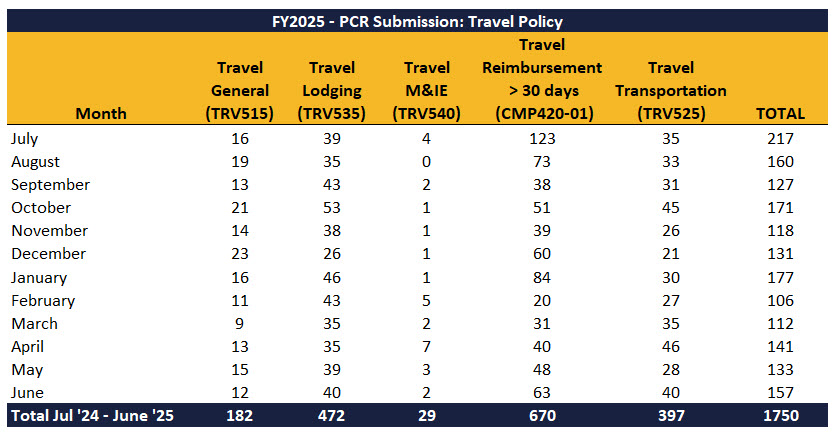
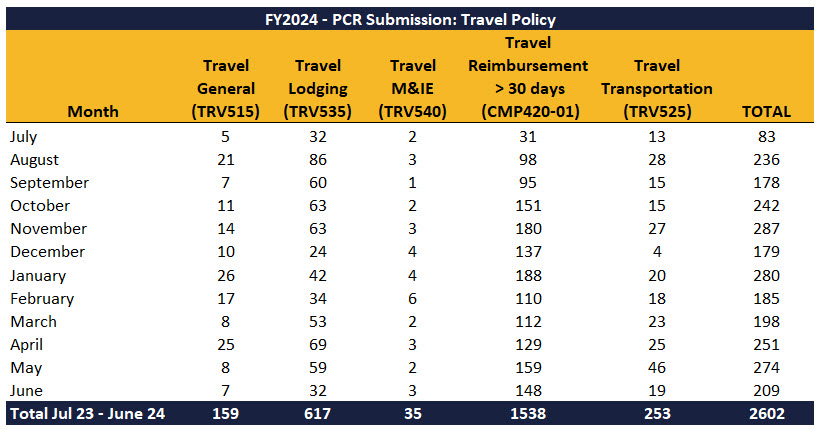
- Compliance / Policy and Compliance Review (PCR) – We have revised these processes and built them into the cases. New service in ESC replaces the Justification for Exception to Policy (J4E2P) form in OnBase.
- ESC Policy and Compliance Review form
- Feedback received from local financial oversight (LFO) designees has noted significant improvements to ease of approval routing, communication opportunities when asking questions, and better transparency of the overall compliance process.
- PCR Report – ESC report that end users can run (self-service) and view all PCR’s submitted for/by an individual or a department.
- Group and Individual Travel combined into one service to capture better capturing.
- Quick Responses – Communication templates added to the ESC Agent view. The templates cover a variety of topics and provide consistency in messaging from travel specialists to travelers and departments.
- Requests for Cash Advance/Zelle – Fields were added to the Travel Support form to facilitate timely submission and processing of advances to students and community members.
- Travel Report Edits – Updates were made, per end user requests, to the ESC report that can be run (self-service) for viewing all travel requests submitted for/by an individual or a department.
- Duplicate Case Report – Created to notify RPSU leadership of potential duplicate case submissions, removing redundancy and potentially related communication errors.
Planned Trend Reports
Once we have baseline plus three months of data, we will begin trend reporting. Examples of trend reports we are planning to implement include the following:
Reduction of Case Cycle Time Accordion Closed
- % Total Case Duration
- % Time in Approval Queue
- % Time in Work in Process Queue
- % Time in Booking Queue
- % Time in Documentation Received Queue
- % Time Expense Claim (EC) Signature Queue
- % Time in Compliance Review Queue
Process Improvement – Occurrence Reductions Accordion Closed
- % Problem Cases
- % Incomplete Cases
- % Cases Requiring Reapproval
- % Cases with Incomplete Travel Documentation