

Can health coaching from an AI chatbot create a similar sense of connection as coaching from a human?
A research project led by Buck Blankenship, associate teaching professor in the College of Education, and Natalie Papini, assistant professor in the Department of Health Sciences, is collaborating with the Department of Health Sciences’ UCAN program to train an AI chatbot to provide high-quality coaching to students.
The aim is to provide a new tool that will increase the number of students UCAN reaches and that will help students who may be more comfortable opening up to a bot than a human coach.
“Ultimately, we hope this work will inform how AI can responsibly complement, not replace, human-centered health coaching, while also improving access to supportive wellness services for students across NAU,” Papini said.
This is one of four projects funded this year by NAU’s TRAIL program, which provides small grants to study the potential uses of generative AI in research. Professors in seven colleges also received funding to develop creative ways use GenAI in their classrooms. Learn more about TRAIL and past projects.
The recipients of the research grants are:
- Buck Blankenship and Natalie Papini, College of Education and College of Health and Human Services: Do Chatbots Elicit the Same Pathways to Change? A Biophysiological Comparison of Human and AI Health Coaching
- Jeb Helms, College of Health and Human Services: Scaling AI-Powered Pain Communication Training Across Physical Therapy Programs: A Multisite Pilot Study
- Lan Zhang, Steve Sanghi College of Engineering: Perceiving the Invisible: User Awareness of Malicious Tool Behavior in AI Agent Environments
- Robert Goodman and Chad Woodruff, College of Social and Behavioral Sciences: A Bidirectional Bridge Between Agentic AI and Existing Neuroscience Infrastructure
Chatting with an AI coach
The AI chatbot that Blankenship and Papini are building will be trained to conduct UCAN motivational interviewing approach and with the same materials currently used to train human coaches. Right now, UCAN serves between 250 and 300 students each academic year, and the chatbot can expand that reach, particularly to students in statewide campuses or online.
Students will participate in coaching sessions with this chatbot, and the researchers will measure stress, emotional regulation and physiological responses like heart rate variability and galvanic skin response.
“Students will not be expected to share anything beyond what they feel comfortable discussing, and the chatbot is intended to function as a supportive coaching tool rather than a replacement for mental health care or clinical services,” Blankenship said. “The study is focused on understanding how students experience these interactions compared to traditional peer health coaching.”
They will start recruiting students to participate in the fall semester.
Can you tell when an AI agent is misleading you?
Zhang’s project examines whether people can detect adversarial behavior from an AI agent when that behavior is subtle. Scenarios will include an AI agent appearing to be helpful and functional while injecting misinformation, manipulating summaries and sources or seeking sensitive information from users.
Participants in her study will act as academic paper reviewers. A “helpful” AI agent will introduce misleading or manipulated information into the review process, and Zhang’s team will analyze whether users recognized these anomalies and responded appropriately. They’ll also look at participants’ familiarity with AI.
“One major research goal is understanding how users assign responsibility when something goes wrong—whether they blame the AI agent, the external tool or themselves,” Zhang said. “Longer term, we hope this work can inform safer AI agent design, improve transparency mechanisms for tool-augmented AI systems and contribute to future research on trust, security and human-AI collaboration.”
This research will fill a gap in the field by looking at the threat of subtle malicious behavior, which Zhang believes is more concerning than obvious failures or hallucinations.
“This project aims to better understand the human side of AI security—specifically how trust, expertise and interaction design influence a user’s ability to detect manipulation in realistic AI-assisted workflows,” she said.
About 50 participants, including students and faculty members, will be recruited for the study, which takes place in the fall.
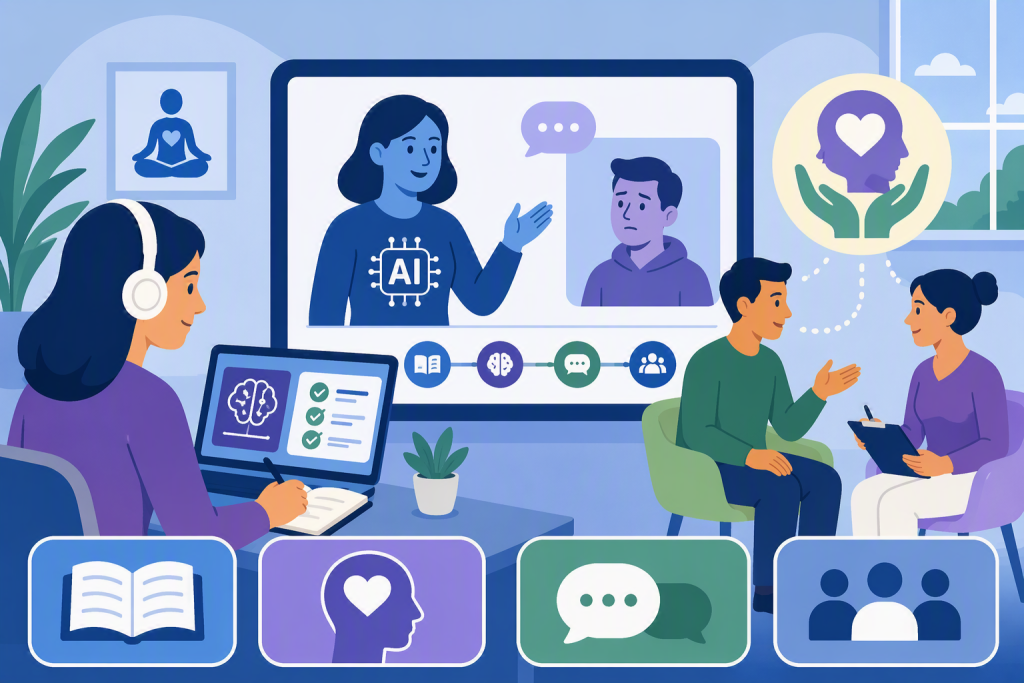
Top image: Generated by MS Copilot with this prompt: I need a horizontal image (1000 by 700 pixels) that illustrates the use of AI in training mental health coaches. It needs to be accessible, so no small text, and make sure the color contrast is accessible. Please focus on people and images, not text. I do not want the people to look like actual images of people, so more of a graphic style. It was my second attempt; the first I was not specific enough and it created its own UCAN logo and then refused to forget the pieces I told it to forget, so I started over.
 Heidi Toth | NAU Communications
(928) 523-8737 | heidi.toth@nau.edu