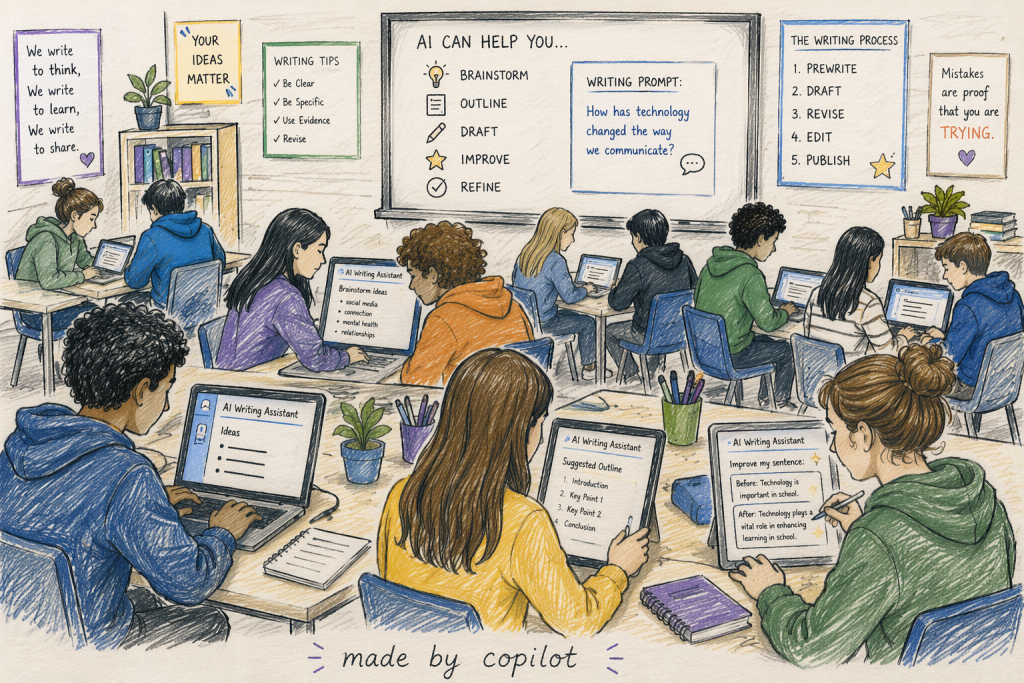


How do you help students get over their reticence of AI?
The answer, according to one psychology professor, is simple: You don’t. You teach students how to use AI ethically, in a way that enhances their learning and enables them to think critically about AI-produced material. In the process, you give them the tools to either use AI responsibly or decide it’s not for them.
Funded by a TRAIL grant, Viktoria Tidikis, a teaching professor in the Department of Psychological Sciences, is implementing a project that will allow students to use generative AI to brainstorm research questions, conduct literature searches, organize information and evaluate AI-generated content. They’ll be taught to question and fact-check information, consider the ethical implications of using and disclosing the use of AI and use it in academia without cheating.
“Students are being exposed to powerful technologies without sufficient guidance or training in how to critically evaluate and appropriately use them,” Tidikis said. “My project approaches this resistance as something understandable rather than something students simply need to ‘get over.’ The goal is to help students develop informed, critical and ethical engagement with AI by increasing literacy, transparency and confidence in how these tools can be used responsibly.”
Tidikis received one of 10 Transformation through Artificial Intelligence in Learning (TRAIL) instructional grants NAU gave this year. TRAIL, which is sponsored by the Office of the Provost, offers small grants to faculty members so they can develop innovative ways to use gen AIto increase student learning. Another four research grants were given.
The instructional grants went to:
- Alana Marta Kuhlman, College of Arts and Letters: Advancing Ethical AI Literacy Through Writing Center Innovation
- Allana Zuckerman, College of Health and Human Services: Teaching Students to Question the Machine: Integrating AI Feedback Auditing and AI-Human Faculty Workflow for Ungrading in a Health Sciences Course
- Benjamin Lucas, Dana Ernst and Ian Williams, College of the Environment, Forestry, and Natural Sciences: The Pillars of Intelligence: A Foundational Mathematical Sequence for the AI Era
- Carla Nikol Wilson, College of Social and Behavioral Sciences: Queer Archives in the Age of Artificial Intelligence
- Catharyn Shelton, College of Education: Redesigning an Educational Technology Course to Expand Future Teachers’ Critically Conscious, Career-Ready GAI Literacies
- Marco Gerosa, Steve Sanghi College of Engineering: AI-Powered Interview Training for Requirements Elicitation in Software Engineering
- Misha Baltushkin, Dana Ernst, Monika Keindl and Nandor Sieben, College of the Environment, Forestry, and Natural Sciences: Developing an AI Mathematics Grading Agent for Enhanced Student Feedback and Instructional Efficiency
- Susan K. Williams, The W. A. Franke College of Business: Create and Manage a GenAI Intern: Exploratory Data Analysis with a Human-in-the-Loop
- Viktoria Tidikis, College of Social and Behavioral Sciences: Reducing Student Resistance to AI Through Structured Literacy, Transparency, and Ethical Integration
- Xin Yi Bao, College of Social and Behavioral Sciences: More Human Than Ever: Filmmaking with AI
The many uses of AI in developing software
Gerosa’s project will introduce AI into the software engineering process, but maybe not in the way you’d expect. The students will do all the coding; the AI chatbots will be the “clients” whom they interview to figure out the parameters of the software. The interviews require soft skills that students often haven’t developed yet.
“These skills are hard to practice in class because they require close attention from the instructor and practice with real clients who are difficult to recruit,” Gerosa said. “We want to build a chatbot that would simulate the client of a project and reproduce common issues that real clients do, like providing incomplete, inconsistent and conflicting information.”
How do you compare to an AI student?
Yi, an associate professor of practice in creative media and film, will have AI writing scripts, making a shot list and preparing to make a film. But the students won’t be using it. Instead, the AI will essentially be a student in class and will do the same assignments, then the students will compare their work to the AI product.
In her screenwriting class, AI will do projects, including personal journal entries, that students will then read and critique. In filmmaking, AI will produce a short film, and again, the students will compare that product—which likely will be technically sound but, Yi anticipates, lacking in soul—to their own imperfect but authentic productions.
Her goal is to show students the value of their own life experiences in producing creative work—something AI can’t do.
“The whole point is to get students to stop treating their own lived experience—their messy histories, trauma, complicated families—as baggage and start seeing it as their greatest creative advantage,” Yi said. “In creative fields, our wounds aren’t a liability; they’re the only thing that separates our work from the A-student who has no soul. AI is a useful mirror for that, because it’s the perfection of ‘correct and polished’ with nothing underneath. I’m essentially using AI’s limitation as a teaching tool to help students stop running from their own lives and start trusting them.”
The top image was generated in MS Copilot. The initial prompt was: Can you create an image that shows people using AI in the classroom? Please do not focus on any individuals; I want it to show a classroom with lots of different people working. Show them using technology to create a writing project. It provided me with what looked like a photo; I wanted something that was obviously not real people. So I added this: Please make it more graphic-like–I don’t want it to be confused with a real photo. And add “made by Copilot” at the bottom. It then gave me a few style options, including the hand-drawn sketch style.

Heidi Toth | NAU Communications
(928) 523-8737 | heidi.toth@nau.edu