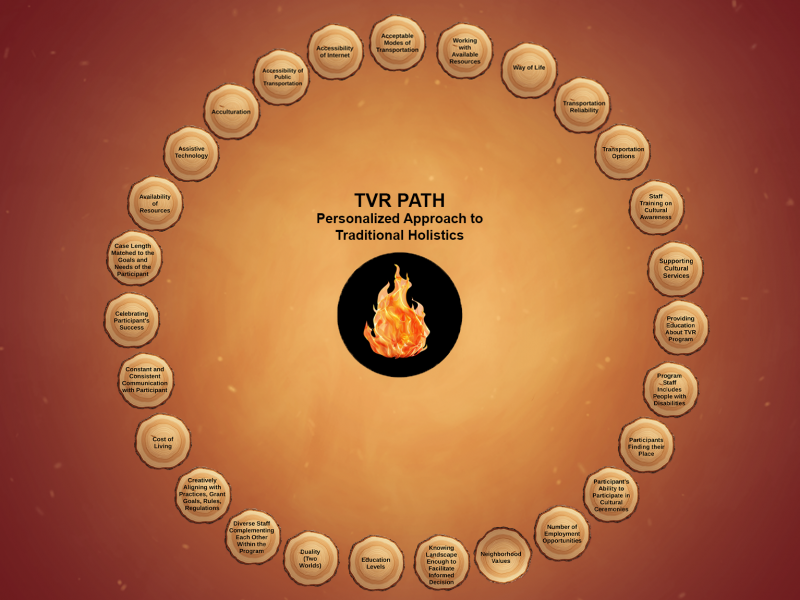
IHD is proud to announce the launch of TVR PATH (Tribal Vocational Rehabilitation Personalized Approach to Traditional Holistics), a new tool designed to support culturally responsive services within Tribal Vocational Rehabilitation programs.
Tribal Vocational Rehabilitation (TVR) services were established in 1975 to serve American Indians and Alaska Natives with disabilities living on or near federal and state reservations. These programs provide vocational rehabilitation services that help individuals prepare for and obtain meaningful employment while honoring each person’s cultural beliefs, identity, and informed choice. TVR PATH emphasizes a personalized, holistic approach to supporting program participants. It helps TVR staff visualize key elements of the vocational rehabilitation system at the participant, program, and community levels, and understand how these elements interact to support successful outcomes.
Developed through a community-driven, participatory process, TVR PATH incorporated feedback from TVR directors, counselors, and Tribal partners across the country. Over 180 contributions from interviews, focus groups, and workshops were distilled into a 27-element visual diagram, each representing a component of the TVR system that directly or indirectly supports culturally responsive services. The diagram is designed to be flexible and adaptable, enabling programs to modify wording, layout, or images to best reflect their own culture and community.
TVR PATH is offered in three formats: an interactive diagram with animations, an interactive version without animations, and a printable PDF, allowing teams to explore and understand the system in ways that suit their needs. The visual representation, a fire surrounded by logs, symbolizes how each element fuels and sustains meaningful services, while also representing the relationships and people that give the system its purpose. Resources are also provided to support adapting both the visual nature and the content to suit individual TVR programs.
This resource is ideal for new and seasoned TVR directors, counselors, and program teams, supporting staff training, strategic planning, and community engagement. By centering Tribal knowledge and experience, TVR PATH provides a big-picture guide to creating culturally respectful and effective services that complements existing resources.
TVR PATH was developed through IHD’s Culturally Appropriate Research in American Indian Employment (CARE) project, funded by the National Institute on Disability, Independent Living, and Rehabilitation Research (NIDILRR), with guidance from Tribal advisors and TVR professionals nationwide. The toolkit reflects the diversity of Tribal programs and the lived experiences of those who work within them, providing a flexible, practical resource for improving employment outcomes while honoring culture.
Explore TVR PATH and learn how to adapt it to your TVR community here.