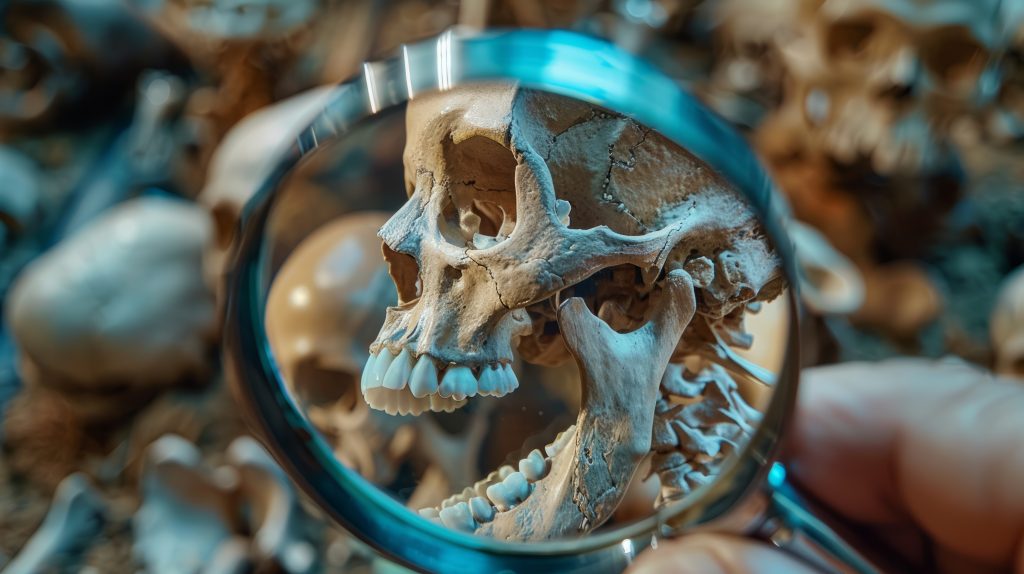


History not only lives in books. It can be found in the physical traces people leave behind, including their bones. A class at NAU teaches students how disease outbreaks can be understood through an anthropological lens, focusing on what human remains and historical accounts reveal about the spread of disease and the impact of epidemics.
In ANT 105: Plagues, Bones and History, students study the relationship humans have with diseases and how plagues are presented not just as isolated events, but also as forces that shaped communities and economies.
Corina Kellner, a professor in the Department of Anthropology, is a biological anthropologist who studies people from the past and how they weathered various social, cultural, economic and political changes. After the COVID-19 pandemic, she wanted to bring an anthropological perspective to the study of plagues and diseases to show how they have influenced human history.
“My specialty is in ancient Peru,” Kellner said. “In my field, we look at bones and cemeteries, and I wanted to bring that perspective to the study of diseases. In the class, we go over things like the Black Death in the 1300s in Europe and Asia, we cover the flu pandemic of 1918 and discuss tuberculosis, which is a scourge that we don’t see a lot in the United States, but it is kind of rising again. We look at sexually transmitted infections and what that means in terms of shame and morality, and we also look at other different aspects of disease.”
Students study context clues to gain insight into how people died and how they were buried. For example, in a lecture where students go over what the remains of people with syphilis on their bones look like and how to figure out whether they used a mercury cure when they were alive.
The class covers general studies and liberal studies requirements for Social and Political Worlds. Kellner said there are typically only a handful of anthropology majors in the class, while the majority are biology and biomedical students.
“I recommend this class to anyone who went through the COVID-19 pandemic because we were bearing witness to something that our ancestors witnessed too in their lives,” Kellner said. “I’ve had a couple of business students in the past and remember the one time I had a marketing major. The final project was perfect for him since students have to create some kind of informational piece about a disease to create awareness.”
The class is divided into four or five topics throughout the semester, and students have journal assignments where they can give Kellner feedback and where she can see how they are synthesizing the material. They work with a free textbook and supplement their research with videos and web pages.
“The final topic we cover is public health, what it means and what measures we have to take to keep ourselves safe,” Kellner said. “We need to be careful with misinformation and disinformation about disease and public health. We need to be more patient and kinder to one another when diseases hit. The biggest feedback I have gotten from students is that they thought of diseases as just biology, but with this class, they were able to see the cultural, social and economic impact they have. We need to be more active in combating diseases and understanding the science behind everything.”
For more information about ANT 105: Plagues, Bones and History, visit NAU’s class catalog.
Check out more cool classes:
Where crime scenes come to life
Get more stories from the Student Edition of the NAU Review.
 Mariana Laas | NAU Communications
(928) 523-5050 | mariana.laas@nau.edu