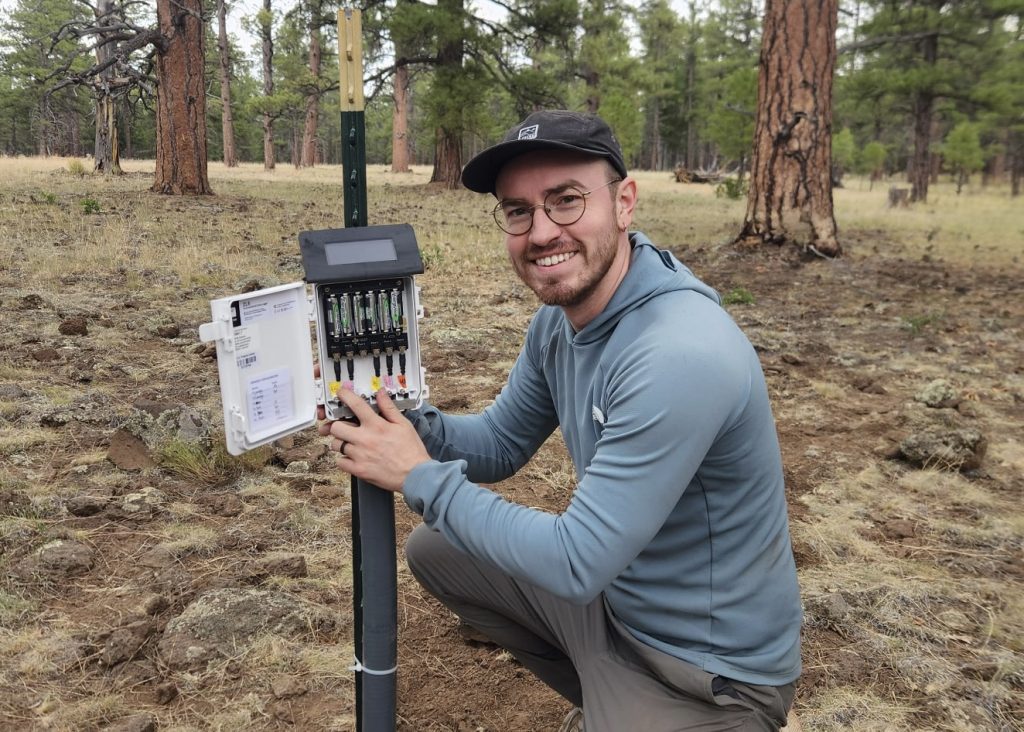


The small mountain streams that feed many of the West’s rivers may face a much drier future.
A new study led by NAU researchers found that groundwater-fed streamflow, known as base flow, has been steadily declining across headwater watersheds in the western United States since 1950 and could decrease by 45% to 65% by the end of this century if current climate trends continue.
The study, published recently in Earth’s Future, analyzed 75 years of streamflow data from 115 headwater basins across 11 Western states and used machine learning models to project future conditions under multiple climate scenarios. Researchers found that warming temperatures, shrinking snowpack and increasingly dry conditions are already changing when and how water moves through mountain watersheds.
“Headwaters are where much of our downstream water supply originates, but they’re often some of the least monitored parts of a watershed,” said lead author Caelum Mroczek, a research affiliate in NAU’s School of Earth and Sustainability (SES) and a recent doctoral graduate. “We found that these systems are already showing widespread declines in base flow, and those declines are expected to continue as the climate warms.”
Mroczek said headwater streams make up nearly 88% of the western U.S. river network and supply much of the region’s surface water. Because these streams depend heavily on groundwater, changes in groundwater recharge can have major consequences for water availability downstream.
To better understand how different landscapes respond to climate change, the research team grouped watersheds into four categories ranging from high-elevation, snow-dominated mountain basins to lower-elevation, rain-driven systems common in southern Arizona and other arid regions.
Although the details varied among regions, one pattern appeared across all four groups: peak base flow is occurring earlier in the year than it used to.
Historically, Mroczek said, melting snow gradually recharged groundwater and sustained streams through late spring and summer. But because temperatures are rising, snow has begun melting sooner, and more precipitation now falls as rain rather than snow. The result is more water arriving earlier in the year, followed by lower groundwater contributions during the late summer months, when communities and ecosystems often need it most.
“We’re seeing increases in base flow during late winter and early spring, but then substantial decreases in June and July,” Mroczek said. “The water isn’t necessarily disappearing immediately—it’s arriving earlier. The concern is that it’s becoming increasingly out of sync with when people and ecosystems depend on it.”
The researchers found that antecedent moisture—that is, how wet the landscape has been in preceding months—was the strongest predictor of future base flow. Snowpack and temperature also played major roles, particularly in mountain watersheds where seasonal snow acts as a natural reservoir.
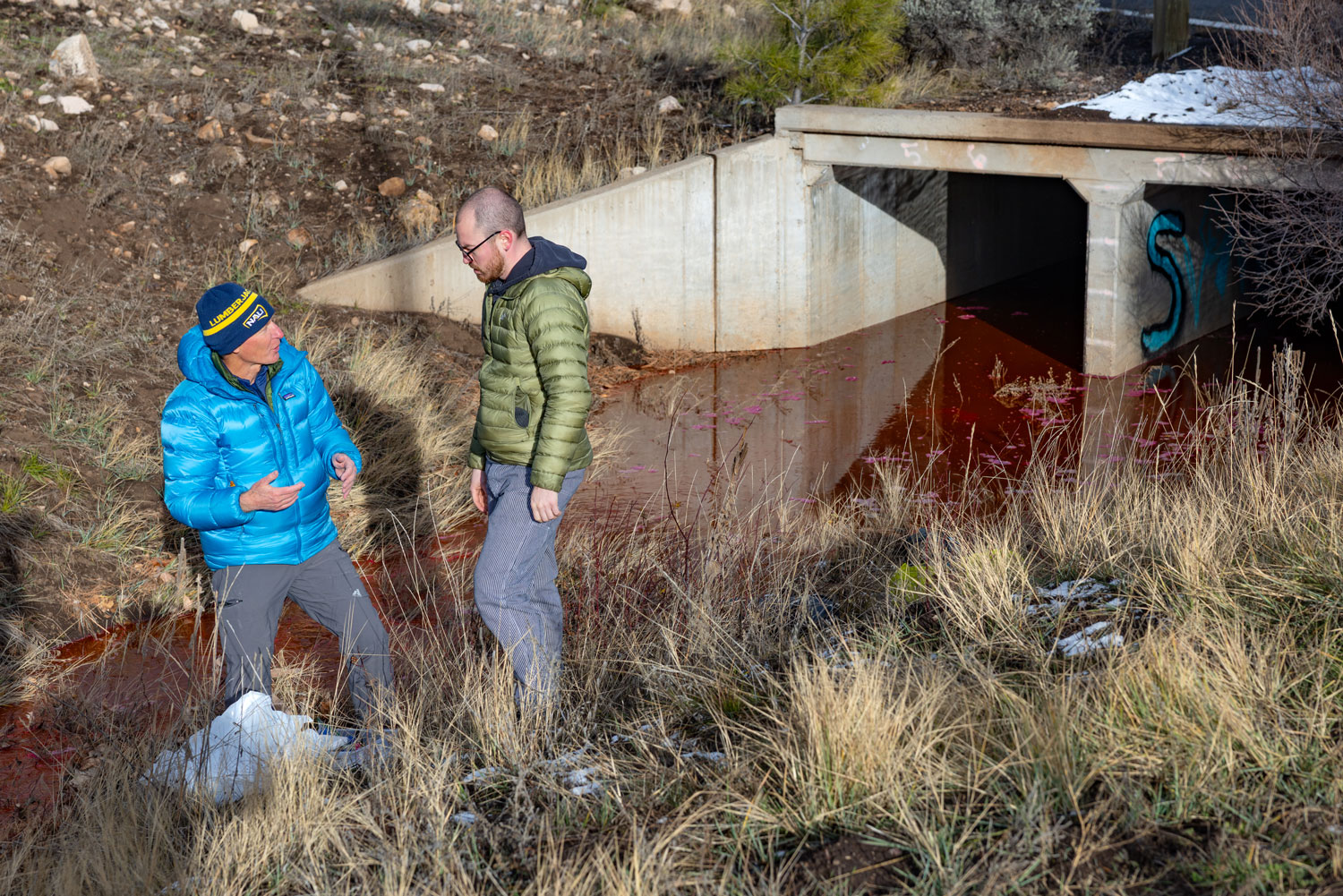
Under a high-emissions climate scenario—one “where we really go for it with fossil fuels,” Mroczek said—some of the region’s most vulnerable headwater systems could experience the greatest relative losses, amounting to millions of acre-feet of water.
Those changes could have consequences far beyond remote mountain streams. Base flow helps sustain water supplies, supports fish and wildlife habitat and helps maintain streamflow during dry periods. Reduced groundwater contributions could also increase vulnerability to drought and wildfire across the region.
For Mroczek, the findings highlight the need to think beyond annual weather cycles and focus on longer-term water trends.
“It’s easy to remember a wet year or a dry year,” he said. “But these systems operate over decades. Water may still come out of the tap today, and reservoirs may still be functioning, but what we’re seeing is a gradual reduction in the natural storage systems that support water availability over time.”
The study also underscores how much remains unknown about the West’s smallest streams. Because many headwater systems are remote and unmonitored, researchers have limited ways to measure how climate change is affecting them.
“These are some of the most important parts of the watershed, but we don’t have much data on them,” Mroczek said. “Improving monitoring in headwaters will be critical for understanding and managing future water resources.”
Co-authors on the study were SES professor Abraham Springer and assistant professor of data science Benjamin Lucas. Their research was supported by the Arizona Board of Regents Technology and Research Initiative Fund program.

Jill Kimball | NAU Communications
(928) 523-2282 | jill.kimball@nau.edu