

What can distant, tiny objects in space tell us about how our solar system formed? As it turns out, quite a lot.
A pair of new studies, one of which was led by NAU Ph.D. candidate Anastasia Morgan, examined Trans-Neptunian Objects (TNOs)—some of the most far-flung bodies in the solar system—in an effort to better understand how the system formed and how it has evolved. The studies were the first in history to harness the joint power of NASA’s Hubble and Webb telescopes.
Morgan and her colleagues expected to find lots of variation in the TNOs’ colors, shapes and materials, evidence that the objects have been traveling and colliding with each other for eons. What they found instead was very little variation, suggesting much less movement than they imagined.
“For these objects to have a lot of the same color and shape, it’s telling us that they have probably sat there and not been very collisionally active,” Morgan said. “The models say they should have been altered by collisions, but that’s just not what we’re seeing.”
Morgan’s study, along with a complementary study led by University of Victoria Ph.D. candidate Marielle Eduardo, was published Sept. 8 in The Astronomical Journal.
Crash course on TNOs
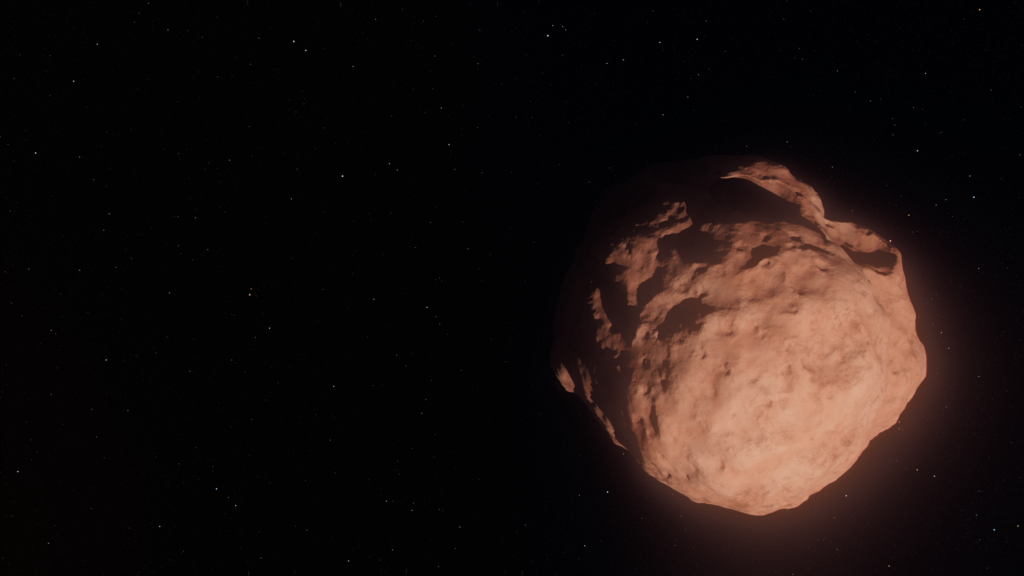
TNOs are typically small, faint, icy bodies orbiting the Sun beyond the orbit of Neptune. Most TNOs are more than 100 million times dimmer than objects visible to the unaided eye. The TNOs Morgan studied are some of the smallest and faintest that have ever been directly seen; to get an idea of just how small and faint, imagine, she said, standing on Earth and trying to measure a swarm of fireflies on the Moon without magnification.
Morgan said TNOs offer the best view into an early stage of planet-building, when a disk of dust and pebbles in orbit around the Sun coalesced into city-sized “planetesimals,” but had not yet merged into full-sized planets. Beyond Neptune, this second stage never happened, leaving behind a frozen population of planetesimals.
“TNOs hold some of the history of the formation and evolution of the outer solar system,” Morgan said. “They tell us what was here at the beginning, and more broadly, they give us clues into how other planetary systems are formed.”
In the two coordinated studies, Morgan and Eduardo’s teams studied TNOs in one tiny patch of sky using Hubble, which observes the objects’ visible light, and Webb, which observes their infrared light. Using those telescopes, Morgan measured their colors—which are like a fingerprint of the surface composition—and Eduardo measured their size distribution.
Before this study, astronomers thought small TNOs would have undergone many collisions, changing their surfaces. But that’s not what the observations showed. Instead, the small TNOs looked a lot like their larger family members. This implies that collisions are not changing the surfaces significantly—perhaps because there are fewer collisions than expected, or perhaps because the TNOs somehow retain their primordial, pre-collision compositions. The teams are still trying to unravel this mystery.
“You could imagine a scenario where getting knocked around and fragmented would change the surface composition, and then you would see a different surface color for tiny TNOs compared to their larger siblings,” Morgan said. “So, it’s really fascinating to see that the smallest objects are somehow ‘remembering’ and preserving the history of how they were made.”
David Trilling, a co-author of the study and a professor in the Department of Astronomy and Planetary Sciences at NAU, said even TNOs that had moved to a different orbit since being formed seemed relatively unchanged.
“They retain a signature of where they were born, even though their orbits have been scrambled since then,” Trilling said.
Eduardo found fewer very small TNOs than the research expected based on previous planet formation models. The Webb telescope discovered 27 new, remarkably dim TNOs, the smallest among them about 5 to 10 kilometers, or six miles, in diameter which is about five times smaller than what is possible to detect with ground-based telescopes.
Unraveling the universe’s mysteries
When it comes to our understanding of the outer solar system, what do these findings mean? Trilling said they could demonstrate that we don’t know space as well as we thought.
“We thought we’d see lots of variation in the color and size of these TNOs, and we didn’t,” Trilling said. “That means there’s something not quite right about our understanding of how the solar system got to where it is now. Is it an evolutionary misunderstanding? Did we not get the upheaval right? The previous science doesn’t seem to capture how we got where we are today.”
This pair of studies could have big implications for future studies on the formation of the solar system, Morgan added.
“The models tell us TNOs collided with other bodies a lot, but our observations tell us the history of the outer solar system may have been less collisional,” she said. “When the data are inconsistent with the existing models, it means we need to refine and re-test the models. It also means we need to analyze more data, and we will; there’s terabytes and terabytes of it out there.”

Jill Kimball | NAU Communications
(928) 523-2282 | jill.kimball@nau.edu