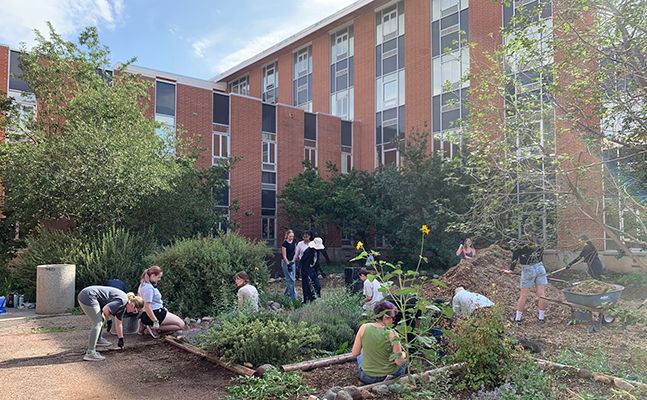


The School of Hotel and Restaurant Management (HRM) and the Department of Biological Sciences are working together to revive an outdoor learning space that connects their learning with food production.
The Shand Garden, named after late biology professor Richard Shand, was established about 15 years ago as a teaching and research-focused garden. Last spring, most of the garden was removed to make way for renovations of the biology building windows. Now that summer construction has ended, a stewardship team composed of W.A. Franke College of Business financial oversight analyst Janan Scott, instructional designer Giovanna Macry and CCC2NAU academic advisor Amanda Gonzalez is working on restoration efforts to bring the garden back to life and continue its mission while adding a badging program that will help students as they search for jobs.
How the partnership started
Scott, a Coconino County master gardener, was approached by HRM’s executive director, Mark Molinaro, with hopes of getting her on board to start a culinary garden at NAU. In the midst of Scott’s search, she found Shand Garden.
“There were vegetables already planted there, so I reached out to the College of Environment, Forestry, and Natural Sciences (CEFNS) to see who was utilizing this garden,” Scott said. “Turns out the space was used by the summer botany class, which was not going to be offered any longer. They needed help maintaining the space and we needed a garden, so I created an agreement between HRM and CEFNS.”
Even though the original vegetable beds were removed for the window renovation project, the partnership remains. With help from staff, faculty and 30 student volunteers from different majors, renovation work in the garden kicked off last month.
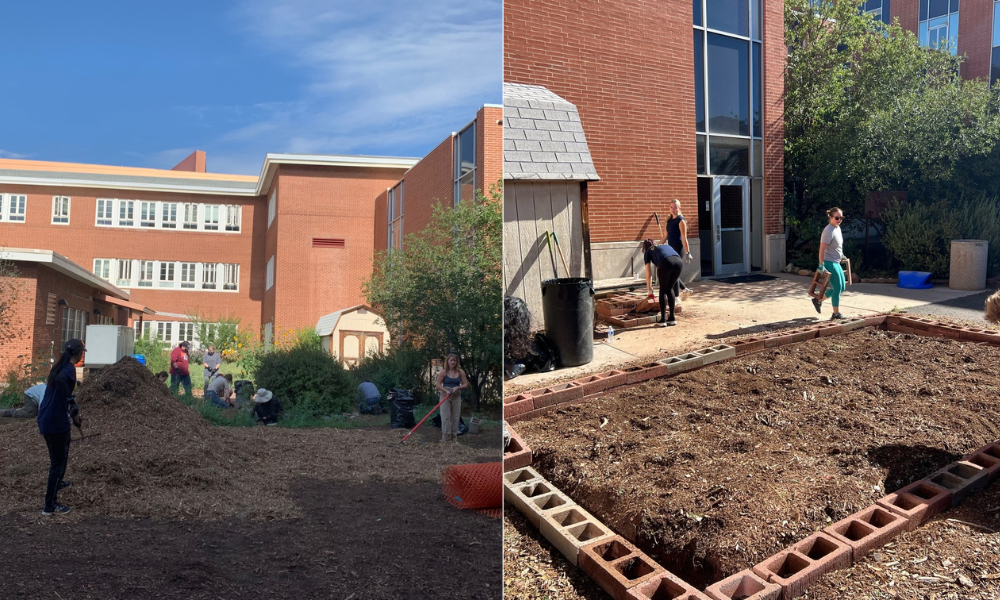 Liz Mott, a biology and Spanish junior who has been volunteering at the garden for almost three years, said seeing so many people show up to help restore the space was the best surprise.
“I couldn’t even count,” Mott said. “Getting to see the growth of the people who care about this garden and being able to complete months of work in a single day was incredible.”
Volunteers installed a new bed and a tree guild with pollinator plants that will benefit the fruit trees already planted there. Chef Travis Bradford and a group of HRM students helped rebuild the compost system while the Blue Key Honor Society helped create a Three Sisters Bed in honor of HRM’s Indigenous hospitality class where corn, beans and squash will grow. Next, the team will solarize the entire field and cover it with heavy-duty plastic to avoid the growth of weeds and get the beds ready for planting next fall.
Learning opportunities
With restoration efforts for the Shand Garden underway, Richard Hodel, assistant professor in biological sciences, is optimistic about using the space for courses such as sustainable botany. Hodel said he is particularly excited about the collaboration between CEFNS and HRM since, as biologists, they approach plants in terms of their ecology, evolution and diversity, but food is one of the most direct ways most people experience plants.
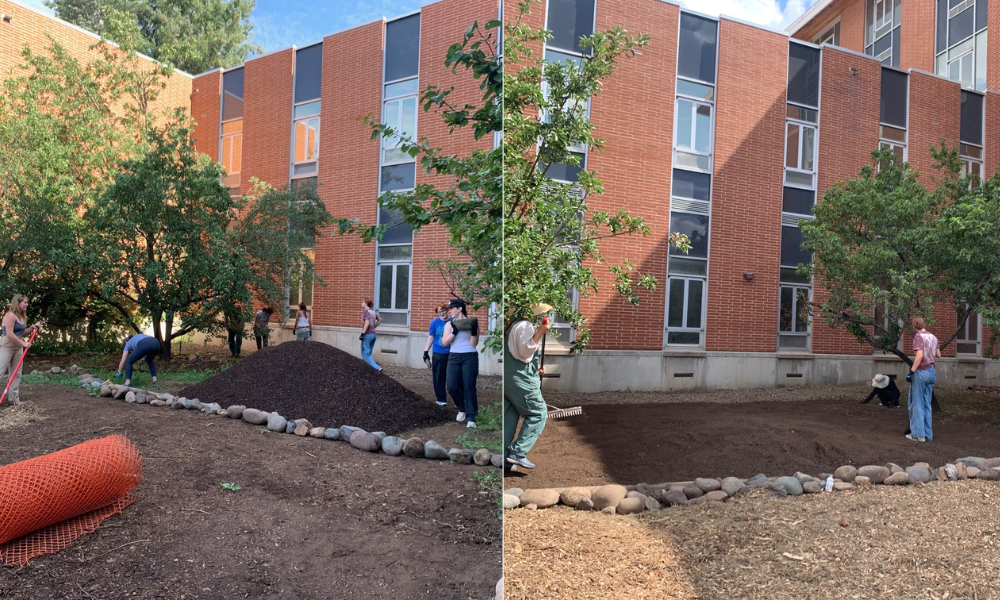 “Many of the most interesting problems we face don’t fit neatly into one academic discipline,” Hodel said. “A garden is simultaneously a biological system, a designed landscape, an educational space and a place where people gather. Having students who are in different majors work together allows them to see the same problem from different perspectives and learn how to communicate with people who have different expertise. Those are career-readiness skills they’ll need regardless of what career they ultimately pursue.”
Hodel also is hoping students will learn the importance of considering what tomorrow’s garden will look like as we face increasingly arid conditions and saline soils, especially in Arizona.
For HRM students, the hope is that the farm-to-table component of the garden will teach them where food comes from and what the stages of progression are.
“The idea is to be able to come out each day and see what produce is available and in season,” Scott said. “We would like the students to be able to taste the difference between fresh-grown produce and grocery store produce and have an appreciation for how much work goes into growing it. Maybe that will also influence reducing food waste.”
Building a resume and a community
The Shand Garden badge program is expected to launch in Spring 2027. This program will give volunteers working at the garden the opportunity to earn badges recognizing the knowledge, skills and abilities they learned, helping students demonstrate to potential employers, internship coordinators or other volunteer programs that they have verifiable skills that make them an ideal candidate.
“Now that construction has concluded, there are a variety of projects associated with revamping the garden that allow us to invite students to get involved in the project management aspect of the work or to serve in a supporting role,” said Macry, who helped design the program. “From reinstalling irrigation systems, to plant bed development using appropriate methods for our region and to suit the intended crops, to compost maintenance for soil health and more, students can develop and demonstrate outdoor space management and leadership skills.”
The badge program will include course activities from interested partner programs so the learning experience is cohesive in co-curricular environments. Learning outcomes and earning criteria will be developed and aligned to the Shand Garden’s activities, and a badging pathway will be mapped out to illustrate to students how they can advance in their garden stewardship knowledge and skills.
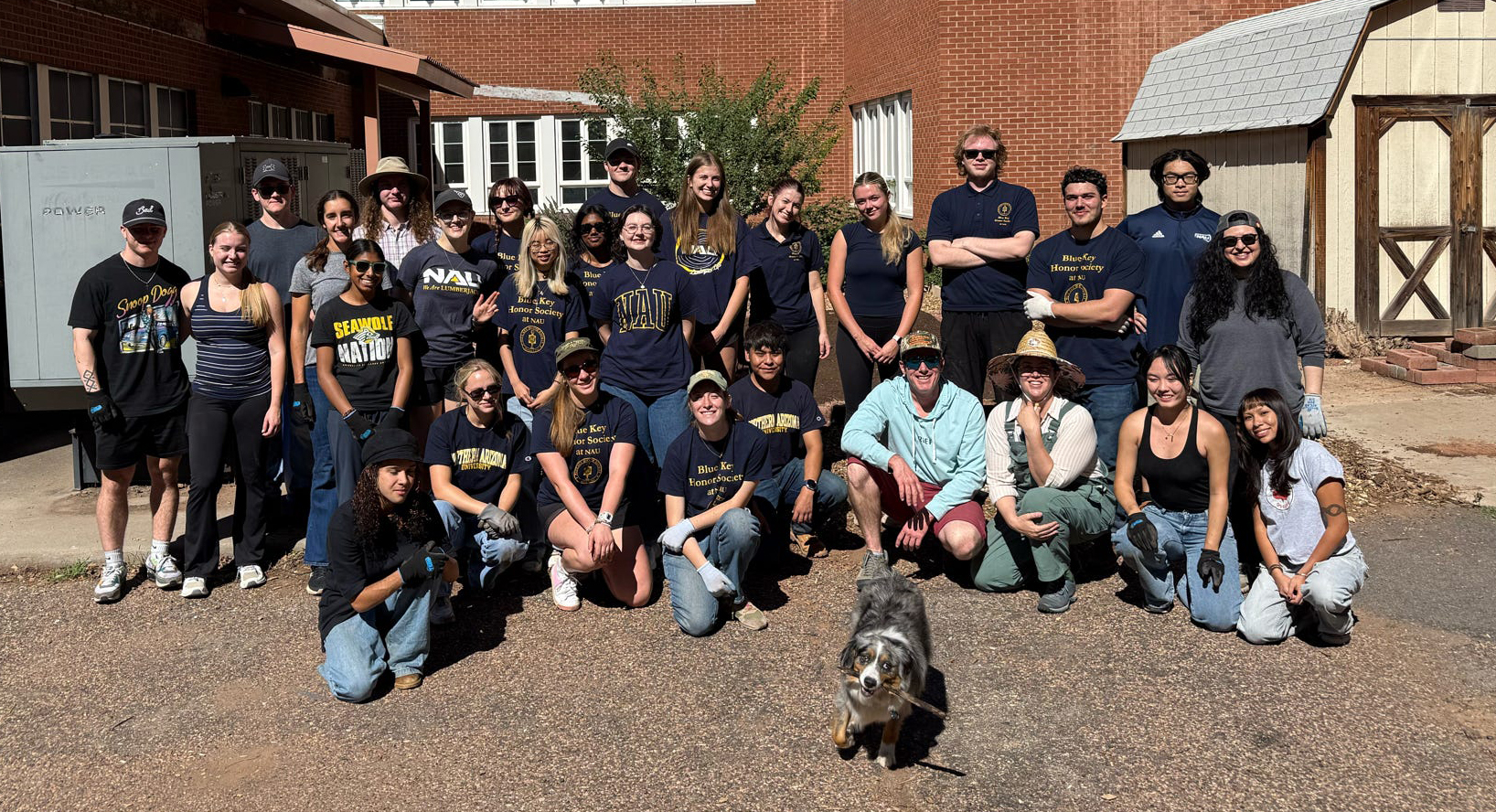
For students volunteering at the garden, the time they spend working there is not only about the skills they will learn, but also about building a community that will witness the fruits of their labor.
“I have always liked gardening and have been interested in sustainable food systems,” said Andrew Kelley, a junior studying ecology and evolutionary biology. “I think this is a wonderful opportunity to get involved and be part of the community the garden creates. So many people of different backgrounds have come together for the garden and the food we will grow there. It is such a welcoming community, and I am excited to see what grows in the garden, especially with the collaboration of HRM and how they will cook all the food that we grow.”
There are three restoration events scheduled for this month: 9-11 a.m. Oct. 10; 4:30-6 p.m. Oct. 14 and 9-11 a.m. Oct. 24. If you are interested in volunteering at the Shand Garden, email Janan Scott.
 Mariana Laas | NAU Communications
(928) 523-5050 | mariana.laas@nau.edu