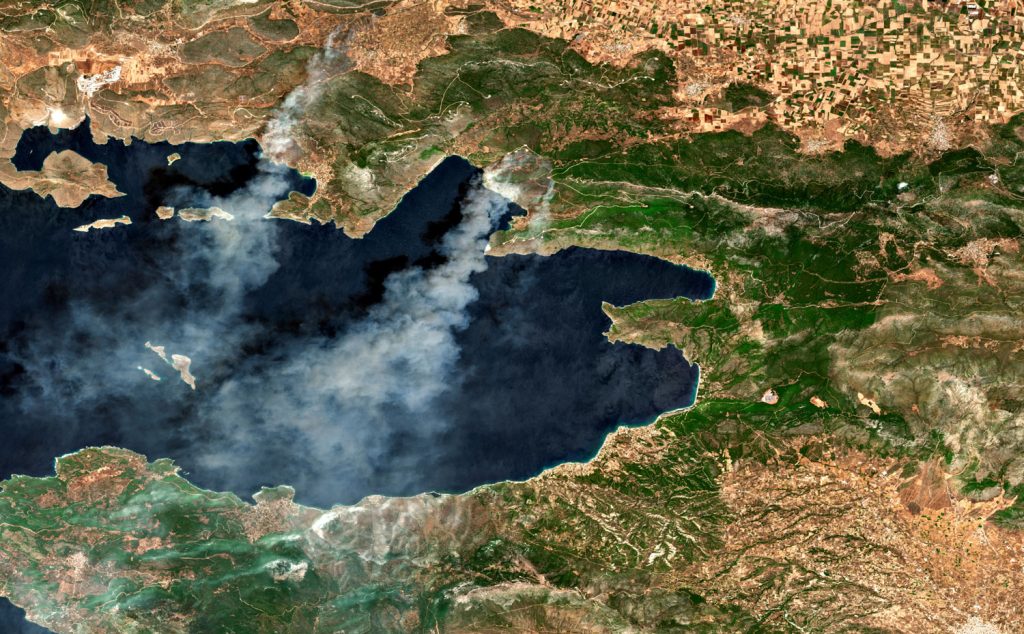


A group of NAU and Flagstaff-based scientists and engineers just captured a coveted award at the XPRIZE Wildfire Competition, winning $250,000 and global recognition.
Team Snuffed won the methodological innovation award and second place overall in the competition’s Space-Based Detection & Intelligence track, beating out a handful of other finalists and an initial field of more than 300 other teams. This is the team’s latest accomplishment on the road to developing hardware and software solutions to a problem that’s relevant both locally and globally.
The award was announced Sept. 23 at the XPRIZE Wildfire Awards Ceremony, held at the New York City Fire Museum.
NAU members of Team Snuffed include David Trilling, a professor in NAU’s Department of Astronomy and Planetary Science, and Alexander Shenkin, assistant research professor in the School of Informatics, Computing, and Cyber Systems. Shenkin is the founder and CEO of EmberSat, a software platform that uses machine learning to analyze publicly available satellite observations over time and identify changes that may signal a developing fire. Shenkin said the tool brings wildfire detection, ongoing fire tracking and contextual clues behind developing fires into one view—helping professionals protect communities and cut down on the cost of wildfires in the United States, an estimated $394 billion to $893 billion annually.
“The challenge is not just detecting fires quickly but also minimizing false positives and making the information easy to act on,” Shenkin said. “Fire managers are already juggling competing demands, often with limited staff, time and resources. EmberSat is designed to reduce their cognitive load, not add another stream of data to sort through.”
At this week’s competition, XPRIZE Wildfire awarded a total of $4.5 million to research teams whose projects will help people and beneficial wildfires coexist safely. The competition challenged teams across two complementary tracks, Space-Based Wildfire Detection & Intelligence and Autonomous Wildfire Response, to prove that speed, accuracy and autonomy can transform how wildfires are detected and addressed at heir earliest, most controllable stage to shorten the time between detection and rapid response, inform management practices and minimize negative impacts. Launched in 2023, XPRIZE Wildfire was sponsored by Pacific Gas & Electric, the Gordon and Betty Moore Foundation, the Minderoo Foundation and Lockheed Martin.
Trilling said that during final testing in April, Team Snuffed’s EmberSat technology monitored approximately 800,000 square kilometers in New South Wales, Australia, delivering detection and fire-characterization information to judges through a live portal and data feeds. But the hope is that EmberSat can cover much more ground in the long term, from fire-prone areas in sub-Saharan Africa and South America to the ponderosa pine forests around Flagstaff, where there have been three major wildfires in the last decade.
“We’re pursuing much broader, ongoing capabilities in stratospheric sensing, resource allocation and fire suppression,” Trilling said. “By bringing a really broad range of technical expertise together, we’re helping to solve a critical problem that’s both local and global.”
Jason Wilder, NAU’s vice president for research, said the team’s XPRIZE win exemplifies NAU’s research goals.
“This,” Wilder said, “is NAU research at its best—partnering with scientists, engineers and fire professionals in our own community to tackle a threat Arizonans deal with every year and produce a solution with truly global reach.”
In addition to Trilling and Shenkin, members of Team Snuffed include Christopher Edwards, a professor in the Department of Astronomy and Planetary Science; Flagstaff-based engineer Cody Hartman; Mike Felts, a fire battalion chief and paramedic in northern Arizona; and a number of other scientists, engineers and fire professionals.

Jill Kimball | NAU Communications
(928) 523-2282 | jill.kimball@nau.edu