


This summer, NAU welcomed 17 first-generation high school students to campus for a month-long journey to explore how AI, social media and communications can be used to address health issues that matter to their communities.
The AI-Advocate Teen Program, developed by Zhan Xu, associate professor in the School of Communication, with support from a National Communication Association Communication Pedagogy Grant, is part of the Upward Bound Math and Science (UBMS) Summer Academy at NAU, a federally funded TRIO program that helps prepare high school students from disadvantaged backgrounds and/or who would be the first in their family to attend college by giving them the skills and motivation they need to graduate high school and continue their path to higher education.
Chris Wilkens, assistant director of student life experience in UBMS and one of the organizers of the program, said they work with students who have an interest in science, technology, engineering and math (STEM) in five targeted high schools in northern Arizona. The goal this year was to teach students how to effectively work with AI and social media to disseminate information to specific audiences.
“AI is shaping their current and future landscape at a rapid pace,” Wilkens said. “Students need to understand it to prepare for modern jobs and to be career-ready in areas of critical thinking skills and learn how to use these tools ethically.”
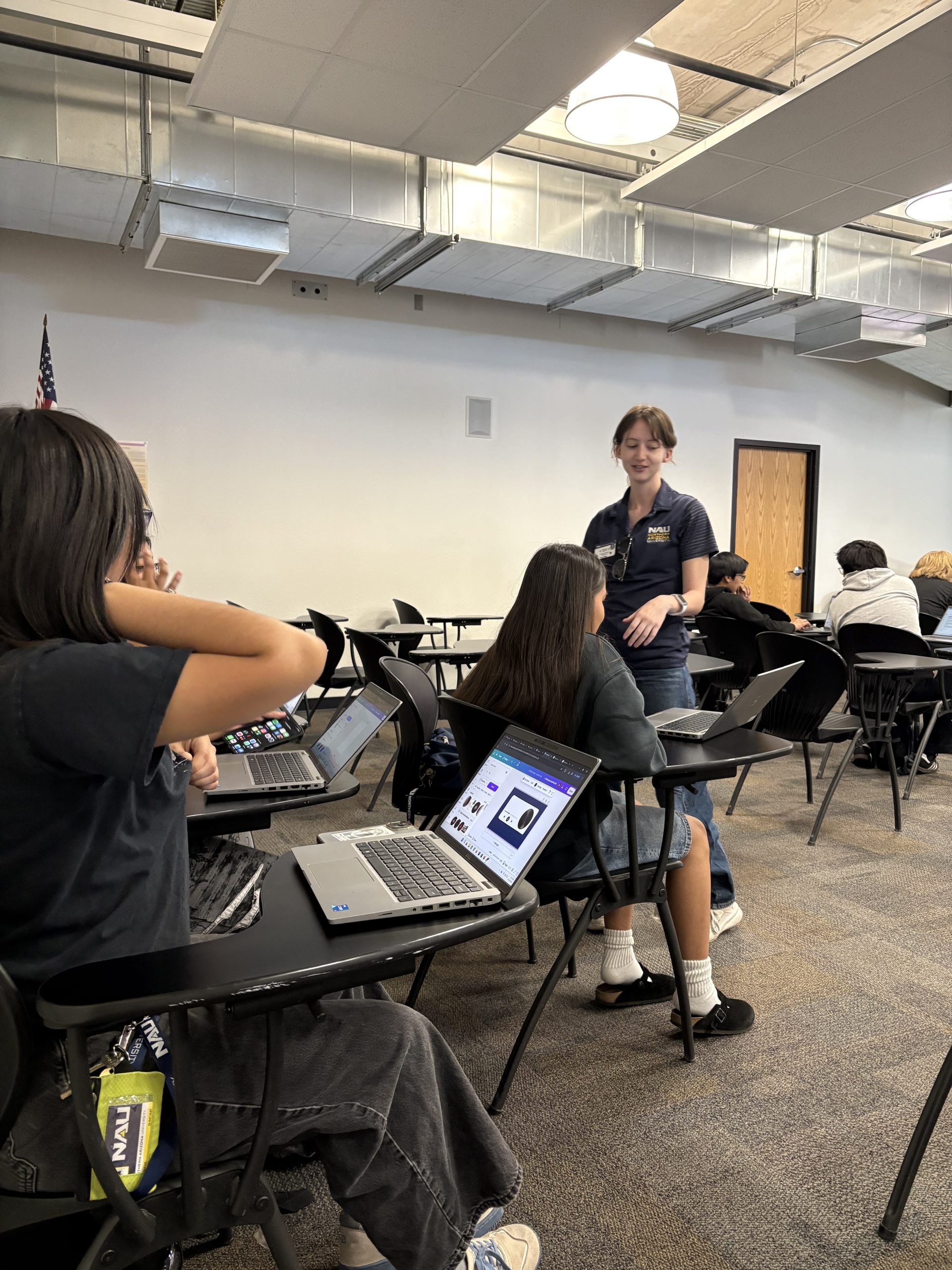
Rebecca Amend, a senior at NAU majoring in creative media and film and strategic communications who is an undergraduate research assistant, served as the instructor for the program. She said that at the beginning, many students expressed skepticism and concerns about AI rather than enthusiasm.
“I expected these high school students to be really big fans of artificial intelligence and found out that a lot of them weren’t,” Amend said. “We had class discussions about the ethics of AI and the pros and cons of using it. My job was to guide them through how they can implement AI in the work that they do and fact-check their sources.”
Students learned to evaluate AI-generated and online content, think strategically about communication and use digital tools responsibly to amplify their messages. As part of their final projects, they designed and launched advocacy campaigns on Instagram focusing on topics that matter to them.
“We initially envisioned a strong focus on public health, but we also wanted students to have room to address broader health, well-being and community issues that were meaningful to them,” Amend said. “As a teacher, it was a lot of fun to see them working on things they cared about, like tips on how to encourage teenagers to get more sleep, mental health, emotional abuse, Indigenous empowerment and creating content about online literacy and using social media platforms responsibly.”
Imani Wallace, a junior at Monument Valley High School who was part of the class, said she enjoyed the experience and learned how AI and social media can be used as tools to connect with each other.
“I learned information about AI and how it is used in certain areas, as well as more details on how it works,” Wallace said. “It is important to be informed rather than to spread misinformation. Social media and AI can make people too dependent and disconnected from reality, but at the same time, many people find them helpful tools for connecting with others and for being themselves.”
For the final assignment, students created a video with a call to action that related to their advocacy topic. Amend said they used AI as a brainstorming tool for written copy, as well as a graphic and image ideas generator.
“It was just wonderful to see their creativity and hear how artificial intelligence kind of supported it when they met roadblocks along the way,” Amend said. “The goal overall was to kind of foster their creativity and help them discover that AI doesn’t have to be all good or all bad; nothing is so black and white, but to learn how it can be integrated in small ways into the work that they’re already doing to support their learning.”
This was the first time NAU implemented the AI-Advocate Teen program, and Xu said the hope is to continue the partnership with high schools and community organizations to bring the program to more young people so that they can continue to learn about how AI and communication education can support youth advocacy.
“Rather than telling young people simply to use or not use AI, I think it is much more valuable to give them the skills to evaluate and use these technologies thoughtfully and responsibly and to show them that these tools can help amplify their own voices and the issues they care about,” Xu said. “One of the most rewarding parts of the program was seeing how much we, as adults and educators, can learn from young people. I went into the project thinking about how we could teach students to become advocates, but the experience reminded me that many of them are already advocates. Our role is often to give them additional tools, opportunities and confidence to communicate more effectively.”
 Mariana Laas | NAU Communications
(928) 523-5050 | mariana.laas@nau.edu