

For centuries, historians have drawn the boundaries of where ancient people lived based on the evidence they left behind; by studying their remains, burial practices and other archaeological clues, they can determine the types of relationships they had with other people in the area. However, this can all change when new archaeological evidence is found.
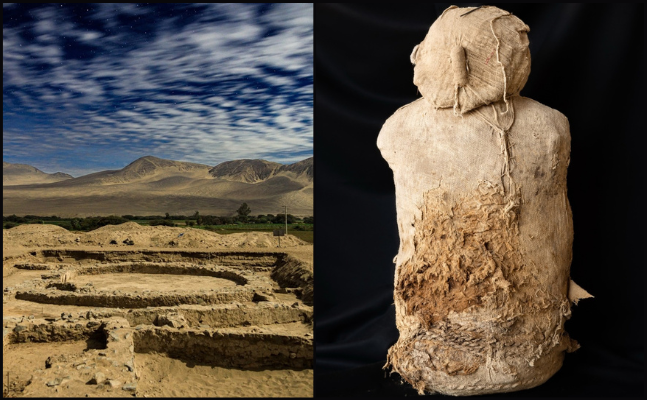
In 2018, Corina Kellner, a biological anthropologist and professor in the Department of Anthropology, was part of a team selected to excavate Huaca del Loro, a large site on the south coast of Peru where the Nasca civilization lived between 1-750 C.E. She returned with a team to work in the area in 2022 and what they found might tell a new story about a piece of the region’s history.
“During our second field session we encountered four wrapped mummified individuals, seated and flexed, with their knees to their chest and their hands around their face,” Kellner said. “That’s typical for a lot of burials in Peru, but what makes these individuals so interesting is that we found them buried by a Wari temple and not in the cemetery like the rest. Also, they were undisturbed for over 1,000 years, which is uncommon in Peru.”
The Wari Empire is thought to have conquered the Nasca civilization; however, the finding of these mummies raises the question of whether the area was colonized with collaboration from both cultures rather than captured through violence.
Following the shroud
To get more answers, and with funds from the NAU Scholarly Research and Creative Grant Program and the H. and T. King Grant for Archaeology of Ancient Americas administered by the Society for American Archaeology, Kellner returned to Peru for five weeks this summer and worked alongside Melissa Lund, a professor at the Pontifical Catholic University of Peru (PUCP) and Alexandra Oshiro, a graduate student at PUCP, both part of the Research Group in Bioarchaeology and Forensic Anthropology in Lima.
“When we first found these individuals, we were able to get X-rays and worked with a radiologist and a doctor to interpret the results,” Kellner said. “This time, with permission from the Ministry of Culture and help from a group of archaeologists from Peru and Susana Arce, director of the Museo Nacional de Lima, where they mummies are kept, we took them out of the museum and did CT scans and took DNA samples. We also took samples from other people and animals found at the site, so that we could run isotopic analysis that will help us figure out diet, relationships and migration patterns.”
Huaca del Loro was occupied during a period of transition called the Middle Horizon, which marked the end of the Nasca civilization and the beginning of a period of state influence by the Wari Empire and the Tiwanaku in Bolivia. Kellner said research on human remains will help them find clues to determine whether the Nasca interacted with the Wari Empire when it came into the region and, if so, what kind of relationship they had.
“We are looking for colonization techniques to see if there was any type of resistance and to determine how complex their relationship was,” Kellner said. “We usually think of colonization as this rough and tumble violent thing, but that is not always the case. Other techniques can influence areas or regions, like what people might want from each other. These findings make us think that the Wari and the Nasca had a previous relationship and that the Nasca civilization might have supported the Wari Empire.”
Kellner said the relationship between these two groups might have been related to ceramic technology, since the Nasca are known for their techniques and colors. It might also have been about textiles and their need for cotton. The Wari Empire settled in Ayacucho, a high-elevation area where planting cotton might have been difficult, while the Nasca lived at a lower elevation ideal for growing cotton and coca leaves, among other crops.
Unwrapping the story
Once Kellner receives the results for the DNA samples and CT scans that were taken, she will begin the isotope analysis at NAU’s Anthropology Isotope Paleodiet lab with the help of her students.
They will interpret the CT scans and review the results of the isotope analysis. Kellner is hoping this helps shed light on how different societies interact with each other.
“We always think we’re fighting with each other, but humans are social animals, and we do cooperate and take advantage of the different strengths of each society,” Kellner said. “Looking at the Nasca region, we kind of turned upside down a little bit of what we thought the Wari were doing in the area.”
Kellner is hoping for a long-term collaboration with the museum in Ica to keep researching and finding answers about these cultures, so that they can go back and share them.
“This is their cultural patrimony; these are their ancestors, and they deserve to know how wonderful and successful they were,” she said.
Top image: Photographed by Jerod Roberts, 2022Huaca del Loro, Peru and Fardo (Mummy Bundle #2)
 Mariana Laas | NAU Communications
(928) 523-5050 | mariana.laas@nau.edu