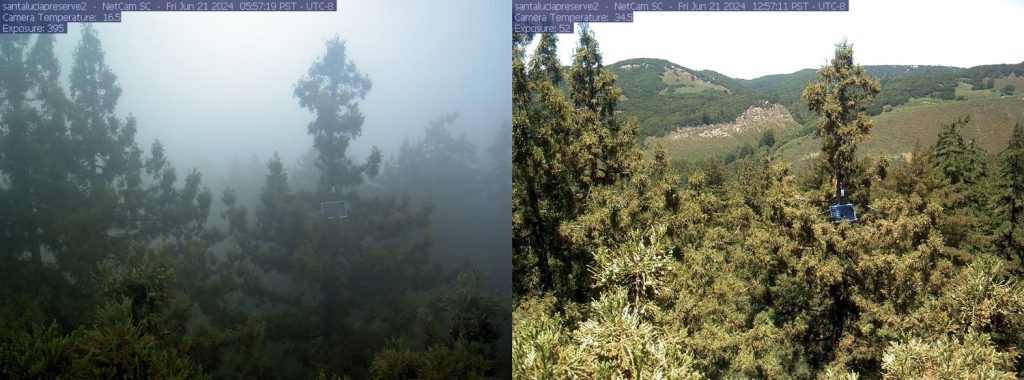


California’s redwood forests are a national treasure. And the coastal fog that often covers the trees in a mysterious gray shroud? That’s no less beloved.
A few researchers at NAU believe those trees, and that fog, are worth protecting. So they’re using machine learning to investigate how the two work together to create a healthy, resilient forest—and how less fog due to climate change may spell trouble for redwood trees in the coming decades.
Camelia Mosor, a third-year undergraduate student at NAU, said it’s well known that fog is a significant source of water for coast redwoods, also known as Sequoia sempervirens. When fog descends on a forest, the redwoods absorb the moisture through their leaves and roots. Researchers previously found that the California coast’s signature summer nighttime fog is associated with an increase in the growth efficiency of redwoods.
“We also know,” Mosor said, “that the frequency and intensity of summer fog has declined due to climate change, which has the potential to exacerbate drought sensitivity in coastal plants” like the coast redwood.
Fueled by funds awarded to her by Save the Redwoods League, Mosor is training machine learning to detect and analyze fog levels in images taken in a redwood forest in Monterey County, California. Those images, taken once per hour inside the Santa Lucia Preserve in Carmel Valley for two years, come courtesy of the PhenoCam Network, a project directed by NAU Regents’ professor Andrew Richardson that chronicles changes in natural landscapes using phenology cameras.
Mosor said it would take a human hundreds of years to analyze that many images. But with machine learning, it takes a small fraction of the time.
“By training a machine learning model to analyze and automatically detect fog in redwood forest PhenoCam images, I’m providing a new and efficient method of detecting fog,” Mosor said. “Ultimately, I aim to create a method for automated fog detection that will be useful in enabling further research into the role fog plays in redwood forests.”
Once she’s trained artificial intelligence to accurately recognize the fog, Mosor said, she can immediately apply the machine learning model to other foggy redwood forests across the region where PhenoCams exist, including in Sonoma, Santa Cruz and Del Norte counties.
The climate change part
Mosor’s project is just one piece of a larger research effort at NAU, led by Richardson and Center for Ecosystem Science and Society professor George Koch, that aims to understand how Northern California’s fog patterns are changing as the climate warms—and what that means for the future of the coast redwood.
Along with photos of the forest, NAU scientists are taking regular measurements of temperature, relative humidity, visibility, leaf wetness, tree water stress and redwood trunk diameter, which are then streamed back to facilities at NAU. Koch said the idea is to understand how moisture in the atmosphere controls tree growth. Trees tend to dehydrate and shrink over the course of the day, then rehydrate and grow at night as the water provides fuel for them to produce new wood cells.
“We know that trees grow primarily during the spring through early fall period,” Koch said. “We are testing the hypothesis that, within this period, growth is greater during foggy episodes because the plants are able to rehydrate more fully.”
If Koch’s hypothesis is true, trouble may be ahead for certain redwood forests that aren’t seeing as much fog as they used to. According to researchers at the Pacific Coastal Fog Research project, fog in Monterey County and other California coastal areas has declined by 33% in the last century. That likely means coast redwoods aren’t growing at the same rate they once were, at least in some forests.
But with help from the NAU PhenoCam Network and Mosor’s machine learning models, scientists and their partners can identify the problem early and take steps toward confronting it.
“Government agencies, nonprofits and others can use this data to inform policy on conservation and identify the redwood forests most in need of conservation efforts,” Mosor said. “Additionally, analyzing the changes in fog presence could be used to predict how fog will manifest on the coast in future years, which could assist with work in weather forecasting and the study of changing weather patterns due to climate change.”

Jill Kimball | NAU Communications
(928) 523-2282 | jill.kimball@nau.edu