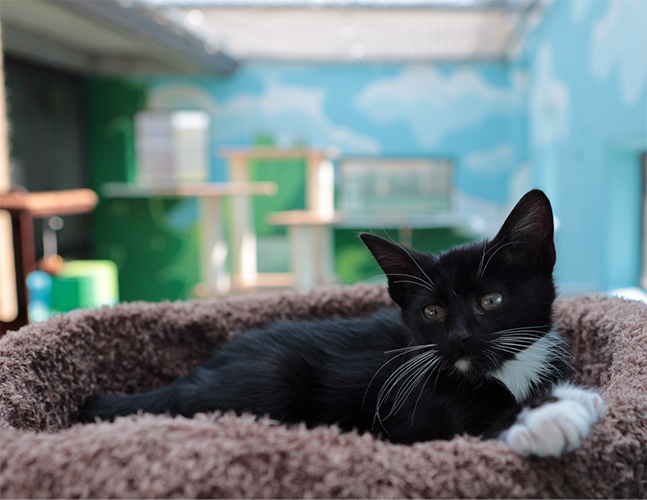


What started as a project to help High Country Humane keep their cat population happy became an opportunity for students, community members and local businesses to come together with one shared purr-pose: giving cats their best (nine) lives in the shelter.
Jessica “J.R.” MacKenzie, a professor of practice of interior design at the School of Art + Design (SoA+D), was contacted by Tresban Rivera, former executive director of High Country Humane, to volunteer her time and expertise for the remodeling of their outdoor catio after the non-profit received a grant from Purina.
For MacKenzie, the decision was an easy one. Being a cat lover, a designer and an animal artist, she not only volunteered her time but also helped recruit local businesses and NAU students to participate in the renovation of the space.
 “It took about a year,” MacKenzie said. “I created the initial concept, and through collaboration with professionals in our community, the design evolved into the finished space. There was a lot to consider in terms of physical design, like daily maintenance and the ever-changing seasonal weather in Flagstaff. However, I also wanted to integrate cat psychology and behavior into the design to make it a special space for them to de-stress and be themselves.”
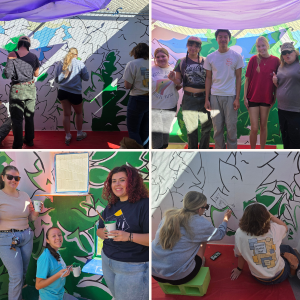
The space includes a four-wall mural designed by emerging artist Serina Boynton, which MacKenzie said was one of her favorite parts of the project since she was able to work alongside 25 of her interior design students to help paint it, giving them not only the opportunity to have fun painting a mural and see how murals can paw-sitively impact a space, but also to understand the full scope of time, effort and materials to professionally install a mural for an interior-related project.
“Participating in the project made me feel very good,” said Hailey Unseth, a junior studying interior design. “I am a big animal lover and enjoyed helping create this space for the cats while giving back to the Flagstaff community. I learned that even this area of design isn’t just about the visual appeal of a space, but the functionality and enjoyability for both people and animals. These types of projects help prepare us for teamwork and what we will be experiencing in our careers.”
The mural design reflects the Flagstaff landscape, featuring towering mountains and billowy clouds that subtly take on the shapes of cats. The mural also depicts tall painted pine trees housing local wildlife, including squirrels and woodpeckers, while tiny cats are depicted enjoying outdoor recreational activities such as snowboarding, skiing, fishing and picnicking. The overall aesthetic has a playful, whimsical, anime-inspired style.
MacKenzie said another objective of the project was to keep the space divided so adult cats could inhabit one side while kittens played in the other. Considering sanitation and weather conditions, the team created a space that could stand the test of time and be flexible. To make the space more interactive for cats, MacKenzie designed a block wall system into the main divider. Individual blocks were designed to be rotated and protrude into the space resulting in openings and pockets for cats to crawl, explore and play, allowing them to physically engage with the architecture of the divider. The design also includes different cat towers and furniture pieces that can be changed out and arranged as needed.
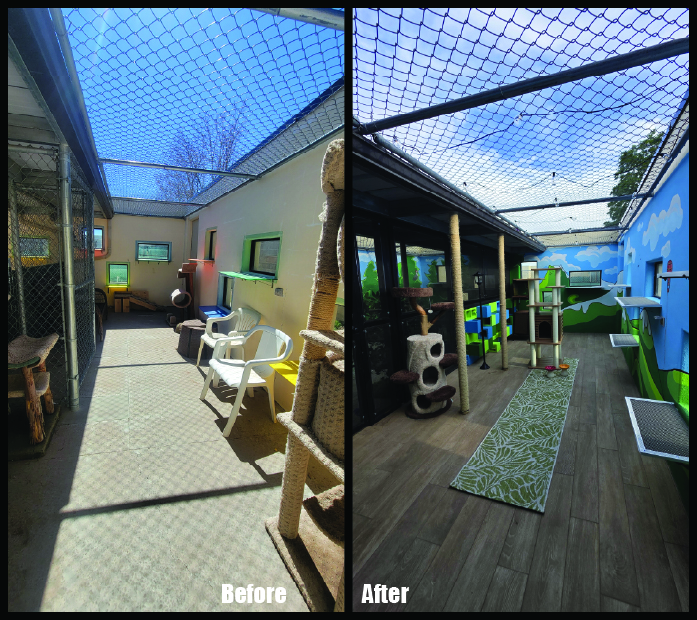 With the help of Sutton Boynton, a welder from CB Mobile Welding, and Tom Gebler, a flooring expert from Floor Coverings International, the catio became a functional and aesthetically pleasing area where students could witness the time, effort, knowledge of materials, color theory, construction, installation and budgeting that come together to make a successful project.
“The overall aesthetic of a space has an impact on our psychological impression of it and how we feel when we live in them, work in them or in this case—helping cats be cats in them. Design should be human-focused—or cat-focused—and I wanted the students to understand how some of the things we do in the built environment can have an impact on the quality of life. I also want them to see that art does have an impact on a space. At its core, design is about creating better experiences, stronger communities and more meaningful places to live. “
 Mariana Laas | NAU Communications
(928) 523-5050 | mariana.laas@nau.edu