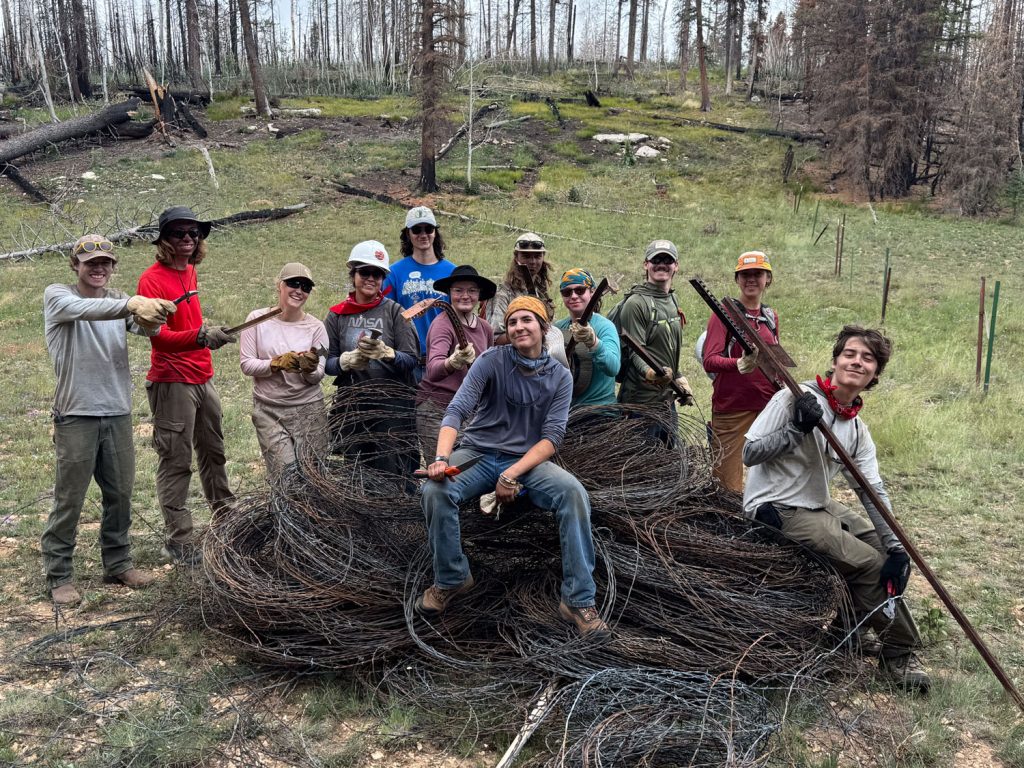


When the 2025 Dragon Bravo fire ripped through thousands of acres on the North Rim of the Grand Canyon, it didn’t just destroy ponderosa pine forests and a historic lodge. It also mangled 40 miles of barbed-wire fencing, creating a hazard for wildlife passing through these lands.
In response, the NAU community didn’t sit by idly. Building on an existing partnership between the university and the nonprofit Grand Canyon Trust (GCT), Honors College professor Ted Martinez arranged for his Grand Canyon Semester students to help clear five miles of the damaged wire and fenceposts over two full days in August.
“Grand Canyon Semester took their first trip of Fall 2026 to the North Rim to work with GCT and Grand Canyon National Park as a way to give back to the park and participate in on-the-ground conservation work,” Martinez said.
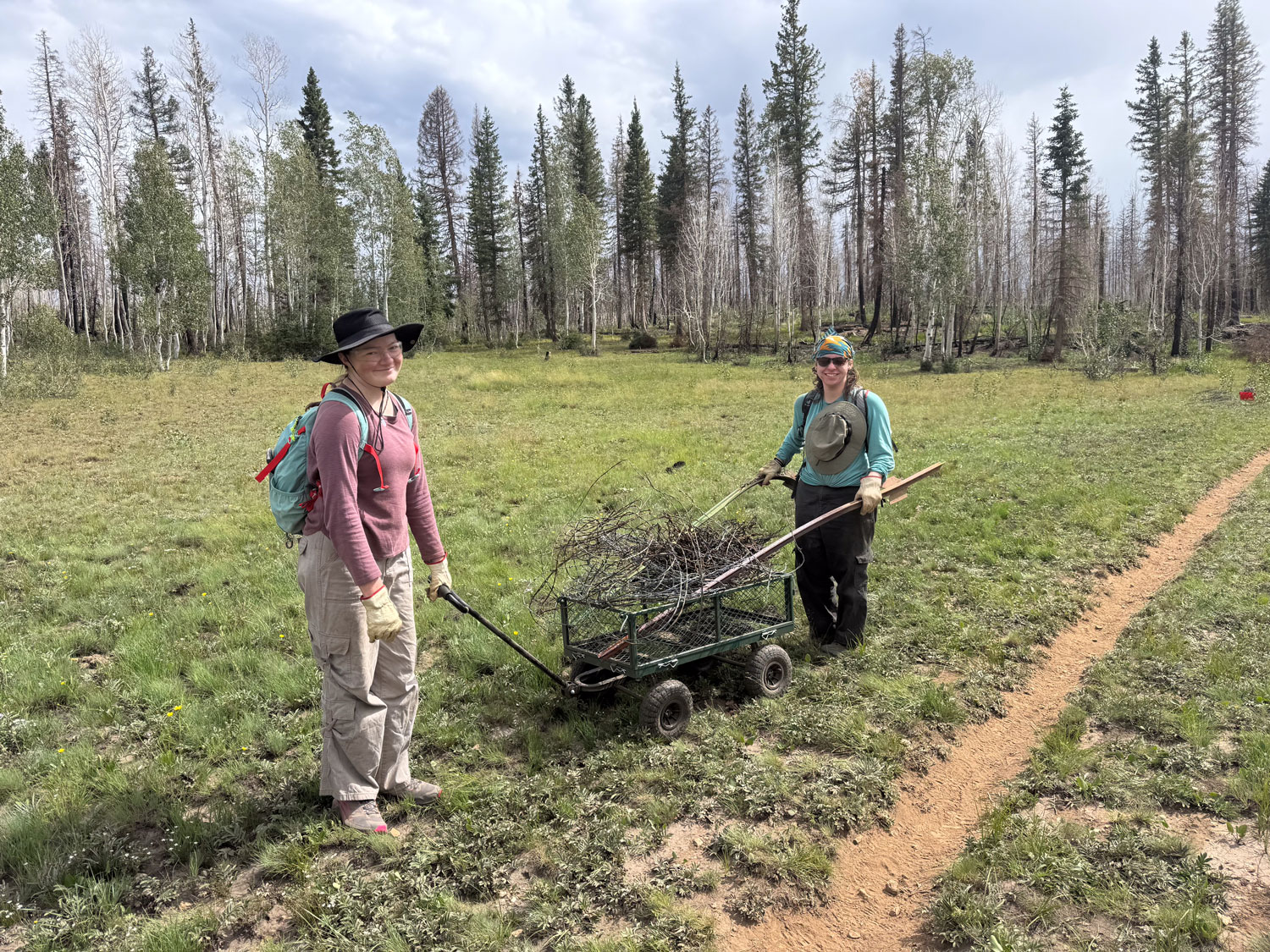
The unique Grand Canyon Semester program mixes classroom discussion with hands-on experience across northern Arizona’s public lands. Through multiple overnight outings to the region’s canyons, mountains and high plateaus, students get practical lessons in geology, biology, recreation, tourism, Indigenous history and culture, art and more.
Martinez said many Grand Canyon Semester students hope to become public lands policymakers, park rangers or environmental engineers after graduation, so a hands-on experience like this is priceless.
“We were in a remote area where there were no fancy overlooks or popular trails,” Martinez said. “The students saw parts of the North Kaibab National Forest and the national park that most people haven’t visited. They left with a deep knowledge of land and place.”
“Being able to make our natural spaces even a little more habitable after the Dragon Bravo Fire was truly an amazing opportunity.”
LeaLynn Scott, junior, environmental sciences
For Samuel Grumeretz, a senior majoring in journalism and minoring in studio art, the volunteer experience echoed a childhood spent camping and working on outdoor service projects. As an aspiring nature documentarian, Grumeretz said taking part in the clean-up project taught him more about the kind of conservation work he aims to capture on film.
“I learned a lot about the nature of on-the-ground work for conservation and got to participate in it myself, something I’ve always wanted to do more of and thoroughly enjoyed,” Grumeretz said. “It gave me contacts in the conservation world and personal experience that will inform and enhance my work in the future.”
“I had the assumption that to conserve we must be hands off and let nature run its course. This project proved that wrong for me. There are things we’ve done to impact the natural world that will not be erased unless we put in effort to fix them.”
Charles Root, junior, ceramic arts
Audrey Kruse, the community engagement director at Grand Canyon Trust, said that due to recent federal budget and staffing cuts, the nonprofit and the park it supports is increasingly reliant on volunteers to assist with recovery work like this.
“Volunteer capacity is one way the public can support the ongoing efforts of our public land agencies right now,” Kruse said. “They’re crucial to making sure the incredible treasures that are our national parks can continue to welcome visitors and people with ancestral ties to the land.”
“This experience allowed me to see firsthand the anthropological effects infrastructure has on all realms of biology.”
Justine Bushman, sophomore, environmental sciences
The students’ volunteer work is part of a partnership between Grand Canyon Semester and GCT that dates back more than a decade. Kruse herself benefited from the partnership in 2014 when, as a graduate student, she worked as a TA for the program.
“Both the program and our organization are focused on boots-on-the-ground work that enriches people and communities, so it feels like a natural partnership,” Kruse said. “So many Grand Canyon Semester alums are now leading students on these experiential learning trips. I was really moved interacting with GCT staff back in graduate school, and now I get to pay that forward. I see it as a wonderful infinity loop; we’re all tied together, giving back to each other.”

Jill Kimball | NAU Communications
(928) 523-2282 | jill.kimball@nau.edu