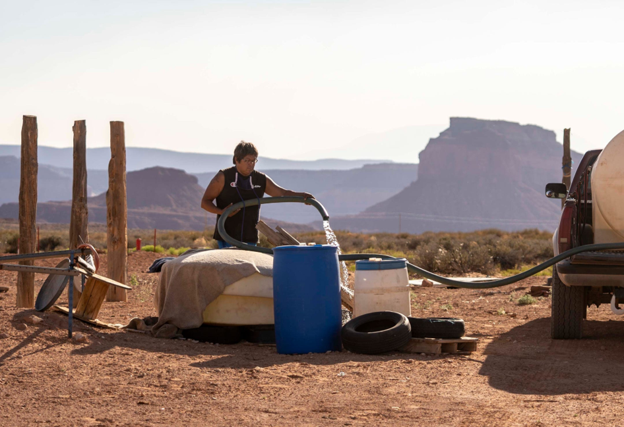


Since the dawn of uranium mining in the American Southwest, residents of the Navajo Nation have grappled with the grim health effects of exposure to radioactive material. That’s why NAU chemistry professor Jani Ingram and a team of researchers, in partnership with Navajo Nation leaders, have been working to help these communities access safe, chemical-free drinking water.
About a third of households on the Navajo Nation don’t have access to piped water and rely largely on well water as a drinking source. But because of the region’s extensive history of uranium mining, and because private well water isn’t regulated by the Safe Drinking Water Act, much of that water is contaminated and unsafe to drink. Working with fellow NAU faculty members Nicky Teufel-Shone, Tommy Rock, Diana Calvo Martinez and a network of Diné residents, Ingram sampled water in wells throughout the region and assisted in creating a map showing where well water is safe to drink and where it’s best avoided.
“We’ve provided them our data on those wells,” Ingram said. “You can see where your community is on the website map, and you can click on a well and get information about it.”
Ingram, whose mother is a member of the Navajo Nation, shared findings from the research project at a recent meeting of the American Chemical Society. Her presentation was part of a symposium titled “Community Engagement as a Catalyst for Clean Water Quality Management.”
In the presentation, Ingram explained that from 1944 to 1986, Navajo Nation lands across Arizona, New Mexico and Utah were extensively mined for uranium, a heavy metal found in rocks that’s used to build nuclear weapons and generate nuclear power. She said she remembered hearing stories from Diné relatives who worked in the uranium mines.
“I didn’t really know the extent of the abandonment of those mines,” Ingram said. “I think you assume people clean up their messes, and that didn’t happen.”
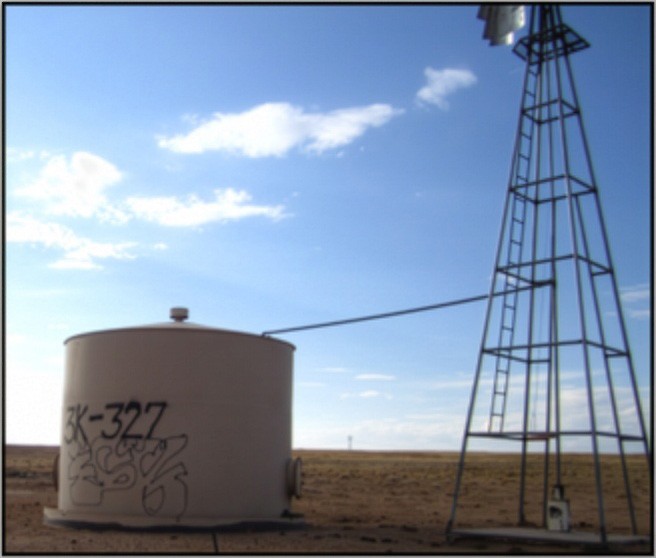
The abandonment of these mines led to uranium and other heavy metals seeping into nearby water resources. Although efforts are now underway to clean abandoned uranium mines, many still have the potential to contaminate the wells that supply drinking water for people and livestock. Uranium exposure has been linked to life-changing health issues such as kidney disease, lung cancer and fertility challenges.
“It became clear that no one was monitoring these wells,” Ingram said. “Everyone on the reservation in that situation is on their own to find a water source for their households.”
Ingram worked with Navajo Nation tribal leaders to investigate potential water contamination, identifying and measuring the amount of uranium and other heavy metals in the reservation’s water wells.
Because many of the wells were on rural lands that are difficult to reach, Ingram relied on Diné residents and students to accompany her and locate wells from which to retrieve water samples. She and her collaborators found that uranium levels in some of the wells were above 30 parts per billion, the upper limit for safe drinking water set by the U.S. Environmental Protection Agency. The research team also found elevated levels of arsenic and manganese in some samples, other harmful substances that can cause cancer and neurological disorders.
Ingram’s team and her Navajo Nation collaborators designed and distributed educational materials identifying which wells were considered safe for sourcing drinking water. They also attended tribal community meetings on reservation lands, spoke to community leaders and identified other culturally appropriate ways to share their findings with community members.
Ingram also provided data to other community organizations working to educate residents on safe water sources. For example, the data are accessible on a website built by the University of New Mexico that maps wells that have been tested on reservations.
Ultimately, Ingram said, her goal is to provide peer-reviewed water quality data that Diné leaders can use to support their requests for improved infrastructure.
“Having this data is really good for the community,” Ingram says. “If they request that a new well be dug, it tends to be that the deeper the well, the cleaner it is. If they have a regulated well, they can request a filter system for it. Our data gives them another tool to help make those arguments.”
The research was funded by the National Cancer Institute, the National Institute of Environmental Health Sciences, the Environmental Protection Agency, the American Cancer Society, the Native American Research Centers for Health and the U.S. Department of Energy.

Jill Kimball | NAU Communications
(928) 523-2282 | jill.kimball@nau.edu