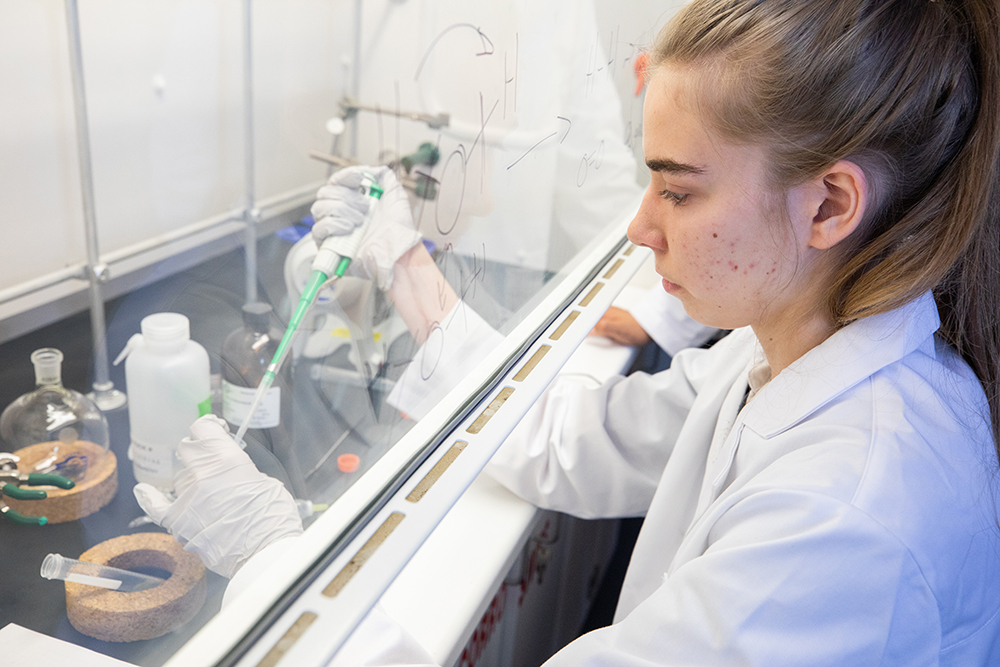


Northern Arizona University received its first T32 grant from the National Institutes of Health, which will allow the university to fund 20 doctoral students over a five-year period.
The grant, awarded to G-RISE at Northern Arizona University, is $1.76 million over five years, providing funding for 20 doctoral students in four different disciplines. Powered by grant funds, G-RISE is focused on increasing the breadth and quality of the biomedical and health-focused science workforce in the United States, which will contribute to greater public and community health.
Between a quarter and a third of applications are funded each year, according to the NIH.
“Through training in foundational research skills, hands-on research and career development activities, G-RISE students will develop the skills needed to not only contribute to but also lead biomedical and translational research projects,” said Dirk de Heer, a professor in the Department of Health Sciences and principal investigator on the grant. “Ideally, these students will be able to use their skills to address the pressing health challenges facing our nation.”
De Heer said the goal is to use the funding to support eight students per year for two years each. Any NAU doctoral students in their second year of studies in biological sciences, informatics and computing, interdisciplinary health or earth sciences and environmental sustainability will be eligible for funding, including tuition support, a stipend of almost $30,000 a year and faculty mentorship. More than 40 faculty members have signed up to be mentors,
Anita Antoninka, associate research professor in the School of Forestry; Cathy Propper, professor in the Department of Biological Sciences; and Jani Ingram, Regents’ professor in the Department of Chemistry and Biochemistry are co-PIs. Kelly Laurila, a research scientist in the Center for Community Health and Engaged Research (CHER) is lead evaluator.
“This T32 award is a powerful endorsement of our faculty’s research excellence and our university’s commitment to advancing biomedical and health‑focused discovery,” said Janelle Chiasera, dean of the College of Health and Human Services. “This NIH investment will elevate outstanding doctoral scholars, expand our research capacity and strengthen the scientific workforce our communities depend on. We are grateful for the collaborative leadership that made this possible and look forward to the impact these scholars will have across Arizona and beyond.”
The grant highlights NAU’s strong pool of faculty mentors with a history of external funding and internationally renowned research and the excellence of current and future doctoral students, de Heer said. NAU also is well positioned for this work because of its institutional commitment to educational excellence and upward mobility.
“This T32 award from the National Institutes of Health gives NAU doctoral students vital support to pursue research that will tackle health challenges facing communities in Arizona and beyond,” said NAU President José Luis Cruz Rivera. “This program reflects NAU’s values of access and impactful research, and it will leave a lasting mark on our university. I am grateful for our faculty who led this proposal and who will support the research, mentorship and success of our doctoral students on their journeys at NAU.”
 Heidi Toth | NAU Communications
(928) 523-8737 | heidi.toth@nau.edu