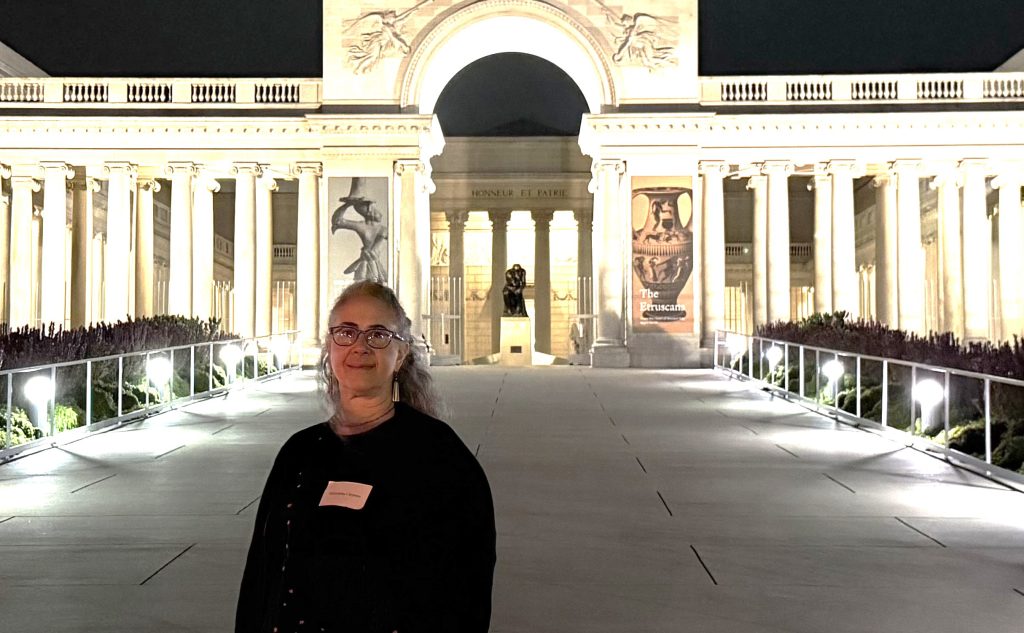


Alexandra A. Carpino, a professor of comparative cultural studies and associate dean of the College of Arts and Letters, was one of four scholars invited to present at an opening day symposium for the first international exhibition of Etruscan art in the United States since 2009. She answered a few quick Qs about her presentation at San Francisco’s Legion of Honor Museum, the two articles she co-wrote for the catalogue that accompanies the exhibition and the history of some Etruscan women who earned a reputation for being modern and independent.
Tell me about “The Etruscans: From the Heart of Ancient Italy” exhibition.
Many Americans are less familiar with the Etruscans compared to their contemporaries, the Greeks and the Romans, and one of the goals of the exhibition was to highlight the significance of their 1,000+-year history on the Italian peninsula, along with their contributions to both Rome and western civilization. Emphasis is placed not only on their technical mastery of terra cotta and metals such as gold and bronze but also on how their material culture reveals their unique social values, customs and beliefs—when viewed together, the goal was to highlight one of Italy’s richest and most innovative pre-Roman civilizations.
Several artifacts have never before been exhibited in the U.S., including the Piacenza Liver (a bronze model of a sheep’s liver inscribed with the names of Etruscan deities and which was used by priests to interpret messages from their gods), the liber linteus zagrabiensis (a religious text written on linen which was preserved because it was later used as the binding for an Egyptian mummy) and the Ombra di San Gimignano (a bronze votive of a priest in a quintessentially Etruscan elongated and abstract style). Lenders include numerous Italian museums and foundations, as well as the Musée du Louvre, the British Museum, the J. Paul Getty Museum, the Metropolitan Museum of Art in New York and many more.
What did your presentation cover?
My presentation, “Mirrors, Myths & Matrons: Reflections on Etruscan Art and Society,” focused on a quintessentially Etruscan artifact—the bronze mirror— whose sheer number and craftsmanship make it one of our most important sources of evidence for understanding their society. While mirrors have been found in the tombs of males and there is nothing to suggest that their use, similar to the wearing of jewelry, was limited by gender in Etruria, both archaeological and artistic data reveal a special association between mirrors and elite matrons. Far more than grooming tools, these objects signaled a matron’s wealth and social standing and were even used as instruments of divination, especially at weddings. What also sets the Etruscans’ mirrors apart from other ancient Mediterranean examples is their engraved or relief decorations, especially on their non-reflecting sides, which include scenes of myth, ritual and domesticity that reveal the interests, values and visual literacy of their owners. My presentation focused on the six mirrors and one bone mirror handle that were on display in the exhibition, each of which revealed something unique about Etruscan art and society.
Tell me about the two articles you wrote for the exhibition.
For the catalogue accompanying the exhibition, I co-authored two essays. For the section “Art and Iconography,” I co-wrote “Engraved Mirrors and Cistae;” and for the section “Cultural Identity and Gender,” I co-wrote “Customs and Social Practices: Women in Etruria.” The first essay provided an overview of two important Etruscan object types associated with women: bronze mirrors, which were used both for grooming and divination and whose engraved imagery significantly augments our understanding of local beliefs, customs and ideologies; and cistae, cylindrical bronze toiletry boxes also enhanced with engraved imagery.
The second essay considered the centrality of elite women within Etruscan society by outlining certain customs and social practices not found elsewhere in the ancient Mediterranean. These include the Etruscan onomastic system which had, as its fundamental unit, a family name which was inherited by freeborn offspring from their father at birth and which women maintained even after marriage. Funerary art and grave goods further demonstrate the wealth that some women amassed during their lifetimes, along with their status and taste for international wares, while art found in sanctuaries highlights their roles as priestesses and devotees. All in all, elite Etruscan women enjoyed privileges that have earned them a reputation for being among the most “modern” and “independent” for their time.