

Here’s what we know about the outer solar system: It’s really cold. Travel beyond the asteroid belt, and you’re suddenly surrounded by ice-covered planets, stars, moons and many other small objects.
Here’s what we don’t know about the outer solar system: how most of that ice behaves.
With funding from the National Science Foundation’s prestigious Graduate Research Fellowship Program (GRFP), NAU Ph.D. student Ivy Knudsen is trying to change that. Over the next three years, she’ll use computer modeling to predict how different chemical compounds behave in the ice on Pluto, helping scientists understand how the dwarf planet formed and how shifting ice might have created pockmarks on its surface.
Knudsen said she plans to make her computer models public, a move that could advance science in space and on Earth.
“I’m motivated by those big questions: How did the solar system form? How did things get here?” Knudsen said. “But beyond that, I’m motivated by the thought that my findings can help people study fluid dynamics here on Earth. What happens if you mix a new liquid into a fuel reservoir? How does ice react if some hazardous chemical is in the ocean and makes its way to the bottom of a glacier? This software could be broadly applicable to aerospace, geology and even marine biology.”
Knudsen, a Ph.D. student who is studying astronomy and planetary sciences, is one of five current and former NAU students selected for the GRFP this year. The three-year program funds the fellows for three years as they conduct research and work toward their degrees.
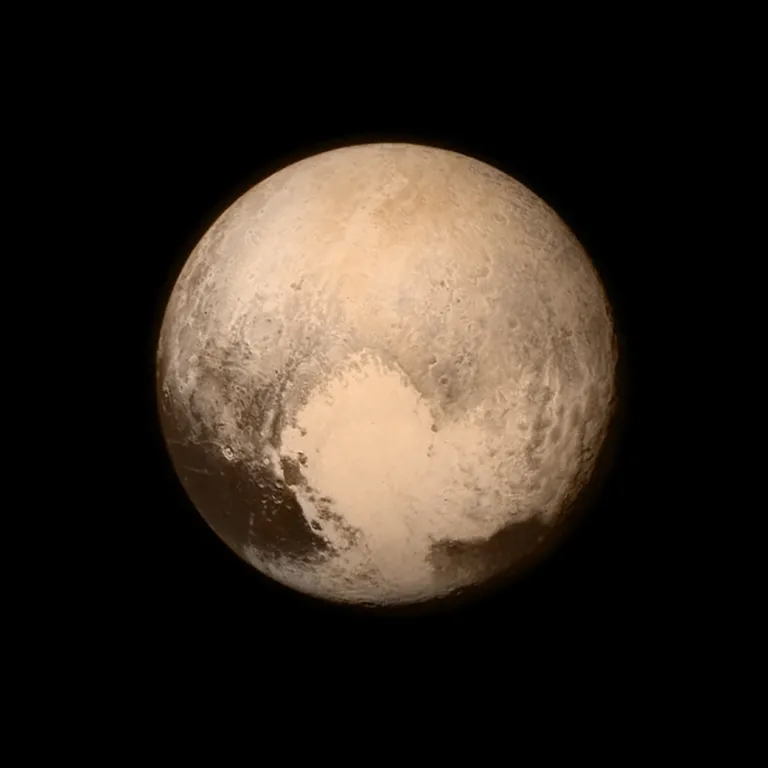
Knudsen explained that ice is more than just cubes in your freezer. Both here on Earth and out in space, ice can be made of much more than hydrogen and oxygen. Because the high-tech James Webb Space Telescope is fitted with spectrometers, scientists have previously deduced that Pluto is made mostly of methane, nitrogen and carbon monoxide ices.
But how has that ice behaved over Pluto’s lifetime? That’s hard to know, Knudsen said—partly because it’s challenging for us to duplicate those conditions.
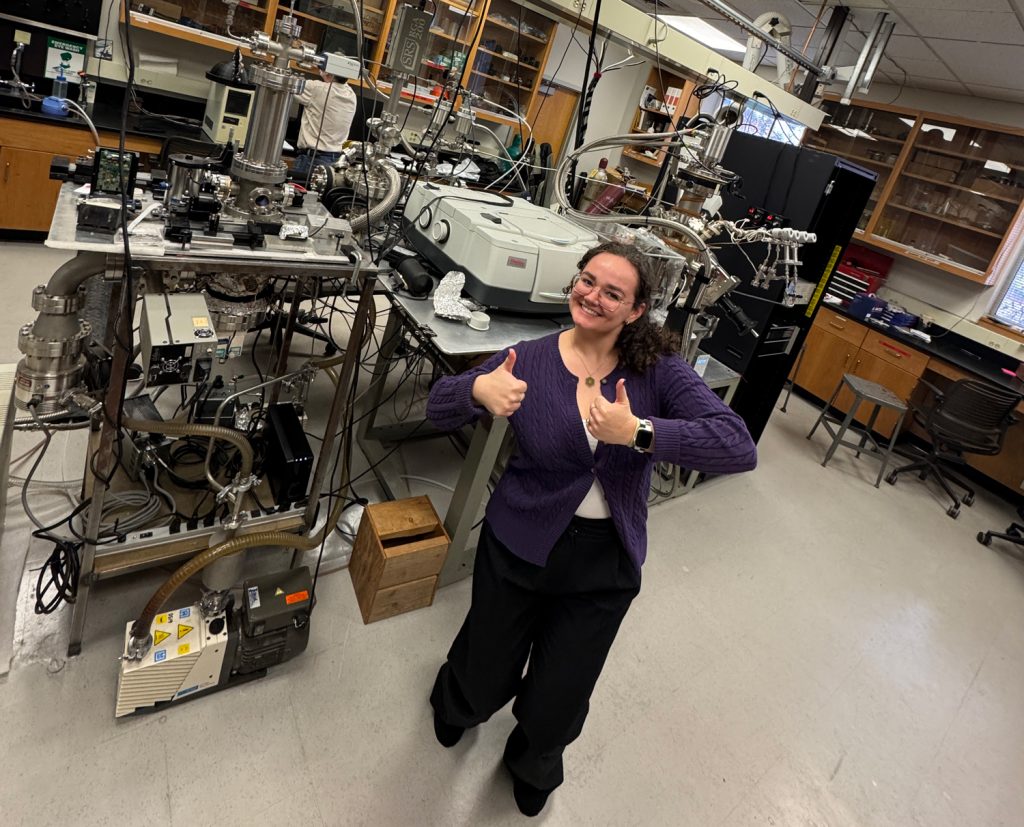
The surface of Pluto is a teeth-chattering -387 degrees Fahrenheit, and “it’s hard to make anything that cold here on Earth,” Knudsen said. “We have an astrophysical materials lab at NAU with a little chamber that makes ice that’s almost that cold, but it takes an entire room of machines to do that. And even though it’s a very high-tech lab, I can’t add one kind of ice to another kind of ice. There’s no physical way to simulate this.”
But there’s a digital way to simulate it, and that’s where Knudsen’s computer modeling comes in.
“On a computer, you can model anything you want,” she said. “I can ask, ‘If I have this much methane ice and this much nitrogen ice and I put it a kilometer under the surface of Pluto, what’s going to happen to it? And we can go from there.”
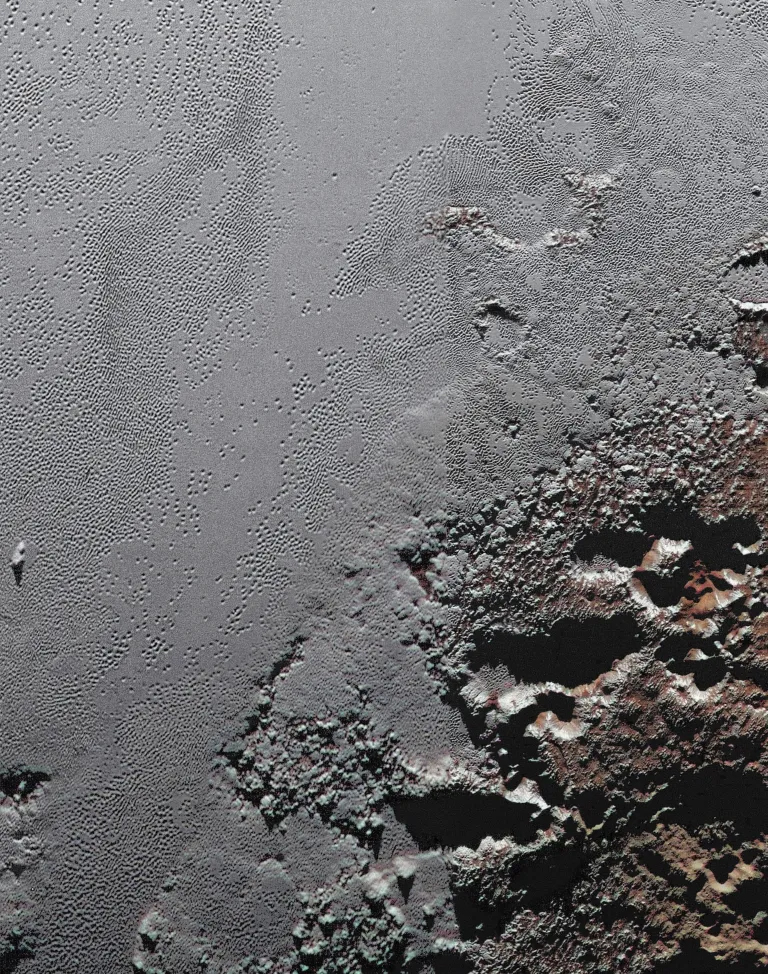
Knudsen said computer modeling work could help her find out why Pluto got its distinctive icy pockmarks, which we saw for the first time during NASA’s New Horizons mission in 2015. Experts in her field have been puzzling about those features for a decade: Did the marks come from collisions with small objects? Or did they come from one type of ice pushing against another type of ice just beneath the surface?
Her work comes at a crucial time in astrophysics. After exploring much of the inner solar system, NASA’s spacecraft will now head farther afield, with proposed missions to Uranus, the small moons of Saturn and more.
“We’re heading that way soon,” Knudsen said. “I’m excited to make a tool we can use before we ever get there and see if we’re right about some of our predictions.”
Before coming to NAU, Knudsen earned a bachelor’s degree in astrophysical and planetary sciences at the University of Colorado Boulder, where she worked in atmospheric science. She switched up her focus after meeting Kelsi Singer, a planetary scientist at Boulder’s Southwest Research Institute (SwRI). For two years after graduation, Knudsen worked with Singer at SwRI, doing research on asteroids, comets, small moons and other small bodies in the outer solar system.
Knudsen said she chose NAU for graduate school because she loved the work her adviser, research professor Will Grundy, was doing, and she clicked well with fellow prospective students.
“I love doing this kind of work—the work of, ‘We don’t know anything about this yet; let’s work on it for a few years and see if we can find out more,’” Knudsen said. “I can’t believe I get paid to solve problems and work on puzzles that have real-world implications. It’s so much fun.”
Want to read about more NAU GRFP research? See our story about recent NAU grad and GRFP recipient Henry Garland here, and stay tuned for more GRFP coverage. To learn more about applying for the GRFP and other scholarships and fellowships, contact academic success coordinator Lillie S. Gordon at Lillie.Gordon@nau.edu.

Jill Kimball | NAU Communications
(928) 523-2282 | jill.kimball@nau.edu