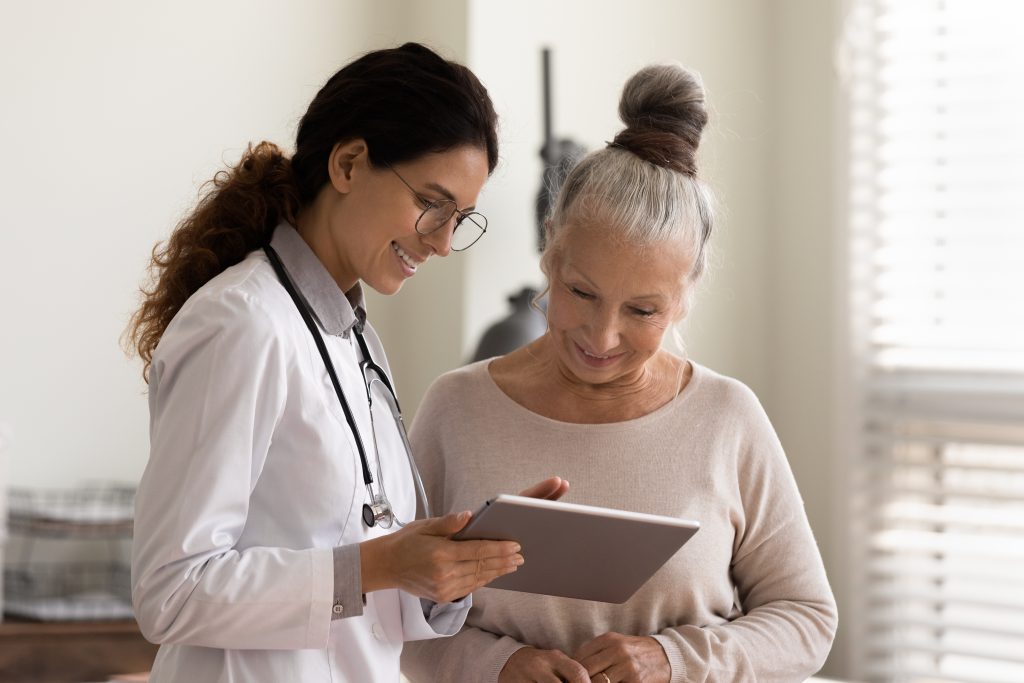


Good healthcare is not only about medical knowledge, but also about human connection. Understanding patients’ needs and histories goes a long way toward providing high-quality care. A new undergraduate certificate at NAU aims to give students a unique set of tools to help them succeed in the industry by bridging the gap between language and culture in healthcare.
Juliana Suby, teaching professor, and Jersus Colmenares, associate teaching professor, both in the Department of Global Languages and Cultures, have been working together to design and implement the Spanish for the Health Professions undergraduate certificate. This program is designed for students who are pursuing careers in, or are already employed in, health-related professions. It focuses on Spanish language acquisition for cross-cultural communication and emphasizes cultural and social knowledge necessary for the better development of healthcare practices.
Suby said it all started when Colmenares designed a Spanish for the Health Professions course at the 300 level that minors and majors from their department could take. They were met with overwhelming demand from students.
“We had an explosion of interest,” Suby said. “It was amazing! Almost immediately, native speakers, heritage speakers and non-native Spanish speakers were attracted to this class. It was so popular that we had a waiting list for the course.”
Colmenares taught the class on a more regular basis, and he and Suby explored the idea of expanding the curriculum into a certificate program.
“One of the defining factors that turned the abstract idea of creating this certificate into a reality was an accident that happened on Highway 180, where a little boy from a Spanish-speaking family visiting Arizona was hit by a car crossing the highway,” Suby said. “I was told that one of the first responders said that the grief and the inability to communicate with the family broke his heart. That was the tipping point for me. By then, the class was already taking off, so I told Jersus that we needed to put this idea into action.”
Hands-on training
Colmenares, who has worked as a medical interpreter in the past and has volunteered for the city of Flagstaff, had a personal understanding of the need for Spanish speakers in healthcare and used his experience to help design the curriculum. Both he and Suby did a deep analysis, interviewed faculty members, looked at textbooks and materials and spoke to nurses, physical therapists and other healthcare professionals to get a clear idea of what students needed to learn to be successful and help their communities.
“When patients go to a healthcare center, a doctor’s appointment or any similar scenario and see that there is a way to communicate that is more comfortable for them, they can express themselves more freely,” Colmenares said. “Addressing this gap, which is huge right now in the United States, is crucial in programs like ours. Understanding what the needs are in the labor market today can put our students at an advantage. This is a skill that will get them ahead.”
In the final class, students are required to do nine hours of volunteer work. Colmenares said it’s a chance for students to use the medical vocabulary they are learning while gaining hands-on experience.
Kai Taras, a graduate student in speech-language pathology, said this component was the one of the most rewarding aspects of the course since she had the opportunity to volunteer at Flagstaff Medical Center as a Spanish interpreter and gained invaluable hands-on experience using medical Spanish in a real clinical setting.
Natalia Canaan, a chemistry, psychology and Spanish junior, saw firsthand the impact the class had in the community as she designed a tool that will make a difference to those who struggle with the English language.
“This certificate has had a huge impact on both my career goals and the way I already serve patients as a pharmacy technician,” Canaan said. “For my final project, I created a Spanish-language pamphlet with step-by-step guidance on how to obtain medication discount cards. More than just improving my Spanish, the class really impacted the way I think about healthcare, advocacy and serving underserved communities.”
More than just language
The Spanish for the Health Professionals undergraduate certificate consists of 19 credits and begins with the introductory 101 and 102 classes. Students then take three series of three Spanish for Health Professions courses, where they get the opportunity to interview experts in different fields and learn to work with artificial intelligence by training chatbots. Colmenares said the class not only teaches students Spanish and medical terminology, but also cultural sensitivities.
“Students learn a lot about disparities and context that comes with immigration, language and cultural barriers,” Colmenares said. “This is not only about language coding or morphology, but also about understanding who the unique person is that we have in front of us and their particular needs that go beyond language but rather entail a very complex background.”
Catherine Garrido, an interdisciplinary studies, health wellness coaching and biology student who graduated this spring, said the certificate helped her home in on her passion for breaking down barriers in health care.
“This class helped me solidify my intercultural knowledge and vocabulary,” Garrido said. “I often felt that many classes I took were separate from patient interaction, but this certificate reinforced why this is such an important certificate and topic.”
To students who are interested in the Spanish for the Health Professionals undergraduate certificate, but feel intimidated by the language learning process, Larissa Axtell, a senior studying nutrition and food with a minor in Spanish, said not to worry.
“When I first heard about the certificate, I was interested but also nervous about taking the classes, but after taking them for two semesters, I can confidently say there is no reason to be,” Axtell said. “So much is covered, yet it does not feel rushed. When I started, I could hardly understand and was struggling. After working with Juliana, I feel so much more confident in my Spanish-speaking skills and in my reading and writing. I also feel more knowledgeable about the language struggle within the medical field.”
For more information about the Spanish for the Health Professionals undergraduate certificate, email Jersus Colmenares or Juliana Suby.
 Mariana Laas | NAU Communications
(928) 523-5050 | mariana.laas@nau.edu