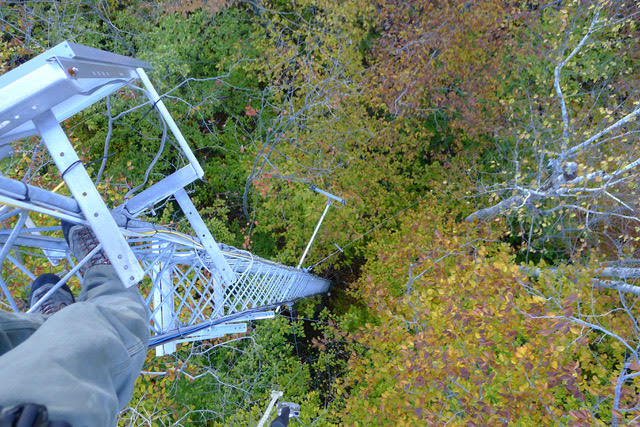


Can we count on forests to continue absorbing the carbon dioxide that’s warming our world? A new study from researchers at NAU and the University of New Hampshire says …maybe not.
The study, led by NAU Ph.D. student Darby Bergl, took advantage of an exceptionally rare 20-year record of measurements taken in New England to ask a simple question: Are temperate forests continuing to absorb carbon dioxide from the atmosphere as expected? They found the answer—at least at this site—was, increasingly, no. Their findings were published on Wednesday, Aug. 5, in Global Change Biology Communications.
For decades, Bergl said, temperate forests in the northeastern United States have helped slow climate change by removing carbon dioxide from the atmosphere and storing it in trees and soils. But between 2004 and 2023, Bergl and her colleagues found, the carbon sink strength of one mature forest in New Hampshire declined substantially.
“We often think of forests as one of our best natural climate solutions because they remove large amounts of carbon dioxide from the atmosphere, so changes in their ability to store carbon could have important consequences for future climate change,” Bergl said. “Our findings suggest that mature temperate deciduous forests may no longer reliably remove more carbon than they release under continued global change.”
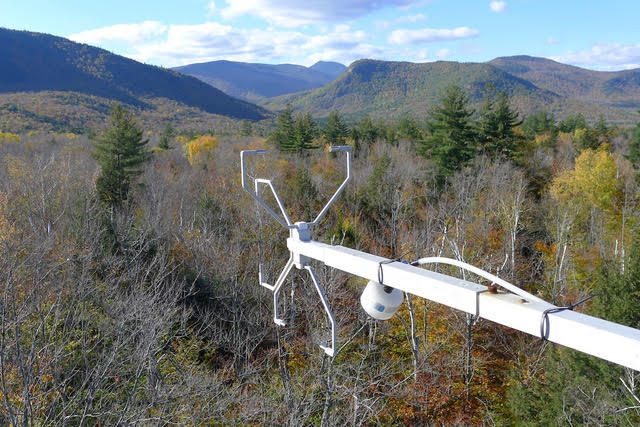
Using continuous measurements of carbon exchange between the forest and the atmosphere, researchers found that the forest absorbed less and less carbon each year. In several recent years, the forest even became a net source of carbon rather than a sink. The decline wasn’t caused by a reduction in photosynthesis, as researchers expected. Instead, it was driven by increasing carbon release from the ecosystem through respiration, the natural process by which plants, roots and soil microbes emit carbon dioxide.
Corresponding author Andrew Richardson, a Regents’ professor at the NAU Center for Ecosystem Science and Society (Ecoss) and a former postdoctoral researcher at the University of New Hampshire, said warmer winters are playing an important role by increasing biological activity during months when forests were once more dormant. The study also points to changes in late-summer growing conditions that may be enhancing carbon cycling underground. Together, these factors appear to be increasing carbon losses faster than carbon gains.
“Our results clearly show the long-term impacts of changing winter weather on the health and productivity of northern forests,” Richardson said. “Forests provide enormous benefits to society, from storing carbon to supporting biodiversity and local economies. Recognizing and addressing these long-term impacts should be a priority for policymakers and resource managers alike, and these findings underscore the importance of developing strategies that sustain forest health and resilience in the decades ahead.”
Bergl said the findings have important implications for global climate projections, many of which are operating under the assumption that forests will continue to absorb large amounts of carbon in the future. It also highlights why long-term observations like these are critical for understanding whether forests can continue to provide one of nature’s most important defenses against climate change.
“The fact that we only detected this weakening carbon sink after two decades of continuous measurements underscores the importance of sustained investment in long-term ecological research, without which gradual but consequential changes like these could easily go unnoticed,” Bergl said.
In addition to Bergl and Richardson, authors included NAU Ecoss associate research professor Mariah Carbone and postdoctoral researcher Yujie Liu; NAU assistant professor of data science Benjamin Lucas; UNH professor of natural resources and the environment Scott Ollinger; David Hollinger and Andrew Ouimette of the U.S. Forest Service; and Boston University distinguished professor of biology Pamela Templer.

Jill Kimball | NAU Communications
(928) 523-2282 | jill.kimball@nau.edu