

Science fiction suggests that life on other planets, if it exists, is likely far more advanced than life on Earth.
A recent study suggests otherwise.
This new study, led by Chris Doughty, a professor of ecoinformatics at Northern Arizona University, proposes that the extent to which life on potentially habitable exoplanets in Earth’s stellar neighbors is advanced is likely related to plant energy, not just how much time has passed. That means that, although Earth is young compared to some of its stellar neighbors, which are older by several billion years, life on exoplanets, with worse conditions for cumulative photosynthesis, likely evolved more slowly over billions of years.
“Physicist Enrico Fermi famously asked, given the high likelihood of intelligent life in the galaxy, ‘Where are they?’ Doughty said. “This paper suggests that our exoplanet stellar neighborhood may be quiet because most Earth-like planets near us are likely to be evolutionarily behind us and still at the microbial stage. Which means we can sleep well, because if life on those exoplanets evolved just like on Earth, most of those planets will just be filled with microbes and not advanced aliens.”
The study was published Sept. 22 in the International Journal of Astrobiology.
What the study says
It doesn’t say there’s not highly advanced extraterrestrial life that could lead to a real-life reenactment of “The Three-Body Problem.” What the study says, according to the researchers, is that such a species nearby is unlikely, as the cumulative photosynthesis on nearby potentially habitable exoplanets would be lower.
And here’s why: If life ever evolved on a planet, its continued evolution wouldn’t just automatically happen over time. Rather, it would be dependent on the cumulative plant energy of a planet, the study authors hypothesize. Looking at Earth, warm, wet places have more plant growth and species than cold, dry places. Scientists believe this is because there is more plant growth and ecological space for animals to exist. Thus, a young, warm, wet exoplanet may have more evolutionary development than an older, colder, drier exoplanet.
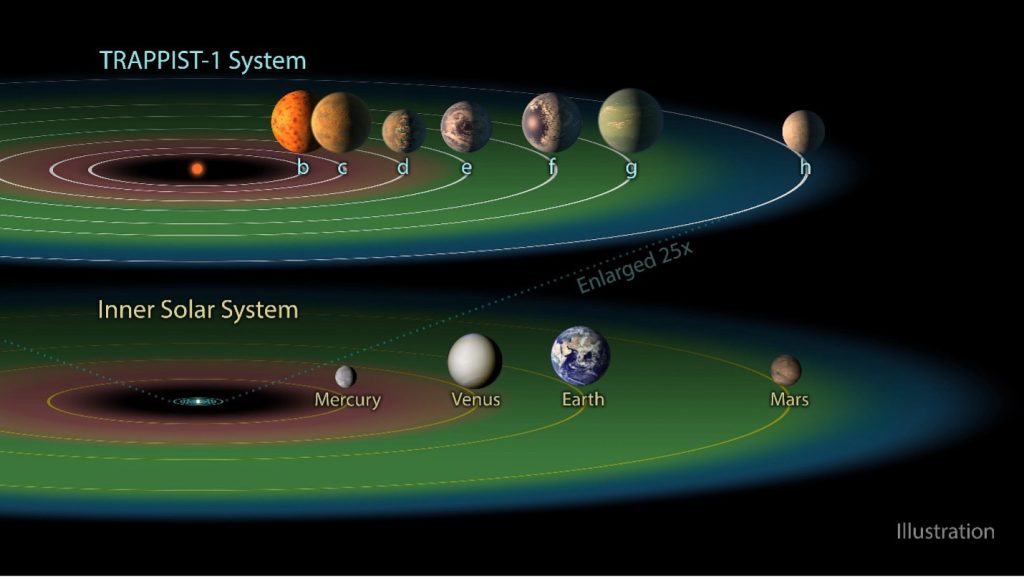
In their paper, Doughty and his coauthors explore the implications of this hypothesis for exoplanets. The planets that are most likely to have life revolve around red dwarfs, the most common star type in our galaxy. These planets, which are often billions of years older than Earth, have dimmer light and are often tidally locked, meaning only one side of the planet faces its sun.
“If photosynthetic life evolved on these planets, that life has been photosynthesizing for potentially billions of years longer than on Earth,” said coauthor Michael Gowanlock, an associate informatics professor at NAU said. “However, the total annual photosynthesis is likely lower because there is less light and half the planetary surface area available for photosynthesis. Who is ahead? That is the mystery we are quantitatively trying to solve.”
Recent work by coauthor Denis Sergeev, a lecturer at the University of Bristol in the United Kingdom, has simulated possible climate patterns on exoplanets including maps of temperature, light and precipitation, which are the main variables needed to predict plant growth on Earth. In the current paper, the authors used those maps to predict potential plant growth and evolutionary rates over their lifetimes for TRAPPIST-1e and 28 other nearby exoplanets that potentially have liquid water. (“Nearby” is relative; TRAPPIST-1e is 40 light-years from Earth.)
But TRAPPIST-1e isn’t Earth. How do they compare?
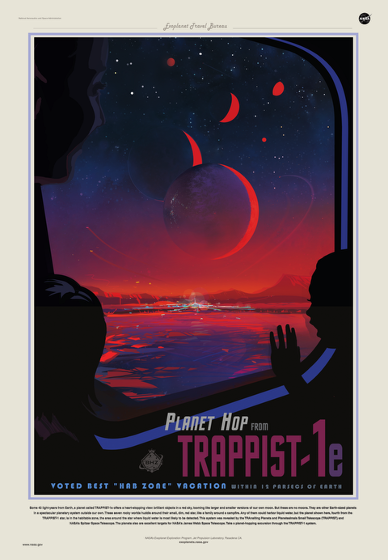
Here’s how it works on Earth. Roughly 2.4 x 1025 grams of carbon were fixed during the 3.2 billion years before more efficient vascular plants evolved. Then 7 x 1025 grams more carbon was fixed before humans evolved. The researchers estimated that TRAPPIST-1e has fixed only 21% of Earth’s carbon despite being several billion years older than Earth.
“Since this is less than the Earth had fixed before the evolution of more efficient vascular plants, we estimated that TRAPPIST-1e may only be at the microbial stage of evolution,” said coauthor Cameron Hrabak, an NAU alumnus. “That’s well behind Earth.”
The researchers made similar calculations for the 29 exoplanets in Earth’s stellar neighborhood that are most likely to have life and found only two planets whose life has potentially evolved ahead of Earth’s: GJ 1061c and K2-3d. Both are bigger, hotter, brighter and older than most Earth-like planets in our solar neighborhood. Three other planets could be at the Mesozoic life stage, which is roughly equivalent to the age of dinosaurs on Earth.
These are estimates, not proof. The atmosphere around TRAPPIST-1e and other exoplanets would profoundly affect climate, photosynthesis and how life evolved; future work with the James Webb Space Telescope could provide additional data that will allow the researchers to hone their estimates.
What’s next, and is it an alien invasion?
This technique can help predict the evolutionary constraints that shape life on those exoplanets that might surpass life on Earth, the researchers said. On Earth, plant growth can be limited by light, temperature or precipitation. For instance, deserts get plenty of light, but growth is inhibited by lack of precipitation. These constraints also shape how life evolves differently—the life in tropical forests has little overlap with desert life. On exoplanets, the planets most likely to surpass Earth’s total carbon fixed and evolutionary stage are mainly precipitation-limited.
Put simply, if there is an alien civilization in Earth’s stellar neighborhood, the ecosystems shaping those intelligent creatures would be more like deserts or temperate ecosystems—much like humans on Earth, as we likely evolved in rain-limited savanna woodlands.
“To use two pop culture references, the ecological characteristics that shape advanced life on those exoplanets might be more ‘Dune’ than ‘Avatar,’” Doughty said.

Heidi Toth | NAU Communications
(928) 523-8737 | heidi.toth@nau.edu