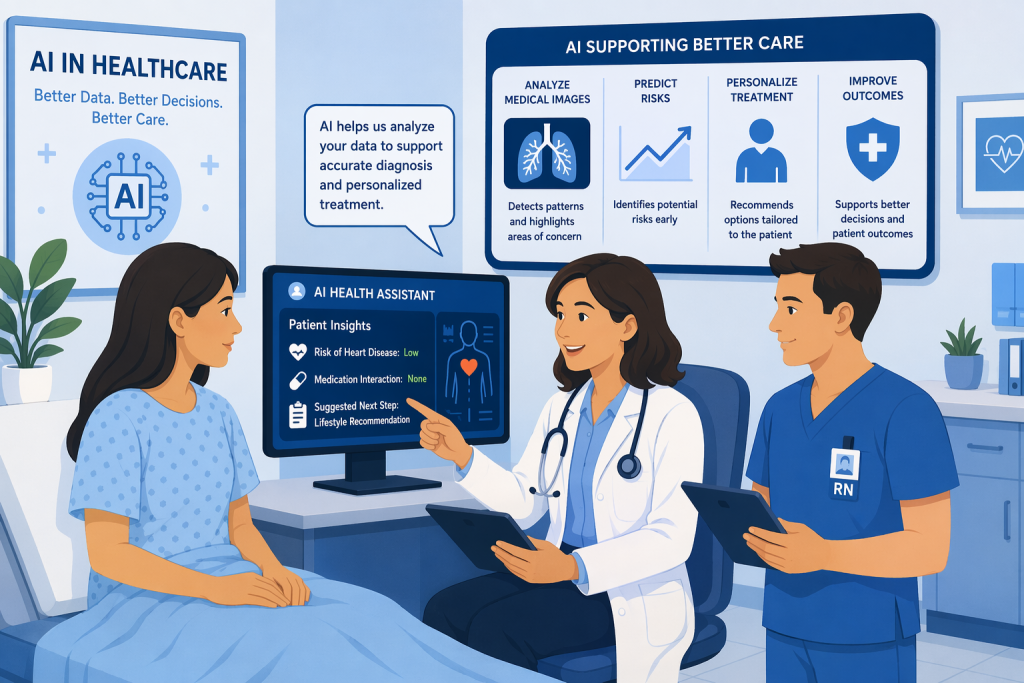


The College of Health and Human Services at Northern Arizona University is accepting applications for two programs that train healthcare workers in the use of AI tools in public and clinical health.
The aim, said program director Tim Curry, a lecturer in the Department of Health Sciences, is to give healthcare providers the knowledge and skills they need to build AI tools that can gather and analyze the massive amounts of health data already available and use those tools to provide more personalized care to patients and communities.
“It’s not replacing the physician; it’s allowing you to know more and make a more informed choice,” Curry said. “It’s allowing us to take the vast amount of data that we have and learn more than we’ve been able to in the past.”
The certificates, available at undergraduate and graduate levels, are designed to give students the necessary health, analytics and coding background to develop and update AI programs and databases that address the problems they’re seeing in their organizations. While the focus is largely on the clinical space and how doctors can help individual patients, Curry also is looking at applications in the public health space.
Both programs are fully online, accessible not only to students in Flagstaff and throughout the state but also to working professionals who want additional education. No previous coding experience is required, and students will get support every step of the way to help ensure they develop the skills they’ll need in a changing healthcare landscape.
“We’ve spoken to multiple hospital groups, and they see a need for this,” Curry said. “Employees need to be up to speed on how these tools work and what they can do.”
Undergraduate certificate: Applied health analytics (16 credits)
Students will take courses in applied health analytics and biostatistics as well as classes on coding, hardware and software and SQL/database use. They’ll partner with the School of Informatics, Computing, and Cyber Systems on the last three. One goal is for students to be fluent in Python when they finish; that’s the most versatile coding language, highly in demand in the job market right now and how most AI programming is written.
Python’s possibilities are endless. Take cancer, for instance: It is, to put it mildly, complicated. Getting the best treatment is critical for surviving and recovering well, but the best treatment isn’t a simple formula. It’s not just about what kind or stage of cancer a patient has; their age, race, ZIP code, family history and so much more also influence how a cancer can be treated.
So, there are dozens of patient variables. Additionally, there are something like 1,000 new journal articles published monthly, one of which might have insight into the particular type of cancer and patient a doctor has. No human has time to process through all of those. AI does. The equation, then, looks something like this: With the right program, a healthcare provider puts all the patient information into the system, which then considers all of the research available and provides treatment recommendations. From there, the patient, the doctor and the whole healthcare team consider those recommendations and make choices.
AI programs can also help with pattern recognition based on the reams of available data that healthcare providers have been collecting for decades.
Learn more and apply for the undergraduate certificate.
Graduate certificate: AI in Health (13 credits)
Grad students also will take biostats, but at the graduate level, and the applied health analytics course, but the Python course will be focused on addressing healthcare problems. The fourth course, called AI in Health, will engage students at what Curry called the “bleeding edge” of topics related to AI application in health fields; students will develop an AI-enabled tool for a problem they see for their culminating project in the course. For those students who are working professionals, Curry hopes they will address problems they experience in their work.
The courses will also include explorations, analysis and application work on patient privacy, including HIPAA and GDPR regulations; the morality of using AI in various ways in healthcare, considering the personal data that go into the programs; and information security. They will also talk about patients’ rights around their own data and how hospitals are allowed to use that information.
Additionally, students will explore how tribal and data sovereignty affect the ways in which healthcare systems can use patient data. For example, Curry said, the information of a patient who lives in a tribal nation but goes to a hospital in Phoenix may have a different set of regulations protecting their personal data than a non-Native Phoenix resident who goes to the same hospital.
Learn more and apply for the graduate AI in Health certificate.
Top image: Created by Copilot with this prompt: Can you create an image that shows the use of AI in healthcare? Don’t make it look like a real photo; make it clear it’s a graphic. Perhaps show a doctor and a nurse with a patient and a computer in the room helping to provide information. I then had to ask it to make the doctor a woman and the nurse a man, a good reminder that GenAI still carries a lot of the same biases as humans.

Heidi Toth | NAU Communications
(928) 523-8737 | heidi.toth@nau.edu