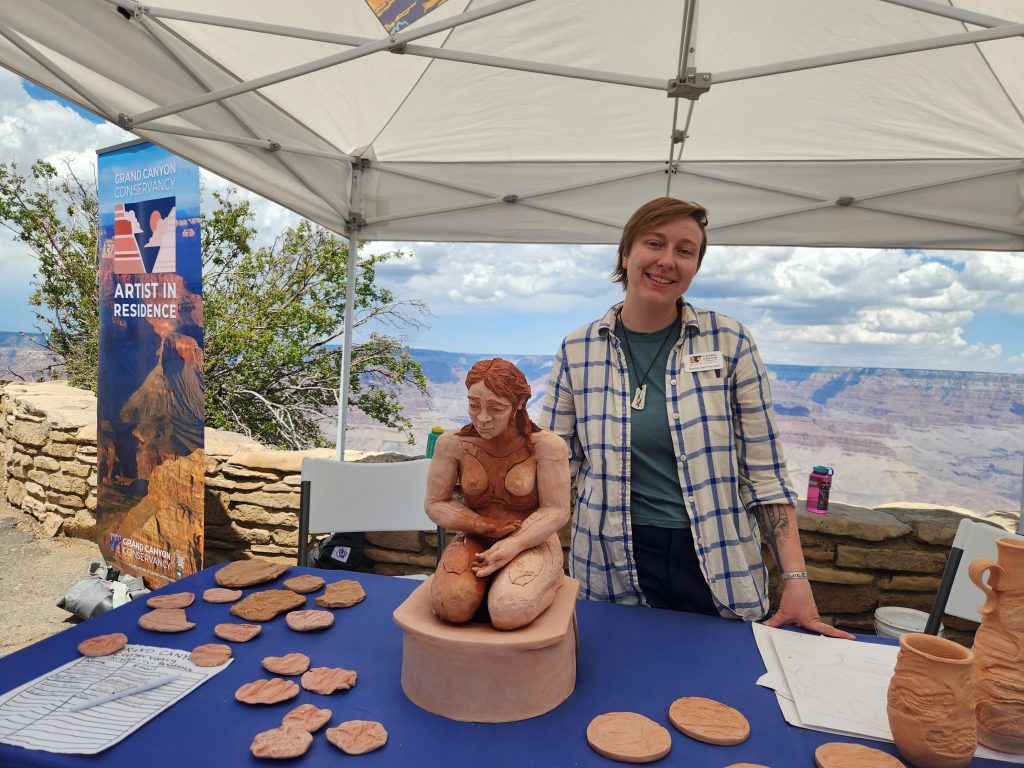


When David Politzer, director of the School of Art and Design (SoA+D), arrived at NAU four years ago, the first SoA+D/Grand Canyon Alumni exhibition had already been scheduled. After its success, Politzer met with Clover Morell, who at the time was the new director of residency, and together, they worked on making the joint exhibition an annual event. This venture has now evolved into a residency program for emerging artists, giving NAU students the opportunity to shift from making art for a grade to building a professional career.
During residency programs, artists can dedicate time to their creative work without worrying about day-to-day responsibilities. These programs provide housing, workspace, resources, mentorship, community engagement and the opportunity to create a network where they can share ideas with other artists. Politzer said that in addition to these benefits, a residency for students also serves as a bridge between their academic careers and their next steps, since they can continue to pursue some of the projects they were immersed in as students, while planning for their future.
“Last fall, Clover explained her plan to add a new housing option that would allow them to host two artists simultaneously,” Politzer said. “Her plan to expand the number of residents included an “emerging artist,” who would be selected from a pool of NAU students. As you might imagine, this was music to my ears, since residency opportunities like this are rare in an artist’s career, much less in such an impressive location.”
Caity Varian, associate director of marketing for Grand Canyon Conservancy (GCC), said the partnership with NAU creates a dedicated pathway for early-career artists to gain professional experience at a pivotal moment in their careers while engaging directly with one of the world’s most inspiring landscapes.
“This collaboration strengthens regional connections by investing in artists who already have ties to northern Arizona while encouraging new perspectives on Grand Canyon’s natural and cultural stories,” Varian said. “Through public programs and exhibitions, the residency also helps visitors and community members connect more deeply with the park through art.”
The first emerging artist residency
The pilot program for the emerging artist residency started this summer featuring Rain Orchard, a studio art major who graduated summa cum laude this spring and was named distinguished senior for the College of Arts and Letters. Orchard’s emphasis on ceramics, along with their senior research project funded through the Office of Undergraduate Research by the SPArCS Grant, helped guide their creative path to the canyon.
“I learned about the history of pottery in Arizona, about natural materials and geological maps, as well as patterns to find out where clay is deposited,” Orchard said. “As the designer of the grant project and primary researcher, I traveled around Arizona to source materials from public lands around the state, collecting clay and then testing it for shrinkage, color, melting point and other materials it contained. It was a life-changing experience.”
NAU selected Orchard as the inaugural artist in residence because of their exceptional artistic practice and deep connection to the landscapes of the Colorado Plateau.
“Rain is a ceramic artist and environmentalist who creates multidisciplinary work using locally and ethically sourced wild clay alongside drawing, metalwork and printing,” Varian said. “Their proposal to explore geological stories and ecological narratives at Grand Canyon closely aligns with the residency’s goals of fostering stewardship, place-based storytelling and public engagement.”
Orchard’s residency at GCC ran from June 1 to July 27 and will result in a future exhibition at NAU’s Beasley Gallery. The work they developed during their time at Grand Canyon National Park included a clay sculpture of a woman representing a spring, which Orchard said they hope helps bring awareness to the pollution of aquifers crisis in the canyon.
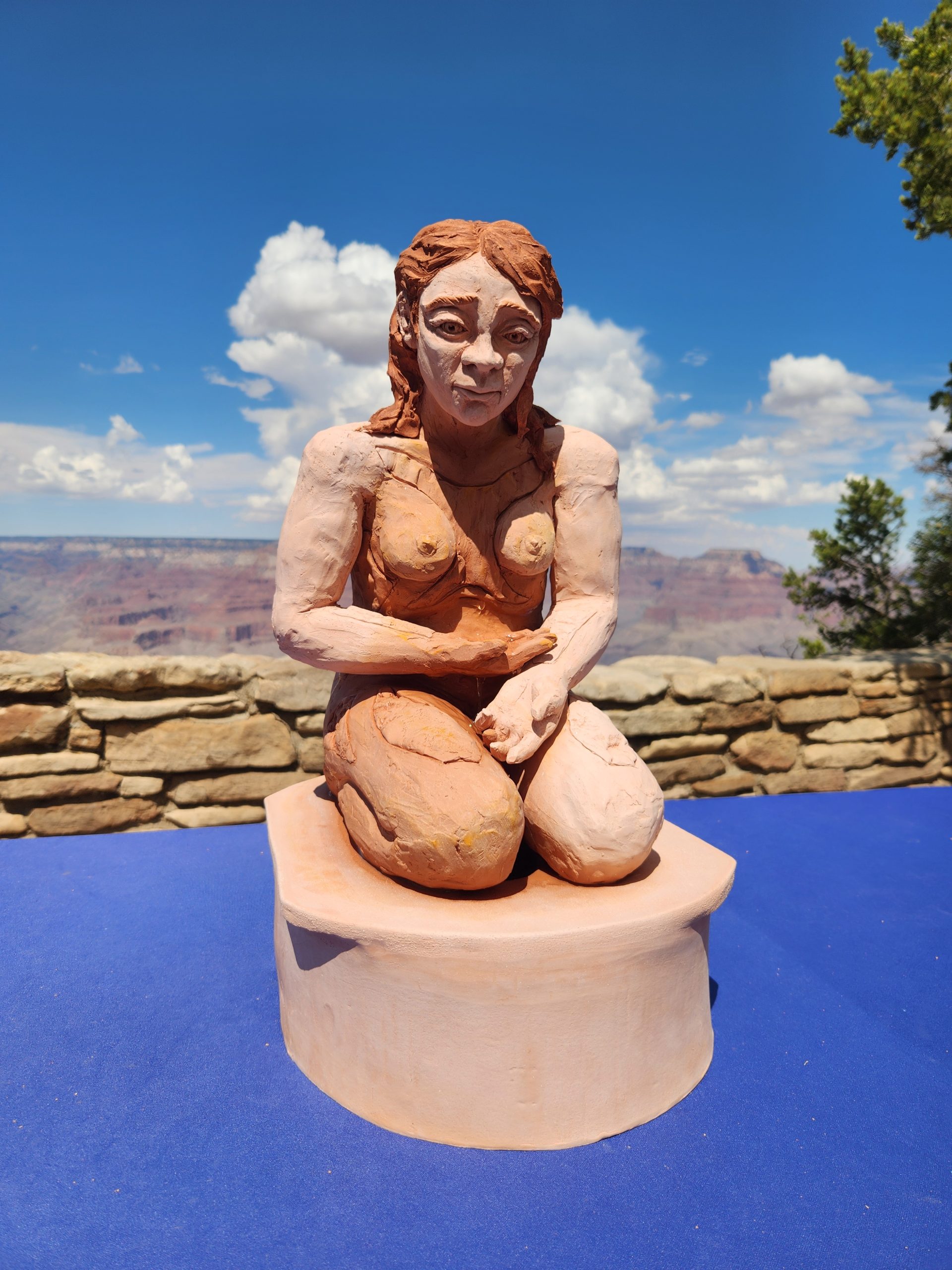 “The sculpture incorporates some of the geological textures of the canyon,” Orchard said. “In her body sit replications of the Muav limestone where the aquifer is held. During my presentation, I told people about the geology that forms the aquifer, how the rock was deposited, what kind of qualities it has and how the shale interacts with the limestone to create the springs that not only carve the canyon, but also support life. But that was also a platform to talk about how the springs are being endangered by the Pinyon Plain mine, only seven miles south of Grand Canyon Village. The shaft goes directly into the Mauv aquifer and has been polluting the water with arsenic, lead and uranium. The research about how the mine is impacting the springs is just starting to happen, even though they started mining about two years ago. They have already pumped out over 80 million gallons of water from the aquifer, which they hold on the surface, now polluted with toxins.”
Orchard has also been collecting textures of rocks from around Grand Canyon to show samples of rock formations without disturbing the natural habitat. They do this by taking clay while on trails and along the rim of the canyon and using it like a stamp that becomes a negative mold.
“I haven’t taken or left anything from the canyon’s environment,” Orchard said. “After creating the molds, I leave the rocks just as I found them. In reciprocity, I remove any trash I find on the trail. Additionally, I have used specimens from the Grand Canyon visitor’s center and NPS interpretive rock collections with the help of their curators and rangers, as well as from the amazing display along the Trail of Time. I was thrilled to run a handful of public programs where guests helped make the molds and label them while I was teaching them about geology and art. With their help, I have created about 200 stamps over the last two months. These will be my tools to continue integrating textures, narratives and connections of the canyon into my work as my art practice progresses. I hope to continue to reveal how humanity is a part of Earth’s complex and beautiful systems.”
What the collaboration means
Politzer said teaching park visitors about their work as part of the program helps strengthen NAU’s ties to the canyon and the community.
“Opportunities like this, when students practice speaking about their work to strangers, teaches them a skill they’ll use the rest of their lives as artists,” Politzer said. “They also become excellent ambassadors for NAU and the SoA+D, generating positive visibility for both.”
For Varian, the new partnership represents an exciting evolution of GCC’s award-winning residency program by creating a new pathway specifically for emerging artists.
“By partnering with NAU, GCC is investing in the next generation of creative voices while strengthening connections between higher education, public lands and local communities,” Varian said. “The collaboration reflects a shared commitment to using art as a tool for education, stewardship and helping people build lasting connections with Grand Canyon National Park.”
For Orchard, the program was a welcome bridge to start their professional career as an artist.
“This was such a dream come true,” Orchard said. “To be an artist in residence in the canyon was on my long-term goal list because the opportunity is competitive and for well-established artists, and instead, this amazing opportunity has helped transform me from a baby artist into someone who’s doing it on their own. Having an art practice with an audience, but also with support after graduation has been amazing. I’m so grateful to the conservancy and to the people at NAU who made this happen. David Politzer, Tai Lipan and Clover Morell were great mentors and champions for me. It’s just been incredible.”
Orchard is scheduled to do a Science on Tap presentation delving into the Grand Canyon’s geology and exploring the intersection of art and science from 6-7 p.m. Aug. 13, at Mother Road Brewery (7 S Mikes Pike) in Flagstaff.
Artists interested in applying for the NAU/GCC Emerging Artist Award can do so in January. Graduating seniors or recent alumni from NAU’s SoA+D are encouraged to apply. Application details will be shared via email and in the SoA+D newsletter. For more information, contact David Politzer via email.
 Mariana Laas | NAU Communications
(928) 523-5050 | mariana.laas@nau.edu