All inquiries can be directed to the INE Director:
Institute for Native-serving Educators (INE)
The Institute for Native-serving Educators (INE) is a collaborative initiative to strengthen schools across Indian Country. Housed in NAU’s Office of Native American and Indigenous Advancement (ONAIA), we partner with Native Nations, Indigenous-serving schools, and public school districts on and bordering reservation communities to develop professional development opportunities that meet community needs. We do not have a one-size-fits-all approach to professional development. Instead, we build a unique professional development experience based on the goals of the community and based on research and best practices in culturally responsive schooling.
Our story
A group of Navajo K12 teachers approached the Office of Native American and Indigenous Advancement (ONAIA) in 2016 to invite NAU to partner with them in building a professional development program modeled after the Yale National Initiative. This led to the development of a partnership between NAU and Navajo-serving schools, called the Diné Institute for Navajo Nation Educators (DINÉ). The first DINÉ cohort launched in 2018. From these first planning conversations, we envisioned one day expanding out to additional Native Nations. After securing a grant from the National Science Foundation that proposed this expansion, we launched the Institute for Native-serving Educators (INE) in 2021. The DINÉ is now one of many programs that fall under the INE.
Our mission
The goal of INE is to reduce educational inequities impacting Indigenous youth and communities, and to be the premier preK-12 professional development institute of choice for Native Nations in the United States.
By developing and supporting high quality, culturally responsive preK12 educators in Native-serving schools, we can address years of educational neglect and radically improve teaching and learning, thus preparing Indigenous students to thrive in higher education and beyond.
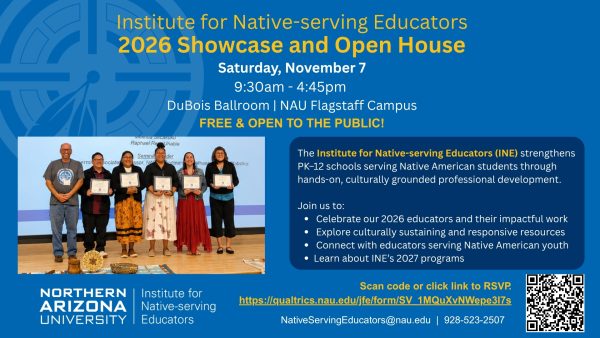
RSVP Today!
2026 INE Showcase and Open House
Saturday, November 7th 9:30am-4:45pm
2027 INE Professional Development Programs
Information on INE’s 2027 Professional Development programs are coming soon. Subscribe to our listserv to be notified when applications open.
K-12 Teachers
The Diné Institute for Navajo Nation Educators (DINÉ) is a partnership between Northern Arizona University and Navajo schools aimed at strengthening teaching in K-12 schools serving Diné and other Indigenous students. The DINÉ began with 9 teachers in 2018, and we have had approximately 85 teachers complete the program since then. In 2022, we have about 45 teachers participating in the DINÉ. Each teacher in the DINÉ writes a robust curriculum unit that we publish online so that other educators can access, adapt, and use them in their own classrooms. There is a clear need and interest in sustaining and growing this program in the coming years.
Modeled after the DINÉ, this partnership began with the San Carlos Unified School District and later opened up to include teachers in any Apache-serving school. This professional development program is focused on growing teachers’ content knowledge, ability to write culturally responsive curriculum, and leadership skills. This program began in 2022 with support from both the San Carlos Apache Nation and the San Carlos Unified School District.
The Culturally Sustaining and Investigative STEM (CSIS) professional development program is focused on growing teachers’ content knowledge, ability to write culturally responsive curriculum, and leadership skills. Modeled after the DINÉ and TLSI, this initiative started in 2023 when the Institute for Native-serving Educators met with several administrators from Hopi community schools expressing their desire to offer professional development opportunities for their educators.
Preschool/Headstart Teachers
The Diné Institute for Navajo Nation Educators (DINÉ) is a partnership between Northern Arizona University and Navajo schools aimed at strengthening teaching in K-12 schools serving Diné and other Indigenous students. The DINÉ began with 9 teachers in 2018, and we have had approximately 85 teachers complete the program since then. In 2022, we have about 45 teachers participating in the DINÉ. Each teacher in the DINÉ writes a robust curriculum unit that we publish online so that other educators can access, adapt, and use them in their own classrooms. There is a clear need and interest in sustaining and growing this program in the coming years.
Modeled after the DINÉ, this partnership began with the San Carlos Unified School District and later opened up to include teachers in any Apache-serving school. This professional development program is focused on growing teachers’ content knowledge, ability to write culturally responsive curriculum, and leadership skills. This program began in 2022 with support from both the San Carlos Apache Nation and the San Carlos Unified School District.
The Culturally Sustaining and Investigative STEM (CSIS) professional development program is focused on growing teachers’ content knowledge, ability to write culturally responsive curriculum, and leadership skills. Modeled after the DINÉ and TLSI, this initiative started in 2023 when the Institute for Native-serving Educators met with several administrators from Hopi community schools expressing their desire to offer professional development opportunities for their educators.
Building on the DINÉ model, and leveraging financial support from a Kellogg Foundation grant, INE partnered with the College of Education to launch a new professional development institute in 2021 specifically targeted to preschool teachers. The inaugural 2021 cohort included 8 preschool teachers from Hopi, Navajo, Salt River, and Gila River. The goal is to support these teachers in learning culturally responsive approaches to early childhood teaching and learning. Similar to the DINÉ, each teacher writes a curriculum unit that is published online for broad accessibility. In 2022, we have about 15 teachers participating in the IECE.
K-12 School Leaders
School leadership is a critical component of an effective school, district, and community. The Indian Country School Leadership Institute (ICSLI) is designed to help build capacity amongst school and district leaders serving Indigenous communities. The ICSLI program will help school and district leaders develop and enhance leadership skill sets to effectively work with Indigenous students, staff, leaders, and community members.
School Counselors
This is an 8-month professional development institute for School Counselors to grow their capacity and effectiveness in working with Indigenous students. Members of the ICSCI cohort will build their capacity to support student wellbeing and success in culturally responsive ways. The program culminates with each cohort member writing a guidance curriculum unit on a topic of their choosing, which they can use in their schools and which is published online as a resource for others. This program began in 2022 with about 18 participating School Counselors.
INE Partnerships
The NAU Department of History and Institute for Native-serving Educators (INE) are proud to host the NEH-funded Teacher Institute Indigenous Histories of the U.S.-Mexico Borderlands.
Faculty from NAU’s History Department and Institute for Native-Serving Educators offered a teach-in around the theme Indigenous Histories of the US-Mexico Borderlands.
During this three-day online summer institute, participants learned with Indigenous faculty and leading historians specializing in borderlands, Native American history, and culturally sustaining pedagogy. The program empowered teachers to center Indigenous histories, themes, and ways of knowing in their classrooms. The program was geared toward secondary Social Studies and STEM teachers, but open to all.
NAU’s Office of Native American and Indigenous Advancement will be the home for all of our efforts that aim to strengthen schooling across Indian Country through INE. If you are interested in developing a partnership through INE, please email us at NativeServingEducators@nau.edu.
Would you like to stay up-to-date on all things related to the Institute for Native-serving Educators? If so, please subscribe to our email list! We will periodically send out updates and announcements through this system. Click here to subscribe to INE’s email list.