Master’s Program Curriculum
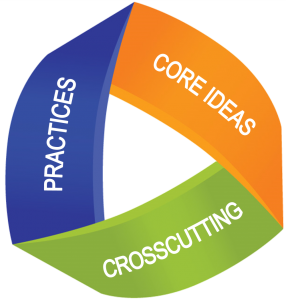 The MAST online graduate program is centered around preparing science teachers, both new and experienced, for three-dimensional learning as described in the Framework for K-12 Science Education. Below, we provide descriptions of each of the required courses for the graduate program. Please see the specific recommended course sequences below for an overview of the two-year program.
Program Instructional Framework
Over the past few years, we have worked to develop the Graduate Programs Instructional Framework. The goals of the framework are to a) provide coherence to the specific practices focused on across the programs, b) connect to current research and national standards documents in science education, and c) provide a common language with which to talk about teaching. This framework is relevant in all courses within the program, but the majority of this work will happen in our science methods sequence, SCI 560 and 561. The specific core practices on the framework were drawn from the rich literature in mathematics and science education, among others, and represent a cutting-edge approach to teaching and teacher learning.
Course Descriptions
Make your selections below to learn more about our courses.
Core Science Education Courses
This course is the first of a two-course sequence in secondary science teaching methods. The goal of the sequence is to develop core instructional capacity that enables you to support and extend all students’ meaningful science learning. In this course, we will focus on current research on teaching and learning, facilitating productive discussions, lesson planning, and effective instructional practices. This course is based on extensive research about how students learn science and how teachers learn teaching.
Textbooks and resources used in the course include:
This course is the second of a two-course sequence in secondary science teaching methods. The goal of the sequence is to develop core instructional capacity that enables you to support and extend all students’ meaningful science learning. In this course, we will focus on curriculum design, elements of effective science units, working on students ideas across time, and effective instructional practices. This course is based on extensive research about how students learn science and how teachers learn teaching.
Textbooks and resources used in the course include:
This course will examine student work and assessment issues in science as they relate to improving student learning and align with standards-based curriculum and instruction. This course contains key assessments.
Textbooks and resources used in the course include:
This course examines the enterprise of science from multiple perspectives including those of philosophers, historians, science studies scholars, and scientists themselves. Specific attention is paid to the impact of this scholarship on the field of science education and the empirical foundations of the practices of science. The course is foundational to all graduate programs in science education. Course components, including lectures, readings, assignments, and discussion, develop various skills including academic writing.
Textbooks and resources used in the course include:
In this course, students will become critical readers of current science education research and its implications to classroom practice. Areas to be discussed include but are not limited to: curriculum and instruction, knowing and learning, equity, technology, professional development, nature of science and informal science education. Students will also receive instruction on basic educational research methods and gain experience in designing a study.
Textbooks and resources used in the course include:
Design and execution of a project that is a capstone for all work exhibited in program of study with an emphasis in practical classroom applications. Finals projects involve the production, improvement, and/or evaluation of a product intended for use by practicing professionals. A final project report must be modeled after a practitioner journal article and defended to a graduate committee.
Recent curricular projects include:
- Explaining the Dust Bowl: Using Historical Data, Meteorological Data, and Soil Science to Model the Causes of the Dust Bowl
- Broken Bone: Engineering Better Bone Healing
- Using Discussion to Address Modern Land Ethics in High School Biology
- Applied Chemistry: Using Community Oriented Curriculum to Expand High School Students’ Understanding and Use of Chemistry
- Historical Molecular Biology: Tools for Enhancing Students’ Understanding of the Central Dogma
- Problem Solving for the Future of Water in Arizona
- Model Based Inquiry: Bring Together Authentic Science Practices and Models to Promote Science Practices and the Teaching of Nuclear Chemistry
Science Content Electives
This course provides an overview of major episodes in the history of science from the scientific revolution of the seventeenth century through the present. Topics include recent historiographical approaches within the history of science along with noteworthy episodes in the history of biology, chemistry, physics, and the earth sciences. The course does not attempt to be definitive or exhaustive in its coverage of the history of science; it is not a celebration of great geniuses or theories. It is instead an attempt to pick out a handful of episodes that are judged to be particularly revealing about the way in which the sciences have developed. Readings include a combination of primary and secondary sources.
Textbooks and resources used in the course include:
In this course, students will learn strategies to integrate engineering design into their secondary science classrooms.
Graduate-level science content course electives will be offered each summer. Please see the Summer Course page for our current offerings. Previous courses have included:
- Core Ideas in the Life Sciences
- Core Ideas in the Physical Sciences
- Core Ideas in the Earth and Space Sciences