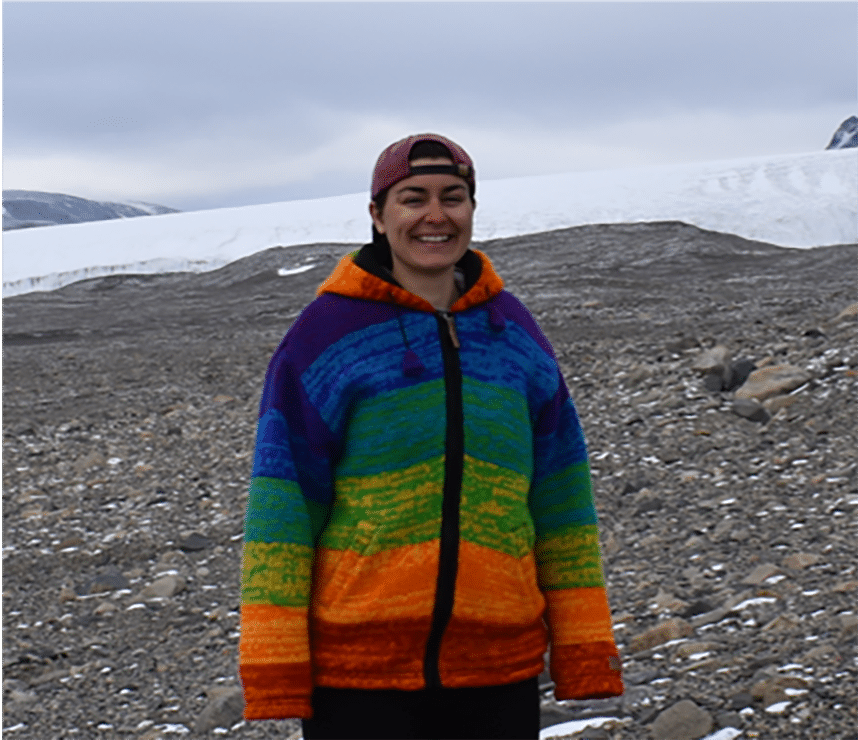
Editor’s note: Four NAU students were selected for the National Science Foundation’s Graduate Research Fellowship Program. NAU News will profile them over the coming weeks.
Meltwater springs in Antarctica may contain the best Earth-bound answers for life on Mars. As to what that answer is—well, Schuyler Borges is looking for it.
Borges, a doctoral student in the Department of Astronomy and Planetary Science at Northern Arizona University, is leading a project comparing rock coating structures in Antarctica that look similar to structures in hot springs all over the world and are comparable to features on Mars. Researchers have argued that the Martian features may be evidence for life on the Red Planet since microorganisms facilitate the production of similar hot spring structures on Earth.
“I think it’s pretty cool work because it shows we are still trying to understand the relationship between biology and geology on Earth and whether relationships between the two indicate anything about potential life on other planets,” Borges said.
This project got a huge boost in April when Borges received a National Science Foundation Graduate Research Fellowship (GRFP), a program designed to support graduate students’ research in STEM disciplines. They are one of four NAU graduate students selected for the GRFP this year.
Borges came to NAU for graduate school after reaching out to professors Mark Salvatore and Christopher Edwards, both of whom are participating scientists on NASA’s Mars Science Laboratory Curiosity Rover. They didn’t go to college with the plan of grad school, though; Borges spent a summer doing Martian research with several women in STEM fields who encouraged them to go to grad school, suggesting Salvatore and Edwards as initial contacts.
Two years later, here they are.
“Schuyler is one of the hardest working students I know,” said Salvatore, now Borges’ mentor. “They are enthusiastic and always eager to take on new challenges. I’m perhaps most impressed by Schuyler’s willingness to step out of their comfort zone and to work with experts in different fields. They are quick to recognize the applicability of their work to a wide range of other scientific topics and to collaborate with folks who they think might benefit from our work.”
Martian research
Borges is working on two major research projects. Their dissertation work focuses on using Antarctic life to understand how to identify life on cold, rocky planets, including Mars but also exoplanets with a similar geologic makeup. Last year, they went to Antarctica with Salvatore to study how communities of microbial organisms that live in glacier-fed streams can be detected from space—no small feat, given the size of microbes.
They used satellite imagery to differentiate between the communities and remotely detect them from orbit, which is uniquely possible in Antarctica. Other parts of the world have too much vegetation to make such research possible. This enables scientists to test the efficacy of tools and processes on Earth before applying them to other planets.
“The environment in the McMurdo Dry Valleys of Antarctica is similar to Mars as it is really dry, exposed to lots of UV radiation and is extremely cold,” Borges said. “The life that exists in Antarctica are some of the most extreme organisms on Earth. This makes them good candidates for potential life that could exist on other planets.”
In addition to Borges’ work with Salvatore, they are collaborating with astrobiologist Tyler Robinson, an assistant professor in the department. His work focuses on finding life on exoplanets, which orbit stars outside of our solar system.
But, as interesting as that research is, it’s not all Borges is doing at NAU, nor is it what caught the NSF’s attention. The research into rock coating structures, which they discovered in Antarctica with Salvatore, focuses on understanding the biogeochemical formation of these Antarctic structures and comparing them with those found at hot springs throughout the world.
“This work has implications for the field of geobiology as well as astrobiology because if these Antarctic structures are forming the same way as those in hot springs, they will be the first of their kind to be identified in a cold, non-hydrothermal environment on Earth,” they said. “This would indicate that we don’t entirely know everything about the environment, both biological and abiological, that favors the existence and preservation of these structures on Earth.”
It’s not just that. So far, these types of structures have been interpreted to be present within a Martian hot spring. If the Antarctic structures form the same as others in hot springs, a cold environmental analog for the features found on Mars would be discovered. This work could mean that, in addition to hot springs, cold environments could be habitable for life and potentially form these structures on Mars.
Or, Borges could find that the Antarctic features aren’t associated with life, in which case they argue the Antarctic structures are a false positive analog for life on Mars. As such, they would change the conversation about the potential for life on Earth’s nearest neighbor.
 The GRFP
Their first semester at NAU, Borges enrolled in Robinson’s Writing a Fellowship Proposal course. It’s Robinson’s fourth year teaching it, and three of his students have received the GRFP and two have received honorable mentions. Both the course material and the feedback they got from classmates helped Borges as they applied for the fellowship, which is a drawn-out, labor-intensive process.
Despite that, Borges enjoyed the process—sort of.
“You’re devoting a ridiculous amount of time to these proposals that are so selective you’re like, ‘This is a waste of time because there’s no way I’m going to get this.’ But you’re also spending a lot of time showing yourself how far you’ve come and what huge things you’ve already accomplished as you’re developing and owning your dissertation,” they said. “The GRFP is challenging to write because you have to spend a significant portion of the proposal writing about yourself and how you’ve overcome obstacles that make you uniquely qualified to conduct the research you’re proposing.”
While many grant applications focus primarily on the work, only asking the applicants about their qualifications to do that research, the GRFP focuses on the researcher, asking for a three-page personal statement and only a two-page research statement. Writing the personal statement was empowering, even cathartic, Borges said. They’d spent several months prior struggling through a number of challenges, and writing, editing and rewriting that personal statement was a regular reminder of how resilient they were and just how much they were accomplishing every day.
It also required them to briefly but fully explain their research, which is great practice for writing a prospectus, a necessary part of every doctorate. Being able to concisely explain their research is a critical skill, and Borges was grateful for the opportunity to do so.
Because of the skills gained just from applying, Borges recommended every grad student apply for a fellowship, even those who think getting it is a long shot. They offered some advice as well.
Start planning early. This allows applicants to become familiar with the proposal and good proposal writing, as well as plenty of time to revise, rewrite and seek help and feedback.
Attend mock review panels. Professors and graduate students from the Department of Astronomy and Planetary Science volunteer as grant readers to simulate the fellowship review process for applicants, including inviting students to sit in on the mock review panels themselves. This experience helped Borges to see trends in proposals and identify strengths and weaknesses in their and others’ work.
Talk with professors about the proposal review process. Many professors have served on proposal review committees and can explain how the process works and what types of proposals get funded. Students also can ask for samples of successful proposals as a guide.
Seek out and incorporate as much feedback as possible. Committee members may respond differently to data presentation, proposal structure and explanations. Proposals where most of the committee agrees that the applicant successfully addresses important questions are more likely to get funded. Thus, asking for as much feedback from a diverse group, and incorporating that feedback, significantly helps.
Next steps and the importance of outreach
Borges is fascinated with Mars, but they have another, concurrent plan for their future in science: making it a more open and encouraging field for diverse groups. After facing gender discrimination, they set a goal to continually discuss social inequities within STEM and work to overcome those for current and future scientists.
“Scientists often think we don’t need to be talking or focusing on social issues because that’s unrelated to the subjects we teach or the work we do, and that’s fundamentally untrue,” they said. “The science we teach is taught from a colonized lens, and we often neglect to mention any of the contributions people of color have made to our fields.
“I want to be able to create safe STEM learning environments and be a face of change in academia by supporting the success of those with marginalized identities. Also, as a queer person, I haven’t had very many people to look up to in science, as my gender identity is often excluded in ‘women in [insert STEM field here]’ spaces. I want to be a voice and advocate for LGBTQ+ people in STEM and create systemic changes to enable those least privileged within our community to be able to become the doctors, health care providers and researchers we so desperately need for our community.”
In addition to that advocacy, Borges would like to do a postdoc at NASA and eventually become a professor, but they’re open to different possibilities when that time comes. Right now, the focus is on research. The GRFP offers researchers a lot of flexibility in their work; while most grants have a specific timeline in which investigators have to get results, this one allows researchers who face major obstacles—like, say, a global pandemic that upsets travel, education and many of the factors that go into research—to adjust their projects and go in a new direction as needed. It also allows them to search for more answers beyond the initial research questions.
Borges isn’t there yet, but it’s nice to have the option.
“This flexibility is quite nice, as this is often not the case for others whose funding goes toward the project and not the scientist,” they said. “In other instances, your research path is more laid out for you, and you don’t always get to be able to influence it as easily.”
Learn more about Borges’ work at their blog.

Heidi Toth | NAU Communications
(928) 523-8737 | heidi.toth@nau.edu