In the past few decades, thanks to improvements in ground-based and space-based observatories, astronomers have discovered thousands of planets orbiting neighboring and distant stars (aka. extrasolar planets). Strangely enough, it is these same improvements, and during the same time period, that enabled the discovery of more astronomical bodies within the Solar System.
These include the “minor planets” of Eris, Sedna, Haumea, Makemake, and others, but also the hypothesized planetary-mass objects collectively known as Planet 9 (or Planet X). In a new study led by Northern Arizona University and the Lowell Observatory, a team of researchers hypothesize that the Large Synoptic Survey Telescope (LSST) – a next-generation telescope that will go online in 2022 – has a good chance of finding this mysterious planet.
Their study, titled “On the detectability of Planet X with LSST“, recently appeared online. The study was led by David E. Trilling, an astrophysicist from the Northern Arizona University and the Lowell Observatory, and included Eric C. Bellm from the University of Washington and Renu Malhotra of the Lunar and Planetary Laboratory at The University of Arizona.
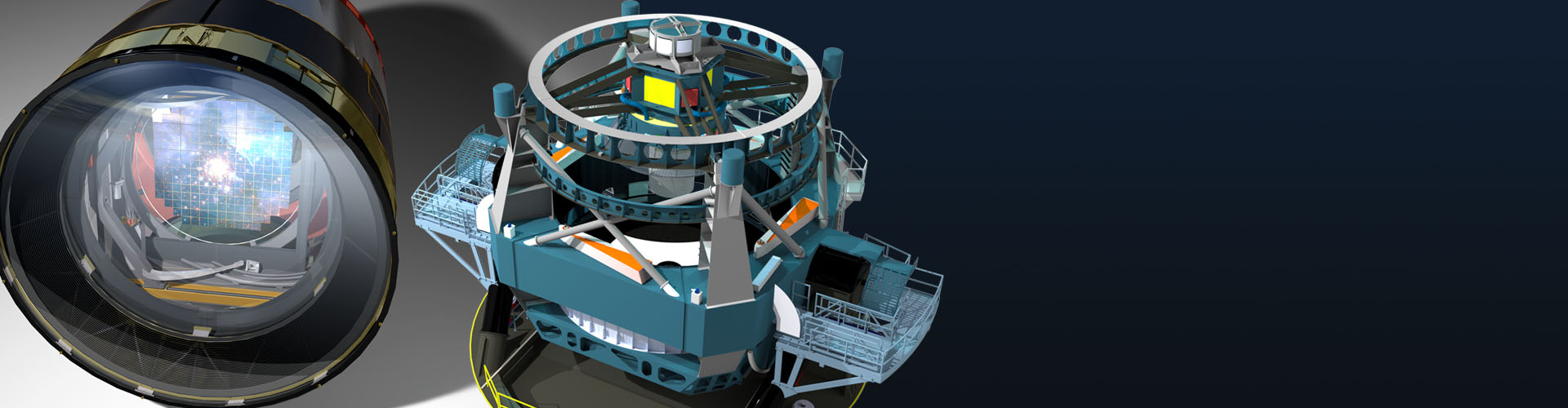
Located on the Cerro Pachón ridge in north-central Chile, the 8.4-meter LSST will conduct a 10-year survey of the sky that will deliver 200 petabytes worth of images and data that will address some of the most pressing questions about the structure and evolution of the Universe and the objects in it. In addition to surveying the early Universe in order to understand the nature of dark matter and dark energy, it will also conduct surveys of the remote areas of the Solar System.
Planet 9/X is one such object. In recent years, the existence of two planetary-mass bodies have been hypothesized to explain the orbital distribution of distant Kuiper Belt Objects. While neither planet is thought to be exceptionally faint, the sky locations of these planets are poorly constrained – making them difficult to pinpoint. As such, a wide area survey is needed to detect these possible planets.
In 2022, the LSST will carry out an unbiased, large and deep survey of the southern sky, which makes it an important tool when it comes to the search of these hypothesized planets. As they state in their study:
“The possibility of undiscovered planets in the solar system has long fascinated astronomers and the public alike. Recent studies of the orbital properties of very distant Kuiper belt objects (KBOs) have identified several anomalies that may be due to the gravitational influence of one or more undiscovered planetary mass objects orbiting the Sun at distances comparable to the distant KBOs.

These studies include Trujillo & Sheppard’s 2014 study where they noticed similarities in the orbits of distant Trans-Neptunian Objects (TNOs) and postulated that a massive object was likely influencing them. This was followed by a 2016 study by Sheppard & Trujillo where they suggested that the high perihelion objects Sedna and 2012 VP113 were being influence by an unknown massive planet.
This was followed in 2016 by Konstantin Batygin and Michael E. Brown of Caltech suggesting that an undiscovered planet was the culprit. Finally, Malhotra et al. (2016) noted that the most distant KBOs have near-integer period ratios, which was suggestive of a dynamical resonance with a massive object in the outer Solar System. Between these studies, various mass and distance estimates were formed that became the basis of the search for this planet.
Overall, these estimates indicated that Planet 9/X was a super-Earth with anywhere between 5 to 20 Earth masses, and orbited the Sun at a distance of between 150 – 600 AU. Concurrently, these studies have also attempted to narrow down where this Super-Earth’s orbit will take it throughout the outer Solar System, as evidenced by the perturbations it has on KBOs.
Unfortunately, the predicted locations and brightness of the object are not yet sufficiently constrained for astronomers to simply look in the right place at the right time and pick it out. In this respect, a large area sky survey must be carried out using moderately large telescopes with a very wide field of view. As Dr. Trilling told Universe Today via email:
“The predicted Planet X candidates are not particularly faint, but the possible locations on the sky are not very well constrained at all. Therefore, what you really need to find Planet X is a medium-depth telescope that covers a huge amount of sky. This is exactly LSST. LSST’s sensitivity will be sufficient to find Planet X in almost all its (their) predicted configurations, and LSST will cover around half of the known sky to this depth. Furthermore, the cadence is well-matched to finding moving objects, and the data processing systems are very advanced. If you were going to design a tool to find Planet X, LSST is what you would design.”

However, the team also acknowledges that within certain parameters, Planet 9/X may not be detectable by the LSST. For example, it is possible that that there is a very narrow slice of predicted Planet 9/X parameters where it might be slightly too faint to be easily detected in LSST data. In addition, there is also a small possibility that irregularities in the Planet 9/X cadence might lead to it being missed.
There is the even the unlikely ways in which Planet 9/X could go undetected in LSST data, which would come down to a simple case of bad luck. However, as Dr. Trilling indicated, the team is prepared for these possibilities and is hopeful they will find Planet 9/X, assuming there’s anything to find:
“The more likely conclusion if planet X is not detected in LSST data is that planet X doesn’t exist – or at least not the kind of planet X that has been predicted. In this case, we’ve got to work harder to understand how the Universe created this pattern of orbits in the outer Solar System that I described above. This is a really fun part of science: make a prediction and test it, and find that the result is rarely what is predicted. So now we’ve got to work harder to understand the universe. Hopefully this new understanding makes new predictions that we then can test, and we repeat the cycle.”
The existence of Planet 9/X has been one of the more burning questions for astronomers in recent years. If its existence can be confirmed, astronomers may finally have a complete picture of the Solar System and its dynamics. If it’s existence can be ruled out, this will raise a whole new series of questions about what is going on in the Outer Solar System!
Further Reading: arXiv