Astronomy and Planetary Science
  • About us
    • People
    • News
      • Accomplishments
      • Newspaper & magazine articles
    • Events & colloquia
    • Faculty & staff directory
  • Degrees
    • Undergraduate degrees
    • PhD Astronomy & Planetary Science
  • Research
    • Faculty Research
    • NAU/NASA Space Grant
    • Research Experiences for Undergraduates in Astronomy (REU)
    • CCC2NAU Internship Program
  • Resources
    • Forms & Policies
      • Forms Index
      • Policies Index
    • Professional development
      • Research & employment opportunities
    • Tuition & aid
      • Tuition information
      • Financial Aid
      • Scholarships
    • Academics & support
      • Advising
      • Commencement
      • Course Syllabi
      • Handy links for homework/research
      • Tutoring
  • Give now
  • IN
  • Astronomy and Planetary Science
  • NAU Astronomy & Planetary Science In the News

Studying Mars on Earth: NAU scientist conducting astrobiological research in Mojave Desert

Posted by on July 1, 2018

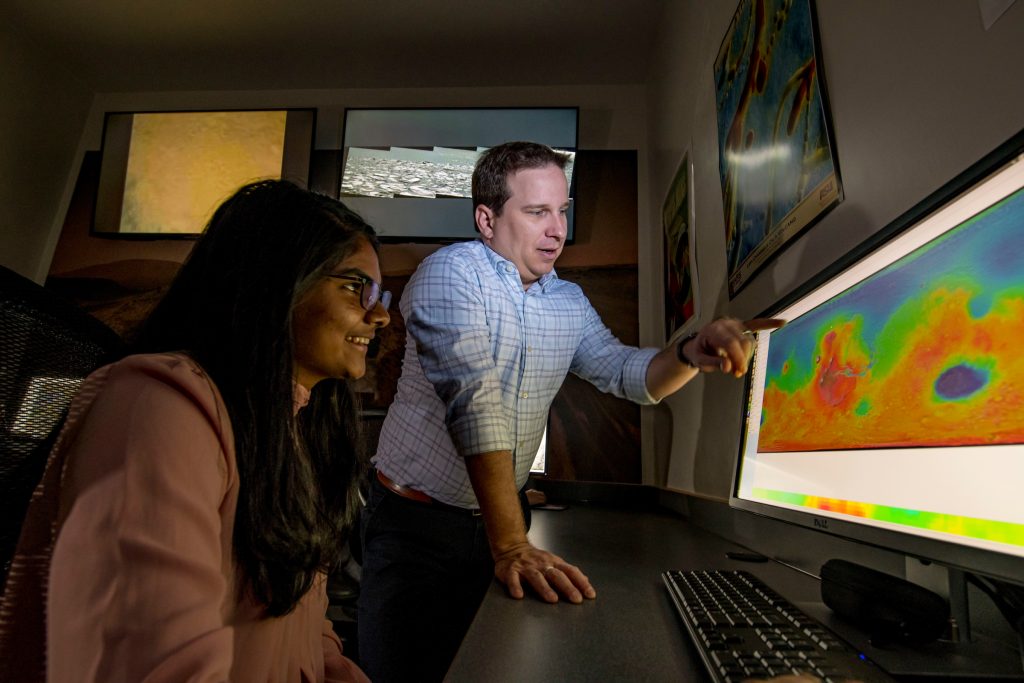
Christopher Edwards -- Mars Rover

By Kerry Bennett
Office of the Vice President for Research


Much research in the field of astrobiology—the study of life in the universe—focuses on the habitability of extraterrestrial environments in our solar system and beyond. NASA’s Planetary Science and Technology from Analog Research (PSTAR) program sponsors research exploring the Earth’s extreme environments to develop a sound basis for conducting astrobiological research on other solar system bodies. By identifying, exploring and characterizing terrestrial environments for habitability and biosignatures, scientists can better predict what future exploration missions may encounter on other planets.

NAU planetary scientist Christopher Edwards was recently awarded a $1.2 million grant from PSTAR to understand the habitability of Mars by studying extreme, Mars-like environments on Earth. As principal investigator, Edwards will lead a team of NAU graduate students and scientists from the U.S. Geological Survey Astrogeology Science Center, Stony Brook University, the University of New Mexico and NASA’s Jet Propulsion Laboratory to study several field sites in California’s Mojave Desert, one of the hottest, driest places on the continent. Edwards selected these sites for the study—including sedimentary deposits and several seasonally dry lakes—because they represent thermophysical conditions comparable to potentially habitable environments on Mars.

One of the most important Mars discoveries in recent years is the existence of recurring slope lineae (RSL), dark and narrow features emerging from steep, rocky exposures that may signal the presence of water. Edwards is a leading expert on RSL, and this three-year project is designed to provide the technical and scientific basis for determining soil moisture content of RSL based on thermophysical data gathered through remote sensing technologies. In this field campaign, Edwards and his team will use a variety of ground-based measurements and sophisticated instruments mounted on unmanned aerial vehicles to simulate data like that acquired of Martian RSL from previous NASA missions.
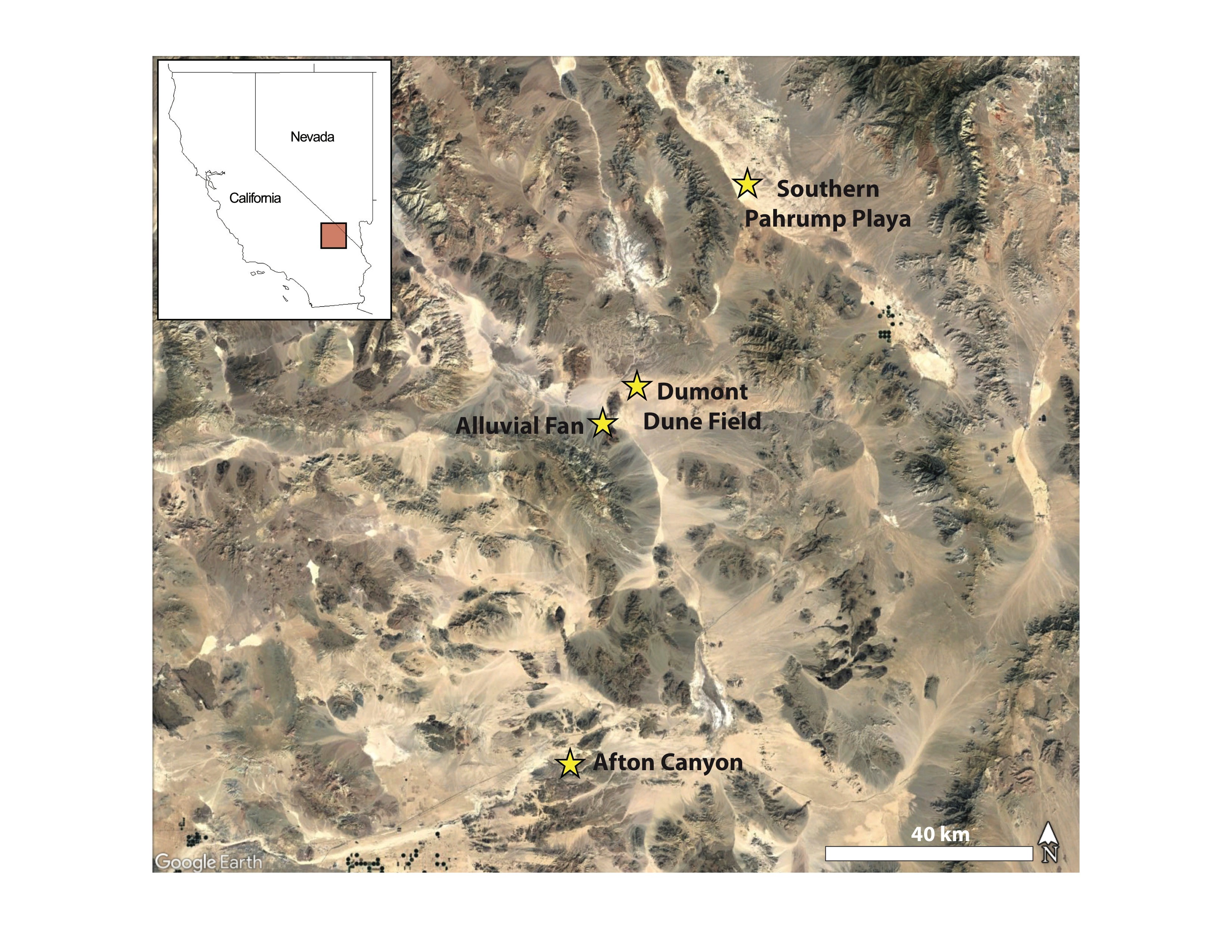
Map of Mojave Desert
Proposed field sites in the Mojave Desert where Edwards and team will carry out field studies acquiring ground truth and simulated data. Landsat/Copernicus imagery acquired 7/2/2016 and 9/8/2016.

“RSL are perhaps the most compelling evidence for present-day liquid water on Mars, and they have driven a significant re-evaluation of the ways in which liquid water and habitability in extreme environments could exist on Mars,” Edwards said. “By conducting detailed fieldwork at these sites using sophisticated numerical models, airborne remote sensing technologies and detailed ground-based in situ measurements, we will create a quantitative representation of the surfaces, similar to those found on Mars and other planetary bodies.

“The project has significant implications for Mars exploration and, more specifically, for instrumentation scientists choose in the future to assess the moisture content of soils, presence of permafrost and/or degree of rock cementation on planetary bodies.”

An assistant professor in the Department of Physics and Astronomy, Edwards’ research focuses on the composition, physical properties and processes and morphology of planetary surfaces, with an emphasis on rocky bodies, including the Earth. A major element of his research has been the design and development of infrared remote sensing instruments for use in space, the laboratory and for fieldwork. His research uses infrared spectroscopy, radiometry, laboratory spectroscopic measurements, geologic field observations and numerical modeling, and has taken him to field sites in the western United States, Yellowstone National Park, Hawaii and Spain, as well as the Himalayan mountains in Bhutan.

3-panel image of sample datasets
These sample datasets are taken with instruments and processed through a pipeline similar to that which will be used by Edwards and team: (left) Visible imagery from a multi-wavelength camera at ~1 cm/pixel resolution; (center) Thermal imagery from a FLIR thermal infrared camera at ~5 cm/pixel resolution; (right) Digital elevation model (topography) derived from the visible imaging data in the left panel at ~5 cm/px.


Source: Studying Mars on Earth: NAU scientist conducting astrobiological research in Mojave Desert

Filed Under: Astronomy, Astronomy and Planetary Science

Categories

Tags

Anna Baker Anna Engle Asteroids Astrobiology Astroinformatics astronomy Brain Food Christopher Edwards Cristina Thomas DART David Koerner David Trilling Deimos Ed Anderson EMIRS EMM Flagstaff Festival of Science Gavin Moriarty Hope Ian Marrs James Webb Space Telescope JWST KNAU Local News Lucas McClure LUCY Maria Chernyavskaya Mars Mars Moon Exploration Mary Lara Nadine Barlow NAU Near-Earth Asteroids OSIRIS-REx PhD Defense Phobos planetary defense Pluto Ryder Strauss Science and Technology Shae Raposa Trojan Asteroids via bookmarklet Wildfire XPRIZE

Archives

Recent Posts

  • Food grows better on the moon than on Mars, scientists find
  • Northern Arizona University student studies comet trajectories through work at Lowell Observatory
  • How to find a comet before it hits Earth
  • Crater on Mars named after former NAU department head
  • NAU professor who died of cancer has Mars crater named after her

Recent Comments

    Archives

    • January 2025
    • December 2024
    • November 2024
    • October 2024
    • September 2024
    • August 2024
    • July 2024
    • May 2024
    • April 2024
    • February 2024
    • December 2023
    • November 2023
    • October 2023
    • September 2023
    • August 2023
    • June 2023
    • May 2023
    • April 2023
    • March 2023
    • February 2023
    • January 2023
    • December 2022
    • November 2022
    • October 2022
    • September 2022
    • July 2022
    • June 2022
    • May 2022
    • April 2022
    • March 2022
    • February 2022
    • January 2022
    • December 2021
    • November 2021
    • October 2021
    • August 2021
    • May 2021
    • April 2021
    • March 2021
    • February 2021
    • January 2021
    • December 2020
    • November 2020
    • October 2020
    • September 2020
    • August 2020
    • July 2020
    • June 2020
    • May 2020
    • April 2020
    • February 2020
    • December 2019
    • September 2019
    • August 2019
    • July 2019
    • June 2019
    • April 2019
    • February 2019
    • January 2019
    • December 2018
    • November 2018
    • October 2018
    • August 2018
    • July 2018
    • June 2018
    • May 2018
    • April 2018
    • February 2018
    • January 2018
    • May 2017

    Categories

    • Astronomy
    • Astronomy and Planetary Science
    • Uncategorized

    Meta

    • Log in
    • Entries feed
    • Comments feed
    • WordPress.org
    Astronomy and Planetary Science
    Location
    Room 209 Building 19
    Physical Sciences
    527 S. Beaver St.
    Flagstaff, Arizona 86011-6010
    Mailing Address
    NAU Box 6010
    Flagstaff, Arizona 86011-6010
    Email
    astro@nau.edu
    Phone
    928-523-2661
    Social Media
    Facebook