In the vastness of space, scientists have found 30-40 of what they call active asteroids. Besides the rarity, they’re unusual in that they have tails—normal for comets, not so much for asteroids.
These mysterious celestial bodies also may hold the secret to the origin of water on Earth.
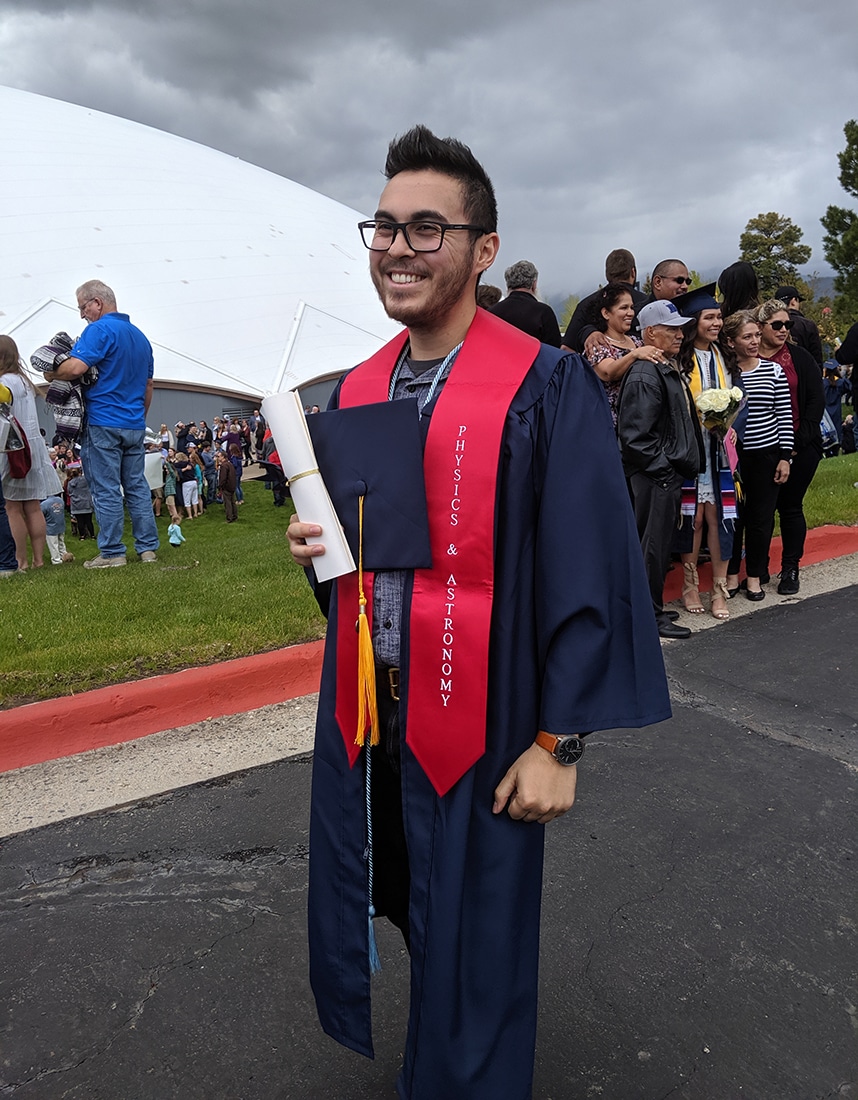
It’s a hotly-contested question, said Northern Arizona University graduate Jay Kueny, and he’s eager to jump into the debate. His research, which he’s done for two years at NAU as an undergraduate and a post-baccalaureate scholar, got a boost when he was selected for the National Science Foundation’s Graduate Research Fellowship Program (GRFP).
“I have always fantasized about space flight and the prospect of mining asteroids for resources,” said Kueny, who earned his bachelor’s degree in astronomy in 2019. “Research that furthers knowledge on asteroid populations and the location of water reservoirs in our solar system could benefit these types of future space missions. Among other uses, space water could facilitate the creation of rocket fuel, breathable oxygen and survival provisions for plants and animals in spacecraft.”
How to study active asteroids
Kueny worked with Ph.D. student Colin Chandler on his research into active asteroids, or these asteroids with tails. Recently, scientists debunked the popular theory of Earth’s water getting delivered mainly by comets during the early years of the solar system; researchers found the hydrogen isotope ratios in Earth’s ocean water didn’t match that in comets. That left a big question about the early days of Earth.
“If we are able to determine that a significant number of asteroids harbor water ice, it would lend credence to an alternate theory—asteroids instead were the main water delivery medium for a primitive Earth,” Kueny said. “The discovery and characterization of active asteroids will further our understanding of how Earth obtained its water and more generally will offer clues on solar system formation and water delivery to potentially habitable planets.”
Learn more about Chandler’s research, for which he won a GRFP award in 2018.
One major obstacle to this work, however, is how rare these active asteroids are. A few dozen out of a million asteroids makes them hard to find, and if Kueny and Chandler can’t find them, they can’t study them. So they’re trying something new.
Enter hundreds (hopefully) of citizen scientists, who don’t need expertise; they just need to have access to a computer and be willing to spend some time poring over pictures of space. The researchers will have these citizen scientists examine publicly available archival telescope image data for images of asteroids. From there, when an asteroid is recognized, the citizen science program Zooniverse will generate a thumbnail cutout and it will be reexamined to determine if the asteroid has a tail.
Considering there will be tens of millions of thumbnails to look at, they need all the help they can get. Kueny and Chandler are in the final stages of preparing the dataset and various media to include in the project’s workflow, as well as a tutorial and field guide.
Upon completion of this project, I aim to provide framework for further efforts to pinpoint water content in our solar system and ultimately provide answers to the current dilemma surrounding the origin of Earth’s water content,” Kueny wrote in the research statement included in his GRFP application. “I expect the results of this project to influence research advancements in exoplanets, solar systems formation and extraterrestrial life with water being a key component in the assembly of habitable worlds.”
Ty Robinson, an assistant professor in the Department of Astronomy and Planetary Sciences, is one of those researchers trying to answer those questions. He worked with Kueny during Kueny’s undergraduate career.
“Jay has been a real joy to collaborate with,” Robinson said. “Jay is certainly one of those rare undergraduate students who can independently arrive at a great research idea and see that idea through from its inception to receiving funding. He is a very deserving GRFP awardee, and we are all excited to see him progress through his research and Ph.D. program at the University of Arizona.”
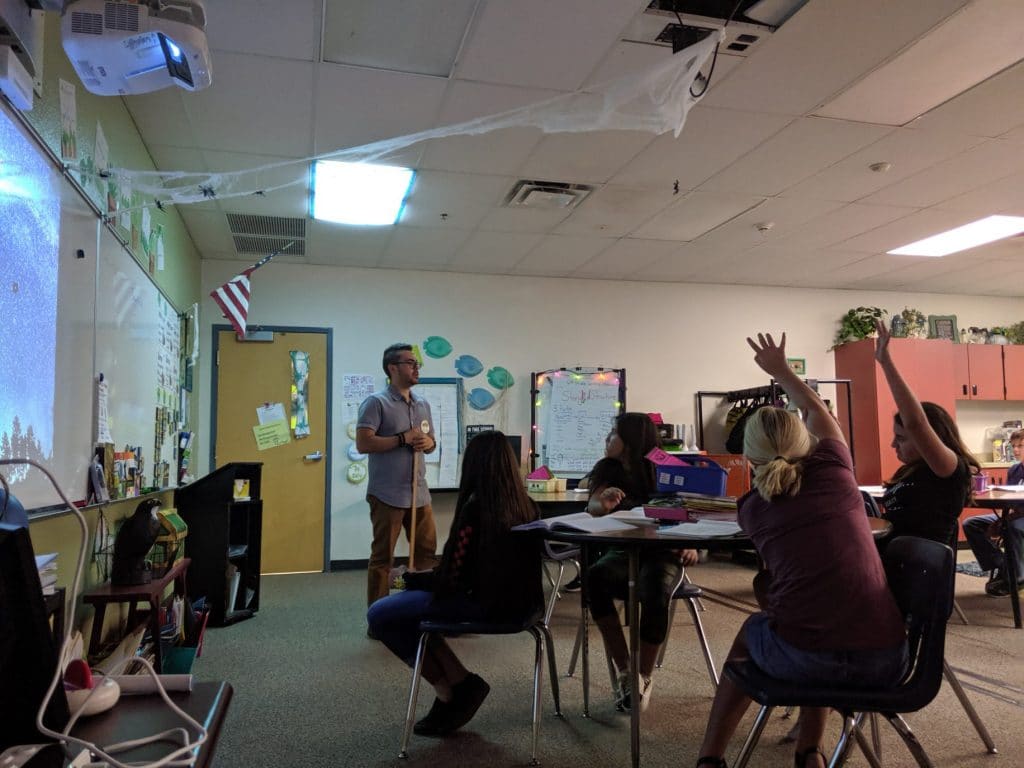
In addition to involving citizen scientists, Kueny intends to share his research with the masses. He shared his desire to combine his teaching experience with this research to develop interactive lessons that center on water in the solar system and what it means for Earth.
Heading into graduate school, GRFP in hand
The application was stressful and required dozens of hours of hard work, Kueny said. He offered advice to future applicants:
- Start writing early. He recommended starting a couple of months before the deadline.
- Get lots of feedback. Ask two or three faculty members or peers to help review and to proofread.
- Ask for review from someone outside your field, who can check for jargon, confusing sentences or concepts that could be explained more clearly.
- Apply before you get to graduate school. Graduate students can only apply once, but applying as a non-graduate student doesn’t affect that one allowed application. Applying as a senior or during a gap year could mean students go into their graduate program with this funding or provide useful experience for a second go-round in graduate school.
Kueny speaks from experience; he applied as a post-baccalaureate scholar. That is allowing him to go into his Ph.D. program at the University of Arizona as an NSF fellow, which means full funding. He wants to study the more technical side of astronomy by pursuing research in adaptive optic systems to push the capabilities of modern telescopes.
“Adaptive optics allows us to observe sky targets as if there was no turbulent atmosphere above us, which would typically constitute fuzziness and distortion in the image,” he said. “Normally one of the hallmarks of a space telescope (no atmosphere to look through), adaptive optics offer the same benefit to much larger ground-based telescopes without the additional costs associated with putting and maintaining a complicated instrument in space.”
Editor’s note: Four NAU students were selected for the National Science Foundation’s Graduate Research Fellowship Program. Learn more about the research of ecology student Kelly Jaenecke, astronomy student Schuyler Borges and geology student Alexis Riche.

Heidi Toth | NAU Communications
(928) 523-8737 | heidi.toth@nau.edu