Icy gas clouds found in deep space between stars are believed to be the birthplace of planets and solar systems. Scientists want to know what these clouds are made of, but so far, even the most powerful telescopes have not been able to provide a complete answer.
Mark Loeffler, associate professor in the Department of Astronomy and Planetary Science at Northern Arizona University, believes these clouds are rich in homonuclear molecules—molecules composed of only one element, like hydrogen (H2), nitrogen (N2) or oxygen (O2).
“Hydrogen is the most abundant element in the universe, yet it hasn’t been detected in space in ice form,” Loeffler said. “Also, we know the clouds are really cold, so they could be loaded with nitrogen.”
Astronomers identify elements in molecular clouds by measuring the amount of starlight that passes through them and makes its way to Earth. However, these homonuclear molecules in ice form absorb very little infrared light, which makes them difficult to find.
“These species have already been detected in the gas phase using submillimeter spectroscopy but have not been detected in the ice yet. This is likely, because to detect these molecules in an ice, astronomers use infrared spectroscopy and these molecules are very weakly absorbing in the infrared.”
Laboratory studies have already shown that the absorption features of these molecules can change depending on how they combine with others to form compounds.
But scientists’ ability to detect these homonuclear molecules is expected to change with findings from the new James Webb Space Telescope, the world’s largest and most technically advanced space observatory with a huge infrared telescope.
“It is an engineering marvel and very good at detecting faint light.” Loeffler said. “We will see things we’ve never seen before.”
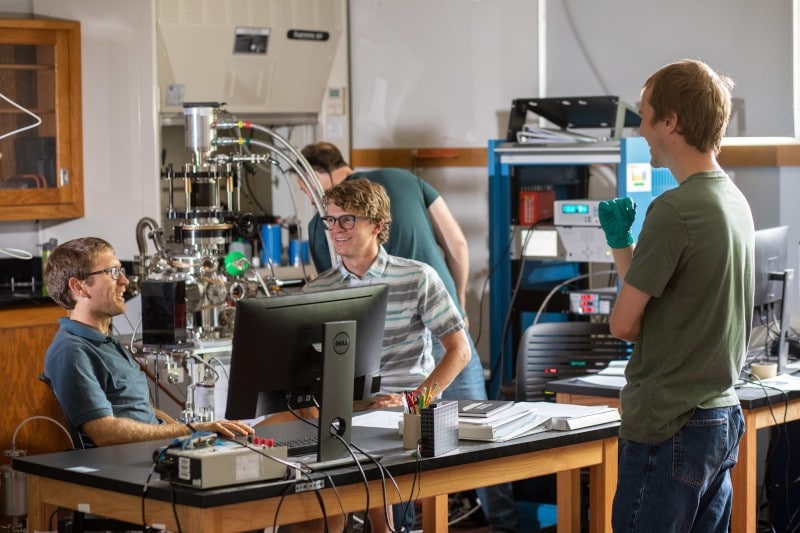
The telescope is scheduled to be launched in 2021. When data from the spacecraft starts coming in, NASA wants to be ready to understand what materials the new telescope senses. The agency is providing a $160,000, three-year grant for Loeffler to recreate conditions of interstellar space in his Processes, Environments, and Astrochemistry on Extraterrestrial Surfaces (PEAXS) Research Laboratory.
“Our goal is to get out in front of the telescope and provide reference data for these compounds in different environments, what they are mixed with and how they are formed. We hope to characterize this fully, so when these species are detected, we can better characterize their environment and abundance.”
Because the homonuclear molecules may attach themselves to space debris when in ice form, Loeffler’s lab is interested in the icy material, including the water ice, different kinds of ice and the rocky grains that have ice on them.
“We will be making ice samples analogous to what we think the environment in the interstellar space will be like, mixed in with other ices—carbon and carbon dioxide—that’s likely how they are. If they are detected by the JWST, scientists will be able to estimate the abundance of these icy molecules in molecular clouds.”
Loeffler and his team will be quantifying the absorption strengths of H2, N2 and O2 in different environments that are representative of the interstellar medium.
“Given that the compounds are likely mixed with other ices (H2O, CO and CO2), we will be investigating how the strength, shape and position of the absorption bands of these homonuclear molecules change in different environments. This will help us and astronomers understand what type of environments these compounds are in and the concentration of these compounds with respect to the other ices detected.”
Loeffler says this lab work is important because there is a strong possibility that many of these molecules are mixed in ices that exist in interstellar space.
“Their presence could significantly alter the solid-state chemistry that occurs during the evolution of these cold molecular clouds. Considering these icy clouds are thought to be the birthplace of stars and subsequently planetary systems, understanding the composition of these regions is paramount to getting an idea of how these regions evolved.”
Loeffler is collaborating on the project with NAU professor Stephen Tegler and adjunct professor Will Grundy, an astronomer at Lowell Observatory, who will both play a critical role in helping to properly place the PEAXS lab results in context relevant to the astronomical community. In addition, the NASA grant will provide funding for an NAU doctoral student to study icy molecules in the PEAXS Lab.
Loeffler’s research focuses on using laboratory experiments to investigate radiation effects in solid materials ranging from condensed gases to terrestrial minerals. His research spans a variety of scientific disciplines including physics, chemistry, materials science and geology.

Bonnie Stevens and Kerry Bennett
Office of the Vice President for Research