Astronomy and Planetary Science
  • About us
    • People
    • News
      • Accomplishments
      • Newspaper & magazine articles
    • Events & colloquia
    • Faculty & staff directory
  • Degrees
    • Undergraduate degrees
    • PhD Astronomy & Planetary Science
  • Research
    • Faculty Research
    • NAU/NASA Space Grant
    • Research Experiences for Undergraduates in Astronomy (REU)
    • CCC2NAU Internship Program
  • Resources
    • Forms & Policies
      • Forms Index
      • Policies Index
    • Professional development
      • Research & employment opportunities
    • Tuition & aid
      • Tuition information
      • Financial Aid
      • Scholarships
    • Academics & support
      • Advising
      • Commencement
      • Course Syllabi
      • Handy links for homework/research
      • Tutoring
  • Give now
  • IN
  • Astronomy and Planetary Science
  • NAU Astronomy & Planetary Science In the News

NAU physicist receives prestigious 2018 Cottrell Scholar Award

Posted by on July 1, 2018

By Julie Hammonds
Office of the Vice President for Research


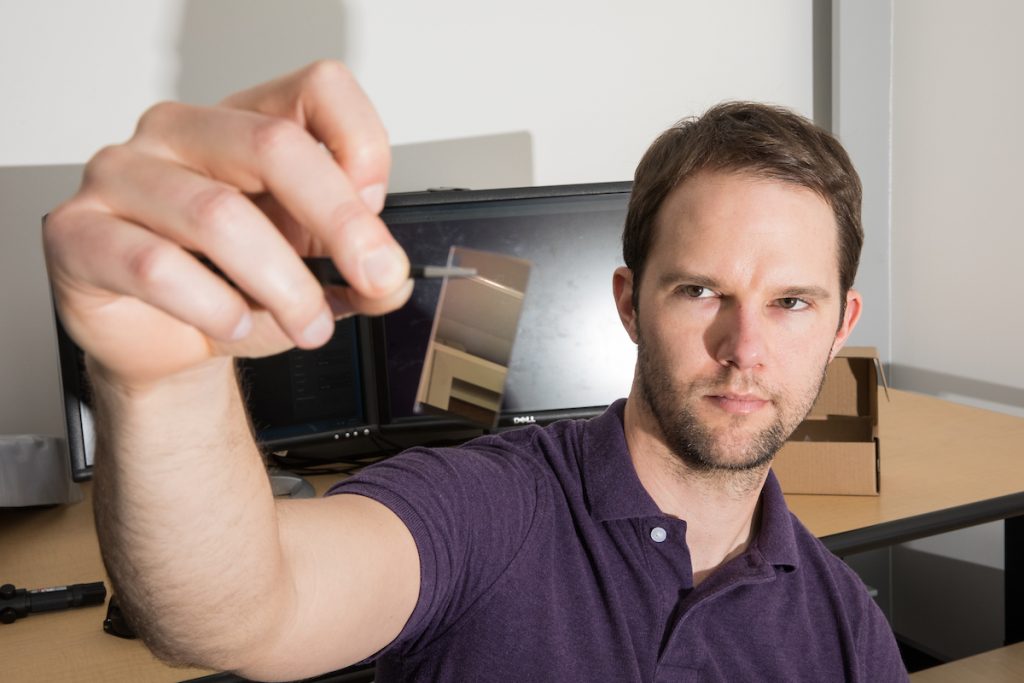
A Northern Arizona University physicist who studies complex, hybrid nanomaterials has been recognized for his academic leadership and the quality and innovation of his research. The Research Corporation for Science Advancement (RCSA) recently named assistant professor John Gibbs a 2018 Cottrell Scholar. This award includes a three-year, $100,000 grant to advance his teaching and research.

One of only 24 early-career teacher-scholars selected nationally from the fields of chemistry, physics and astronomy—and the first from NAU—Gibbs was chosen for his proposal to study the fundamental principles of active matter, “Investigating Shape-Dependent Emergent Collective Behavior in Artificial Active Matter Systems.”

Building on earlier research

Gibbs prepared the foundation for this new project with earlier studies on the movement of microscopic particles suspended in fluids.

“In this field, we’re looking at how active microscale particles travel from one point to another, and we’re trying to propel them in a controlled manner,” Gibbs said. “Understanding and controlling the behavior of matter at the microscopic level may someday change how we respond to oil spills, assemble new materials or perform microsurgery.”

Gibbs recently contributed to a study of how shape affects the behavior of microparticles composed of titanium dioxide, a light-sensitive photocatalyst. The study concluded that geometry significantly affected movement, opening a new avenue for advanced motion control. The resulting paper was recently published in ACS Applied Materials and Interfaces. Gibbs also was the principal investigator and corresponding author of a 2017 paper published in Advanced Materials, a top-five materials science journal, on a novel method to manipulate particle-particle interactions.

“This new project will build on what we learned in these earlier studies,” Gibbs said. “We will look at how large numbers of active particles show emergent behaviors, which are phenomena only seen when many mobile particles interact with simple but well-defined rules. The hope is that we’ll gain a better understanding of how such systems behave, knowledge we can use for practical applications. On a larger scale, we expect to discover new materials with unprecedented properties that emerge from these simpler pieces.”

Preparing future scientists

In the experimental lab next to his office, students will observe particle behavior through a microscope, take video and collect and analyze data. More advanced students will build the actual particles used in the experiments.

“This project is ideal for introducing students to research,” Gibbs said.

With the funding he receives from RCSA, Gibbs will also develop a new course to launch graduate students into successful scientific careers.

“The new course will cover what scientists actually do, including writing proposals and managing labs,” Gibbs said. “These things aren’t often taught in traditional programs, but NAU has a significant focus on developing working scientists.”

RCSA funds scientific research and the development of academic scientists. To be eligible for the award, an applicant must be in his or her third year as an assistant professor. Gibbs joined the faculty of NAU’s Department of Physics and Astronomy in 2014. He is an affiliated faculty member of the Center for Bioengineering Innovation and is affiliated with the School of Informatics, Computing, and Cyber Systems. Gibbs’ research interests cover the physics and applications of nanomaterials, including optical and mechanical properties, metamaterials and propulsion at the nanoscale.

Source: NAU physicist receives prestigious 2018 Cottrell Scholar Award

Filed Under: Astronomy, Astronomy and Planetary Science

Categories

Tags

Anna Baker Anna Engle Asteroids Astrobiology Astroinformatics astronomy Brain Food Christopher Edwards Cristina Thomas DART David Koerner David Trilling Deimos Ed Anderson EMIRS EMM Flagstaff Festival of Science Gavin Moriarty Hope Ian Marrs James Webb Space Telescope JWST KNAU Local News Lucas McClure LUCY Maria Chernyavskaya Mars Mars Moon Exploration Mary Lara Nadine Barlow NAU Near-Earth Asteroids OSIRIS-REx PhD Defense Phobos planetary defense Pluto Ryder Strauss Science and Technology Shae Raposa Trojan Asteroids via bookmarklet Wildfire XPRIZE

Archives

Recent Posts

  • Food grows better on the moon than on Mars, scientists find
  • Northern Arizona University student studies comet trajectories through work at Lowell Observatory
  • How to find a comet before it hits Earth
  • Crater on Mars named after former NAU department head
  • NAU professor who died of cancer has Mars crater named after her

Recent Comments

    Archives

    • January 2025
    • December 2024
    • November 2024
    • October 2024
    • September 2024
    • August 2024
    • July 2024
    • May 2024
    • April 2024
    • February 2024
    • December 2023
    • November 2023
    • October 2023
    • September 2023
    • August 2023
    • June 2023
    • May 2023
    • April 2023
    • March 2023
    • February 2023
    • January 2023
    • December 2022
    • November 2022
    • October 2022
    • September 2022
    • July 2022
    • June 2022
    • May 2022
    • April 2022
    • March 2022
    • February 2022
    • January 2022
    • December 2021
    • November 2021
    • October 2021
    • August 2021
    • May 2021
    • April 2021
    • March 2021
    • February 2021
    • January 2021
    • December 2020
    • November 2020
    • October 2020
    • September 2020
    • August 2020
    • July 2020
    • June 2020
    • May 2020
    • April 2020
    • February 2020
    • December 2019
    • September 2019
    • August 2019
    • July 2019
    • June 2019
    • April 2019
    • February 2019
    • January 2019
    • December 2018
    • November 2018
    • October 2018
    • August 2018
    • July 2018
    • June 2018
    • May 2018
    • April 2018
    • February 2018
    • January 2018
    • May 2017

    Categories

    • Astronomy
    • Astronomy and Planetary Science
    • Uncategorized

    Meta

    • Log in
    • Entries feed
    • Comments feed
    • WordPress.org
    Astronomy and Planetary Science
    Location
    Room 209 Building 19
    Physical Sciences
    527 S. Beaver St.
    Flagstaff, Arizona 86011-6010
    Mailing Address
    NAU Box 6010
    Flagstaff, Arizona 86011-6010
    Email
    astro@nau.edu
    Phone
    928-523-2661
    Social Media
    Facebook