
Astronomy and Planetary Science
  • About us
    • People
    • News
      • Accomplishments
      • Newspaper & magazine articles
    • Events & colloquia
    • Faculty & staff directory
  • Degrees
    • Undergraduate degrees
    • PhD Astronomy & Planetary Science
  • Research
    • Faculty Research
    • NAU/NASA Space Grant
    • Research Experiences for Undergraduates in Astronomy (REU)
    • CCC2NAU Internship Program
  • Resources
    • Forms & Policies
      • Forms Index
      • Policies Index
    • Professional development
      • Research & employment opportunities
    • Tuition & aid
      • Tuition information
      • Financial Aid
      • Scholarships
    • Academics & support
      • Advising
      • Commencement
      • Course Syllabi
      • Handy links for homework/research
      • Tutoring
  • Give now
  • IN
  • Astronomy and Planetary Science
  • NAU Astronomy & Planetary Science In the News

NASA telescope’s ‘non-detection’ of first interstellar object in solar system leads NAU team to conclusions about mystery object’s size, reflectivity

Posted by on November 14, 2018

David Trilling

Nov. 14, 2018

In November 2017, a team of scientists pointed NASA’s Spitzer Space Telescope toward a comet-like object known as ’Oumuamua—the first interstellar body ever found in our solar system—but the object proved too faint for the infrared telescope to detect.

Though initially disappointing, this non-detection of ’Oumuamua eventually provided new information about the cosmic interloper, according to a new study published in the The Astronomical Journal by Northern Arizona University professor of physics and astronomy David Trilling, postdoctoral scholar Andrew McNeill, Ph.D. student Alissa Roegge, senior research specialist Nathan Smith and a team of collaborators from several research centers, including the Harvard-Smithsonian Center for Astrophysics, NASA’s Jet Propulsion Laboratory at the California Institute of Technology and The Johns Hopkins University Applied Physics Laboratory.

’Oumuamua was first identified by astronomers at the University of Hawaii’s Pan-STARRS 1 telescope on Haleakala, Hawaii—who named the space rock after the Hawaiian word for “scout”—in October 2017. Subsequent observations conducted by multiple ground-based telescopes and NASA’s Hubble Space Telescope detected sunlight reflected off ’Oumuamua’s surface. Some interpretations of the data suggest that the space rock is very elongated, like a cigar.

The non-detection helped the team determine the object’s size. Because Spitzer tracks asteroids and comets using the infrared light they radiate, the telescope provides more specific information about an object’s size than an instrument that tracks objects using reflected light. The fact that ’Oumuamua was too faint to register on Spitzer’s detectors means the rock’s dimensions must be less than 320 feet by 460 feet by 1440 feet (98 by 140 by 400 meters).

The new study also suggests that ’Oumuamua may be up to 10 times more reflective than comets that reside in our solar system—a surprising result, according to the paper’s authors. Because infrared light is often heat radiation produced by “warm” objects, it can be used to determine the temperature of a comet or asteroid; this can, in turn, be used to determine the reflectivity of the rock’s surface—what scientists call albedo. Just as a dark T-shirt absorbs more sunlight than a light one, a rock with low reflectivity absorbs more sunlight than a rock with high reflectivity. So a lower temperature means a higher albedo.

“One plausible explanation is that ’Oumuamua was a dormant comet nucleus reactivated, after millions of years in interstellar space, by heating during its orbit near the Sun,” Trilling, who is the lead author on the study, said. “This reactivation either destroyed the thin dark mantle expected to be created by cosmic rays and galactic ultraviolet radiation and/or coated the surface with an optically thick layer of new, fresh ice.”

’Oumuamua is now on its way out of our solar system and beyond the reach of current telescopes, however, so scientists will never know for sure how large it is, what it looks like or how reflective it is.

“Usually, if we get a measurement from a comet that’s kind of weird, we go back and measure it again until we understand what we’re seeing,” Trilling said. “But this one is gone forever; we know as much about it as we’re ever going to know.”

What does ’Oumuamua look like? Print your own 3D model of the interstellar object
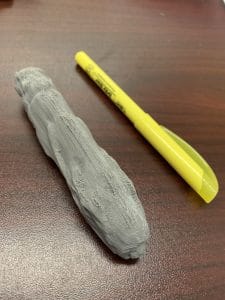
Colin Chandler, graduate student in NAU’s PhD program in Astronomy and Planetary Science, created a three-dimensional model of what ’Oumuamua might look like. Download the file to print your own miniature version of this interstellar object on any 3D printer, such as the printers at Cline Library’s MakerLab.

NAU logoKerry Bennett | Office of the Vice President for Research
(928) 523-5556 | kerry.bennett@nau.edu


Source: NASA telescope’s ‘non-detection’ of first interstellar object in solar system leads NAU team to conclusions about mystery object’s size, reflectivity

Filed Under: Astronomy, Astronomy and Planetary Science

Categories

Tags

Anna Baker Anna Engle Asteroids Astrobiology Astroinformatics astronomy Brain Food Christopher Edwards Cristina Thomas DART David Koerner David Trilling Deimos Ed Anderson EMIRS EMM Flagstaff Festival of Science Gavin Moriarty Hope Ian Marrs James Webb Space Telescope JWST KNAU Local News Lucas McClure LUCY Maria Chernyavskaya Mars Mars Moon Exploration Mary Lara Nadine Barlow NAU Near-Earth Asteroids OSIRIS-REx PhD Defense Phobos planetary defense Pluto Ryder Strauss Science and Technology Shae Raposa Trojan Asteroids via bookmarklet Wildfire XPRIZE

Archives

Recent Posts

  • Food grows better on the moon than on Mars, scientists find
  • Northern Arizona University student studies comet trajectories through work at Lowell Observatory
  • How to find a comet before it hits Earth
  • Crater on Mars named after former NAU department head
  • NAU professor who died of cancer has Mars crater named after her

Recent Comments

    Archives

    • January 2025
    • December 2024
    • November 2024
    • October 2024
    • September 2024
    • August 2024
    • July 2024
    • May 2024
    • April 2024
    • February 2024
    • December 2023
    • November 2023
    • October 2023
    • September 2023
    • August 2023
    • June 2023
    • May 2023
    • April 2023
    • March 2023
    • February 2023
    • January 2023
    • December 2022
    • November 2022
    • October 2022
    • September 2022
    • July 2022
    • June 2022
    • May 2022
    • April 2022
    • March 2022
    • February 2022
    • January 2022
    • December 2021
    • November 2021
    • October 2021
    • August 2021
    • May 2021
    • April 2021
    • March 2021
    • February 2021
    • January 2021
    • December 2020
    • November 2020
    • October 2020
    • September 2020
    • August 2020
    • July 2020
    • June 2020
    • May 2020
    • April 2020
    • February 2020
    • December 2019
    • September 2019
    • August 2019
    • July 2019
    • June 2019
    • April 2019
    • February 2019
    • January 2019
    • December 2018
    • November 2018
    • October 2018
    • August 2018
    • July 2018
    • June 2018
    • May 2018
    • April 2018
    • February 2018
    • January 2018
    • May 2017

    Categories

    • Astronomy
    • Astronomy and Planetary Science
    • Uncategorized

    Meta

    • Log in
    • Entries feed
    • Comments feed
    • WordPress.org
    Astronomy and Planetary Science
    Location
    Room 209 Building 19
    Physical Sciences
    527 S. Beaver St.
    Flagstaff, Arizona 86011-6010
    Mailing Address
    NAU Box 6010
    Flagstaff, Arizona 86011-6010
    Email
    astro@nau.edu
    Phone
    928-523-2661
    Social Media
    Facebook