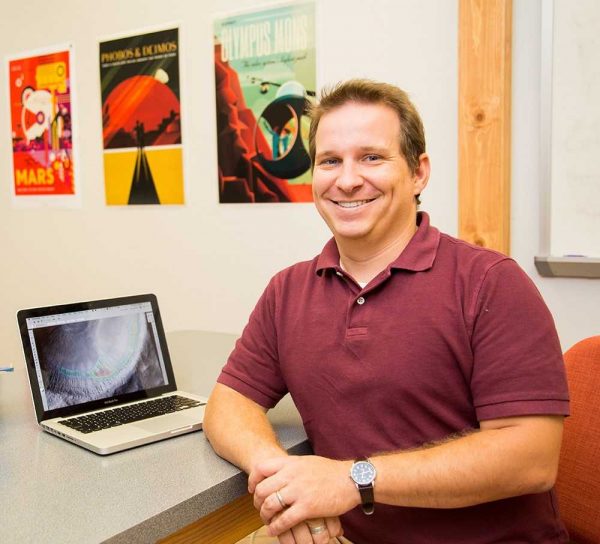
 The relatively tiny Trailblazer satellite, which will measure just 3.5 meters in length with its solar panels fully deployed, will spend more than a year orbiting the Moon at a height of 100 kilometers, scanning it with two instruments on board. Christopher Edwards, assistant professor in NAU’s Department of Astronomy and Planetary Science, will contribute to the instrumentation being developed for the satellite: a visible-shortwave infrared imaging spectrometer built by JPL… Read more
Astronomy and Planetary Science
NAU chemical physicist to collaborate with Lowell scientist on NASA-funded study of Saturn’s moon Titan
 Scientists say Saturn’s largest moon, Titan, is the only body in the solar system besides Earth with liquid on its surface. However, chemical elements behave very differently there in the extremely cold and dense atmosphere, with a temperature of minus 300 degrees Fahrenheit. For example, water forms Titan’s bedrock while methane acts much like water does on Earth—it flows, evaporates and rains down on Titan to form rivers, lakes and seas.
. .… Read more
President’s Prize, Gold Axe recipients, Distinguished Seniors honored at 2020 virtual ceremony
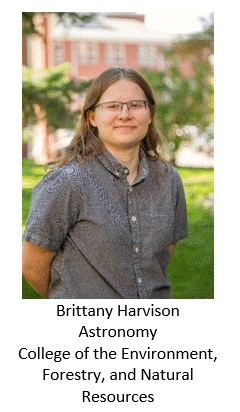
NAU astronomers discover activity on distant planetary object; findings lead to reclassification of Centaur as comet
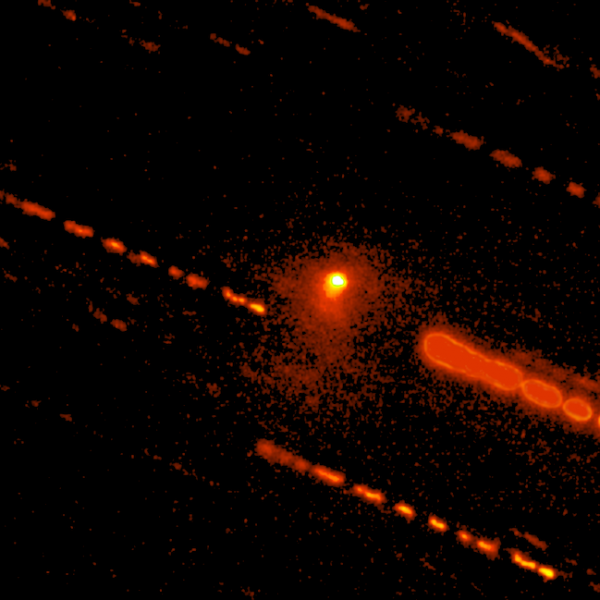
Centaurs are minor planets believed to have originated in the Kuiper Belt in the outer solar system. They sometimes have comet-like features… Read more
How to Build a Spacecraft to Save the World
NAU planetary astronomer Cristina Thomas is quoted in this Wired article. Thomas is the leader of NASA’s Double Asteroid Redirection Team (DART) observation working group.
Wired Magazine: How to Build a Spacecraft to Save the World
NAU scientists author papers in Nature Astronomy chronicling legacy of Spitzer Space Telescope
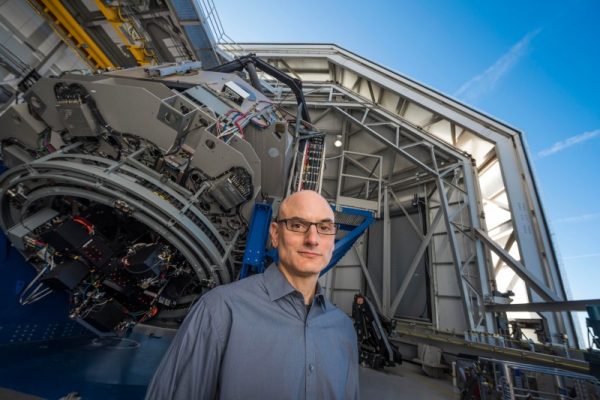 NASA’s Spitzer Space Telescope, designed to study the early universe in infrared light, was the first telescope to see light from a planet outside our solar system. Launched in 2003, Spitzer contained infrared detectors of unprecedented sensitivity, providing astronomers a never-before-possible look at the universe.
. . .
David Trilling, professor in Northern Arizona University’s Department of Astronomy and Planetary Science, is the lead author of “Spitzer’s Solar System studies… Read more