2026 LEGISLATIVE OVERVIEW
(57TH LEGISLATURE, 2nd REGULAR SESSION)
The 2026 legislative session began on January 12th and adjourned sine die on June 13th, lasting 164 days. The legislature proposed a record breaking 2030 bills and 160 resolutions. Of those, 415 bills and 41 resolutions passed, with 264 bills signed by the Governor and enacted into law and 151 vetoed.
FY 2027 BUDGET OVERVIEW
APPROPRIATIONS TO ARIZONA’S UNIVERSITY SYSTEM
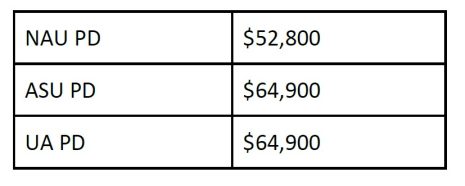
University law enforcement entities were appropriated the following amounts for records management software:
REDUCTIONS TO ARIZONA’S UNIVERSITY SYSTEM
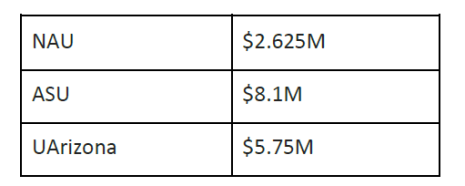
The FY 27 budget included a one-time 2.5% cut to the universities’ baseline appropriation. The amounts are reflected below:
ADDITIONAL REDUCTIONS TO UNIVERSITY PROGRAMS
In addition to the lump sum reduction, the following individual programs were cut or additional costs to the universities were incurred in the FY27 budget:
- University of Arizona is required to use up to $1.2M from their general fund operating budget to operate the Arizona Perinatal and Pediatric Psychiatry Access hotline
- UA Natural Resource Users Law and Policy Center funds were swept, totaling $1.6M
ADDITIONAL HIGHER AND CONTINUING EDUCATION REDUCTIONS
- The budget included a $5M cap on the total amount ABOR can assess from the universities each fiscal year.
FINAL DISPOSITION OF ABOR/ UNIVERSITY PRIORITY BILLS
ABOR AND THE UNIVERSITIES WERE FORMALLY SUPPORTIVE OF THE FOLLOWING BILLS
HB2240 tuition waiver; children; veterans; disabilities (Blackman)
Universities were supportive following working with sponsor to secure dedicated funding source. Dependents of Military Personnel Tuition Scholarship Fund administered by the Arizona Board of Regents to award scholarships to eligible full-time students at Arizona universities or community colleges. Eligibility restricted to a child or dependent of a member or former member of the United States Armed Forces who has a disability rating of at least 30 percent from the United States Department of Veterans Affairs and who was a resident of Arizona or stationed in Arizona when the injury occurred. Appropriates $15 million from the state general fund. (Held in House by sponsor to stakeholder in interim)
HB2786 TPT; exemption; textbook rental (Olson)
University of Arizona driven bill. Exempts the leasing or renting of textbooks from transaction privilege tax under the personal property rental classification. (Signed by Governor)
SB1169 appropriations; graduate medical education program (Werner)
Appropriates $10 million from the state general fund and $18.77 million in expenditure authority in FY2026-27 to the Arizona Health Care Cost Containment System Administration for graduate medical education programs to address Arizona’s physician shortage. Allows the monies to be used for direct and indirect graduate medical education costs and for start-up costs for new residency programs. (Passed Senate, received no committee hearing in House)
ABOR AND/ OR THE UNIVERSITIES WERE FORMALLY NEUTRAL ON THE FOLLOWING BILLS
SB1327 ABOR; research security policy (Farnsworth)
Neutral following adoption of university approved striker amendment language. Requires ABOR to require each university to adopt and post on its website a research security policy that safeguards research, mitigates threats from foreign adversary nations, promotes compliance with federal regulations and establishes processes to update and enforce the policy. Requires ABOR to annually report by October 1 to the Governor and the Legislature on each university’s research security policy and related practices, compliance efforts and the total number of grants, gifts or donations received from a foreign country in the preceding year that exceed $250,000. (Governor signed)
ABOR AND THE UNIVERSITIES FORMALLY OPPOSED THE FOLLOWING LEGISLATION (NONE ENACTED)
HB2775 international organizations; government resources; prohibition (Powell)
Prohibits state agencies, political subdivisions, and their employees acting in an official capacity from participating in or assisting with the enforcement or implementation of any rule, regulation, fee, tax, policy, or mandate of specified international organizations such as the WHO and NATO. Prohibits public institutions of higher education from knowingly soliciting or accepting certain monies, agreements or collaborations from specified entities affiliated with the People’s Republic of China unless ABOR reviews and approves the arrangement, voids unapproved agreements and requires forfeiture of 150% of the value of noncompliant funds without a legislative offset. Requires ABOR to establish a review body and adopt reporting requirements for approved arrangements. (Failed on third read in House)
SB1068 disruption; educational institution; concealed weapon (Rogers)
Prohibits a governing board of a university, college, or community college from adopting or enforcing a policy or rule that bans the possession of a concealed weapon by a person who holds a valid concealed weapons permit or that prohibits the lawful transportation or storage of a firearm. (Vetoed by Governor)
OTHER NOTEWORTHY LEGISLATION- NO OFFICIAL POSITION TAKEN BY ABOR OR UNIVERSITIES
HB2020 – educational institutions; interference; disruption (Keshel)
Decreases the penalty for interference with or disruption of an educational institution if the person is under 18 years of age by making it a class 1 misdemeanor instead of a class 6 felony. (Passed House, not brought to floor in Senate)
HB2040 public educational institutions; adoption information (Keshel)
Requires public educational institutions to give students information on current adoption practices in the United States and on where to find adoption-related resources and support in Arizona whenever an employee discusses contraception or sexually transmitted diseases or infections with students, dispenses contraception to students, or provides STI testing. Requires school districts and charter schools that offer sex education to include instruction on adoption practices, adoption-related resources and support, and the laws on sexual conduct with a minor. (Vetoed by Governor)
HB2060 educational facilities; abortion; prohibited activities (Keshel)
Prohibits public educational institutions and their employees, when acting in an official capacity, from encouraging or facilitating abortions. Prohibits a public school from allowing an abortion provider or an entity or organization that refers patients to an abortion clinic to provide health education instruction. (Passed House, stalled in Senate)
HB2086 vaccination mandates; masks; prohibition (Powell)
Prohibits governmental entities from requiring Arizona residents to wear masks or face coverings, except for long-standing workplace safety and infection control measures unrelated to COVID-19. Prohibits governmental entities from requiring residents to receive any vaccination for any disease or virus. (Vetoed by Governor)
HB2170 state contracts; foreign adversary; prohibition (Diaz, L.)
Prohibits a company domiciled in the People’s Republic of China and that is controlled by or majority owned by the government, military, or ruling political party of the People’s Republic of China from bidding on, submitting proposals for, or entering into contracts with a state agency for electronic or information technology. (Vetoed by Governor)
HB2255 teachers academy; community college students (Weninger)
Expands Arizona Teachers Academy scholarships for community college students to cover up to four academic years or eight semesters, instead of two academic years or four semesters. (Signed by Governor)
HB2311 artificial intelligence service; disclosures; requirements (Rivero)
Requires operators of publicly available conversational artificial intelligence services to provide clear and conspicuous disclosures to each account holder that they are interacting with artificial intelligence. Includes provisions to provide increased protections for minors including prohibiting rewards to encourage increased engagement, prevent statements that would lead a reasonable person to believe the minor interacts with a human, privacy and account-setting tools for minor account holders, and requires protocols for prompts regarding suicidal ideation or self-harm. Prohibits operators from representing that a conversational artificial intelligence service provides professional mental or behavioral health care. (Vetoed by Governor)
HB2575 antisemitism; public schools; prohibition; penalties (Way)
Prohibits public schools, teachers, administrators, contractors, and volunteers from teaching, promoting, or funding antisemitism or anti-Semitic conduct that constitutes harassment or discrimination and creates a hostile educational environment. Prohibits requiring students to advocate anti-Semitic viewpoints for credit and protects employees from adverse action for refusing to teach or promote antisemitism. Establishes reporting, investigation, and enforcement processes with escalating discipline for educators who knowingly or recklessly violate the prohibitions and authorizes civil actions with damages and attorney fees, without immunity. Extends parallel prohibitions, enforcement, employment consequences, and civil liability to universities and community colleges and requires higher education institutions to revise policies, training, grants, and student organization recognition to comply. (Passed Senate COW, then stalled)
HB2809 statewide cybersecurity encryption system; requirements (Gillette)
Requires Arizona to implement a statewide cybersecurity system using post-quantum encryption that meets or exceeds United States Department of Defense CMMC 2.0 standards across state agencies that handle sensitive or confidential data. (Passed House, stalled in Senate before floor vote)
HB2876 public bodies; executive sessions; agenda (Weninger)
Prohibits a public body from placing any proposal to impose or increase a tax rate, assessment or fee on a consent agenda. Requires any topic discussed in an executive session to be placed on a regular agenda for a final vote or final decision and prohibits placing such topics on a consent agenda. (Signed by Governor)
HCR2003 interscholastic; intramural athletics; biological sex (Bliss)
Beginning January 1, 2027, the requirements for schools to designate all interscholastic and intramural athletic teams according to biological sex and the prohibition on opening teams designated for females to male athletes are expanded to apply to athletic associations. Statute establishing private causes of action for athletes and schools harmed by violations or retaliation are also expanded to include athletic associations. Prohibits schools and athletic associations from allowing any individual to use restrooms, locker rooms, shower rooms and other private athletic spaces that are not designated for that individual’s sex. (Transmitted to Secretary of State)
HCR2044 preferential treatment; discrimination; prohibited acts (Montenegro)
Proposes an amendment to the Arizona Constitution prohibiting the state from compelling endorsements of race or ethnicity-based preferential treatment, funding positions in public education that promote such practices, or implementing disciplinary policies that treat individuals differently based on race or ethnicity. Prohibits the use of public monies for programs, training or activities that promote differential treatment or special benefits based on race or ethnicity. Includes exceptions for compliance with federal law, court orders, academic instruction, health services and programs serving members of Indian tribes. (Transmitted to Secretary of State)
SB1013 public employees; merit; hiring practices (Shamp)
Prohibits the state and political subdivisions from adopting hiring policies or practices that base employment decisions on anything other than an applicant’s merit and bars efforts to manipulate or influence workforce composition by race, ethnicity, sex or national origin except as needed to ensure compliance with antidiscrimination laws. Exempts voluntary veterans’ preference employment policies and any other veterans’ preference policies. (Vetoed by Governor)
SB1066 civil liability; fraudulent scientific research (Rogers)
Universities and ABOR worked to amend and include a carve out for universities. Authorizes the Attorney General or a county attorney to bring a civil action against a researcher who knowingly or recklessly publishes fraudulent scientific research. Allows courts to order injunctive relief, restitution, civil penalties, and other appropriate relief and establishes a four-year statute of limitations. Authorizes
private parties harmed by fraudulent scientific research to file a civil action to recover actual damages and reasonable attorney fees. (Stalled in Senate)
SB1078 public records, review standards (Kavanagh)
Establishes the standard of de novo judicial review for questions of law arising from the denial of access to public records, including whether an exception to disclosure applies. (Vetoed by Governor)
SB1423 WICHE; continuation (Angius)
The Western Interstate Commission for Higher Education is continued 10 years to July 1, 2036. (Signed by Governor)
SB1586 state agencies; guidance; website (Bollick)
Requires each state agency to create a dedicated webpage and post all guidance it creates, adopts, or receives from a federal agency that seeks to influence the agency’s interpretation, enforcement, or implementation of state law or administration of federal monies. (Vetoed by Governor)
SB1665 state agencies; hiring practices; appeals (Bollick)
Requires each state agency to adopt a standardized hiring process that assigns weighted, interview panel, and overall grades using published criteria and completes hiring within 90 days. (Passed Senate, retained in House)