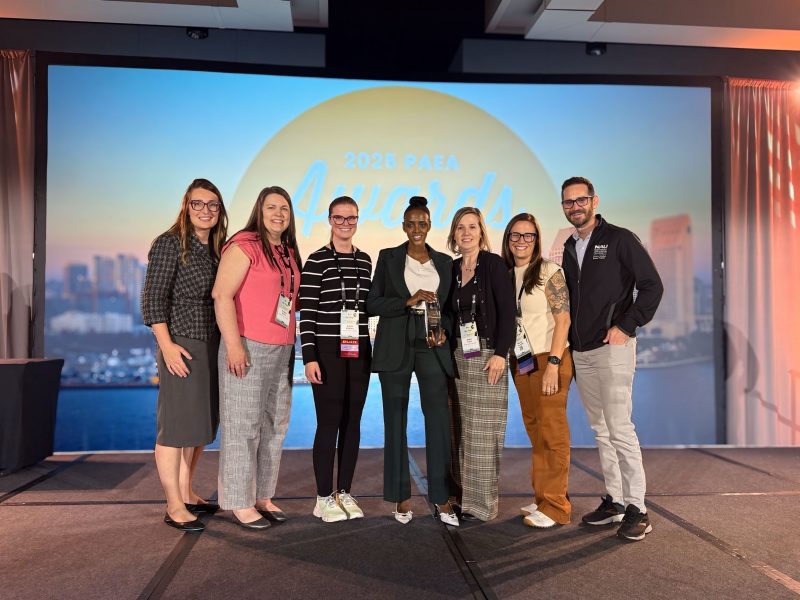
Circle the City Receives 2025 PAEA Partnership Award
Recently, Circle the City (CTC) was nationally recognized with the Physician Assistant Education Association (PAEA) Partnership Award, honoring their outstanding contributions to physician assistant (PA) education and their leadership in advancing healthcare for individuals experiencing homelessness. The award was accepted on behalf of the organization by Fartun Jama, MPAS, PA-C, a current student in NAU’s Doctor of Medical Science (DMSc) program and a preceptor for NAU PA students at CTC.

Circle the City is a Federally Qualified Health Center (FQHC) committed to delivering compassionate, trauma-informed healthcare to individuals experiencing homelessness in Maricopa County. Founded by Sister Adele O’Sullivan, CSJ, MD, CTC opened the first respite center for the unhoused in 2012. The organization has since grown into a comprehensive network of care that includes two outpatient clinics, two medical respite centers, five mobile medical units, three street medicine teams, and a hospital health navigator program. Through these services, CTC provides more than 63,000 appointments each year for over 8,000 patients.
Over the past 10 years, Circle the City has served as one of NAU’s most engaged and mission-aligned community partners, offering meaningful, high-quality clinical education experiences for PA students. CTC provides diverse rotation sites in primary care, mental and behavioral health, medical respite, and immersive learning environments that prepare students to serve patients with complex social and medical needs. Many NAU PA students cite their CTC rotations as transformative experiences that deepen their understanding of health equity and community-based care.
Beyond clinical rotations, Circle the City’s clinicians and leaders actively contribute to the didactic and institutional development of the NAU PA Program. They have served as guest lecturers, mentors, and subject matter experts in Project ECHO sessions, part of NAU’s SAMHSA-funded Bridging Gaps: PA Training for Substance Use Disorder in Underserved Regions initiative. This program enhances student and clinician training to better address substance use disorder and mental health challenges, particularly among underserved populations. CTC’s participation reflects their commitment to workforce development and to advancing the PA profession as a whole.
In 2024, this academic-clinical partnership reached a significant milestone with the establishment of the PA Postgraduate Fellowship in Healthcare for People Experiencing Homelessness, a 16-month program jointly developed by Northern Arizona University and Circle the City. The fellowship, spearheaded by Dr. William Ellert, MD, Chief Medical Officer at CTC, and Dr. Jacob Gubler, DMSc, PA-C, Chair of NAU’s Department of Physician Assistant Studies, provides interprofessional training to prepare PAs with the advanced skills and empathy necessary to serve vulnerable and resource-limited populations.


Reflecting on the collaboration, Dr. Gubler shared, “Circle the City embodies the core values of the PAEA Partnership Award through their unwavering commitment to advancing PA education, promoting the PA profession, and championing equitable, community-based healthcare. Their organization has become a cornerstone in our mission to prepare graduates who lead with compassion and purpose.”
Dr. Alison Essary, professor in the Department of PA Studies, echoed this sentiment in her nomination letter, highlighting that CTC’s leadership “acknowledges the power of collaboration and celebrates the fulfilling nature of their work,” noting that their responsiveness and shared vision have allowed both institutions to achieve meaningful, lasting impact.
The College of Health and Human Services celebrates Circle the City’s well-deserved national recognition and extends congratulations to the organization and all NAU faculty, students, and clinical partners who contribute to this ongoing collaboration. Together, their collective efforts continue to transform healthcare education and delivery for Arizona’s most vulnerable communities.