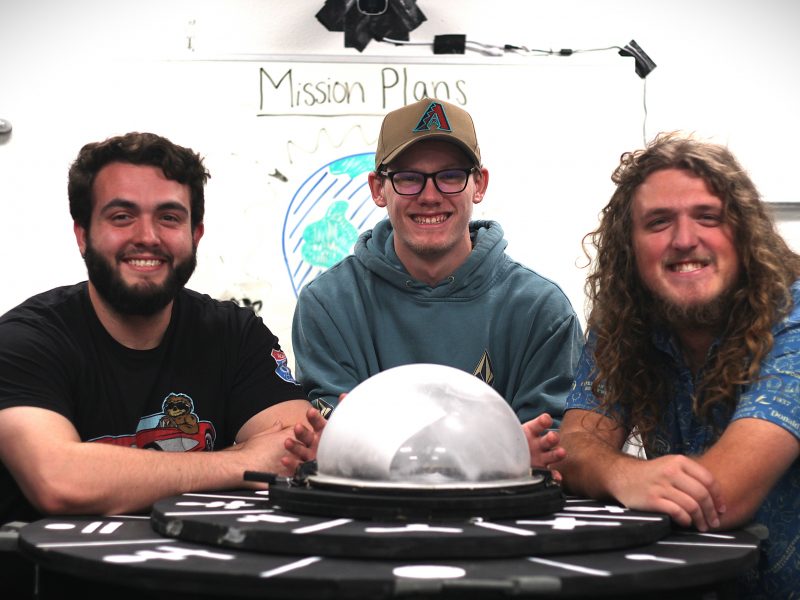
Turning Grit Into Games: Inside ASME’s Escape Room Project
The members of ASME aren’t just solving problems in the classroom—they’re building immersive experiences that challenge, excite, and teach. Through an annual escape room event designed and executed entirely by students, these young engineers are proving that creativity, teamwork, and perseverance can create something unforgettable.
Hear from Ethan Britt, the project lead for the escape room initiative, and Gavin Georgio, president of the Associated Students of Engineering and “Bob the Builder” of the operation, to learn more about the engineering behind the fun—and the life lessons along the way.
Q: When did the escape room project start, and what’s its purpose?
Ethan: The escape room project started back in April 2022. I took over as project lead in April of last year. It’s hosted annually, although we’re still working on making the timeline more consistent.
Gavin: At its core, it’s about giving engineering students real-world experience—hands-on work with coding, Arduino, soldering, woodworking, and soft skills like team communication. The escape room is a free event for campus, but behind the scenes, it’s a learning lab for future engineers.
Q: How many people typically go through the escape room?
Ethan: This year, we’ve had about 70 groups of up to eight people each, so around 400–560 participants total. It’s grown into a pretty major campus event.
Gavin: Our first year had over 700 people. Last year was closer to 600. This year’s numbers are solid too—and we’re offering walk-ins, which helps bring in more spontaneous interest.
Q: How do you choose the themes for each year?
Ethan: We crowdsource ideas from the club. I send out a QR code in our weekly meetings for people to submit ideas. Then we narrow it down to the top five themes and vote. This year we did “Cave Adventure” and “Alien Invasion”—the top two voted themes.
Gavin: It’s very much like being a producer or director. Once the themes are picked, we ask who wants to lead each room, and they run with it.
Q: What’s the biggest challenge in pulling this off every year?
Ethan: Funding and logistics are big hurdles—reserving rooms, organizing volunteers, making sure we have the materials we need. But we receive so much support. We received a Lumberjacks Thrive Grant in the past, which allowed us to get tools and supplies for the room.
Gavin: And translating student designs into reality. Students come in with these big, exciting ideas, but making them functional is a whole different ball game. It’s one thing to design a puzzle, another to actually build it and have it work consistently.
Q: What’s your favorite part of the whole experience?
Ethan: Seeing the look on people’s faces—both the participants and our student builders. Watching someone’s puzzle idea come to life and seeing others enjoy it makes all the effort worthwhile.
Gavin: For me, it’s seeing freshmen or inexperienced students jump in and say, “I don’t know how to do this, but I want to learn.” There’s a guy named Brandon who came in knowing nothing about Arduino or soldering, and now he’s confident and capable. That willingness to learn is amazing.
Q: What skills do you hope students take away from this?
Ethan: Project management, definitely. I’ve managed things before, but nothing on this scale. I want to take these skills into a career where I can lead projects. I also hope students build confidence—so next year, they’re the ones helping others.
Gavin: I’ve learned a lot of soft skills that I didn’t quite know how to navigate before. I’ve learned about leadership and how to teach others. It’s not just about knowing how to do something, but also how to pass that knowledge on safely and effectively. That’s something I never really had to do before. Our members also get valuable hands-on experience that looks great on their resume: how to work in a big team, how to collaborate, how to deal with conflict.
Q: If you could describe the escape room experience in one word, what would it be?
Gavin: Determination. You hit so many roadblocks—technical, logistical, emotional. But you just keep pushing forward. One of our members spent four days troubleshooting a single mechanism. He could have given up on day one, but he learned a lot going through the process. Last year we had a medieval dungeon room, and someone completed it in 20 minutes, but we wanted it to take about 50 minutes. We could have given up and just had a short room, but we were there until 1:00am to add things to achieve our goals. That’s determination.
Ethan: I’d say perseverance. We’ve had delays, funding issues, even red tape. There was a week where we were working with risk management and everything was on hold while we worked with them to make sure everything was safe, and we had to just wait and problem-solve in real-time. That kind of persistence is key.
Q: What do you hope the future holds for this project?
Ethan: I’ll be honest, I’d love to win another campus club award for best event! But more than that, I want this to become a tradition that people recognize and look forward to. Like the Halloween event “RainBOOM,” something with a name and presence on campus.
Gavin: I just want our members to see the value in what they’re doing on resumes, in interviews, and in their careers. We’re not just playing games; we’re preparing people for the real world.
What began as a student-led project has grown into an interdisciplinary showcase of engineering excellence, creativity, and collaboration. With every room built, every puzzle solved, and every student empowered, NAU’s escape room is more than a game—it’s a launchpad.
Feeling inspired? NAU Giving Day is happening on May 1, 2025, and you can fuel experiences like this one with your gift of any size. Projects like the ASME Escape Room teach members valuable life skills that bolster students’ resumes and provide invaluable experience — but they require funding each year to continue. Learn more about how you can directly impact student clubs and organizations at the Sanghi College of Engineering by visiting our Giving Day webpage.